
During the 1990s, Camilo Yáñez (1974) stood out within a generation that was emerging in the context of the Chilean post-dictatorship. Along with a break with the pictorial, references to the history of art, geometric abstraction, and landscape art, Yáñez constantly included in his narrative criticism of the political context in the country. Several other artists of the time also pointed their post-minimalist and neo-conceptual explorations to a crucial historic moment in the twentieth century, characterized—among many other social changes—by a transition to democracy, constant partisan conflicts, the figure of former general Augusto Pinochet who died in 2006, and the complete commitment to the market economy.
To mark the 40 years of the military coup, between March and June of this year, Yáñez presented three views of the recent history of Chile that also served as different ways to assume the relationship between art and politics. In three local spaces, Final Stretch (Sala Gasco Arte Contemporáneo), Impasse (D21), and Defeat (Casa E) gradually weave a narrative in order of appearance.
Perhaps the most encrypted and poetic of the three, Final Stretch included 24 landscape photographs reproduced as large silkscreens and intervened with seemingly hazardous graphisms. The black and white images represent places from the central region, captured based on the measurement of a level staff but rotated in such a way that in the montage the perfect horizon was displayed as a vertical line. The landscape was annulled; it acquired an everlasting stillness that was crossed by another landscape, a collage of drawings that appeared as if they were from the comic and advertising world—copied from the collective unconscious or from a personal memory exercise. Final Stretch, According to Yáñez “is a concept that in equestrian jargon refers to the last part of the career where the horses compete for positioning.” To enter the final stretch represents the moment just before the end. The photographs were taken in 1999 and their reedition, fourteen years later, marks a national period when neo-liberalism enters into crisis. Today, we know that, in more than 20 years of democracy, the governing big conglomerates have, to a large extent, perpetuated the system imposed by the military regime.
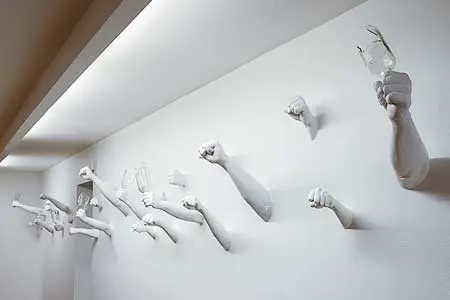
From this consciousness emerges some of the signs in Deadlock, the most overtly political of the three exhibitions and where art demonstrates a failure to influence the social reality. The boundaries with the simple commentary about the current situation of the country are blurred at times: realist representations in white plaster of fists in the air, some menacingly waving broken bottles at the public, are emblems of a silent and ferocious protest that emerges from one of the walls. In another area of the gallery blackboards with hand stumps created with plaster are ready to be used by visitors as chalk; slogans and legends gradually populated the surfaces. Two front pages of El Mercurio periodical were glued to one of the blackboards. One covered the 2013 presidential candidates while the other reported on the great fortunes in Chile. This established the well-known connection between both subjects while it also questioned which one was actually the true power. The red mural by the entrance with the legend "Cofradía Náutica del Pacífico" (Nautical Association of the Pacific) emphasizes an earlier point: Cofradía Náutica was a secret society formed in 1968 by civilians and the military that laid the foundations for the military coup; the struggle for power and the powers that be colluding once again. Deadlock—we are told in the catalog—is in economic terms in a total stalemate, “the total lack of benefits or losses stemming from a sale.”
Defeat is the most intimate chapter of this great narrative that—as we have observed—inquires about both the critical performance of the work when it enters the realm of politics and also about a period in the country marked by discontent but also by inertia.
At the exhibition space in Valparaiso, Yáñez links two videos: Victoria Allende Limpia al Pueblo de Chile (Victoria Allende Cleans the People of Chile) and Carmen 36, with photographs in black and white appearing in the latter. Victoria Allende is an ironic take on how Chile has handled its memory and accountability when it comes to human rights. Victoria Allende is shown cleaning white support that, placed on the floor, repeats the format of a painting by Frank Stella donated in 1972 to the Museo de la Solidaridad Salvador Allende. The second work is a documentary centered on Yáñez’s personal history. It is an interview with the author’s parents who narrate events in their lives associated with the apartment that the family occupied for decades in a building located at number 36 on Carmen Street in Santiago. They talk about their experience during the military coup in downtown Santiago. Current takes of the building abandoned many years ago and property of the judiciary are inserted during their recount. “In what type of society do we live por la chucha (for fuck s sake) where the powers that be fail to fulfill their social role,” concludes Luis Fidel Yáñez, already advanced in years, and with the vigor provoked by profound indignation he cannot help to use a local expletive expression that generates laughter.
CAROLINA LARA B.