
Sala de Espera, an installation by Carlito Carvalhosa conceived specifically for the Original Annex at the Museo de Arte Contemporânea da Universidade de São Paulo (MAC-USP), open to the public between March and September, represented an entire opening strategy for the occupation of a space devoted to experimental projects.
MAC-USP integrates the project of salvaging and revitalizing an architectural complex designed by Oscar Niemeyer in the early 1950s, which had for years been left to decay and to the random use of the state bureaucracy.
Now, with its new designation as the definitive site for the Museu de Arte Contemporânea, the building is rediscovering its first avocation, even in solidarity with nearby architectural landmarks such as the São Paulo Biennial’s Pavilion building.
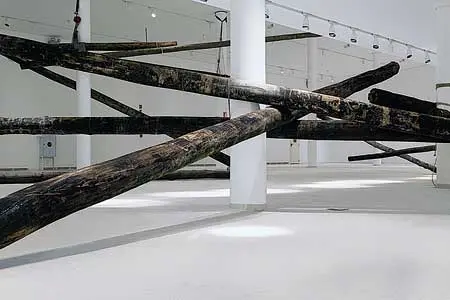
Carvalhosa’s exhibition stood out in the institution’s program both for its symbolic dimension and its dialog with a set of modern architecture, as well as for its translation of levels of coexistence dramatized by the intervention.
In the proposed intervention, with all the calculated installation strategies, the issue of displacement was incorporated into the viewer’s sensorial experience. Indeed, how to traverse the Original Annex through the variegated obstacles created by the artist for his Sala de Espera?
As the structural basis for the installation and a component of its dialog with the architectural space, the exclusive use of almost 100 wooden posts, used in the past for street lighting and now invested with a different intention, touched on decades of the existence of another life in the city, or another plural coexistence.
Seen as a record of this complex relationship between a witness to modern architecture and a contingent part of a city’s past, with the omnipresence of discarded public lighting posts interspersed with pillars in the ample exhibition space, revealed other readings of the site, a new semantics.
Sala de Espera, which covered 1,500 square meters of the area projected by the great modern architect, reinterpreted hidden instances of space and time through an encounter with the meanings of another relational experience.
It bears emphasizing that the physical dimensions of the exhibition space, from the six meters in height of the highest section to the almost five meters of the lowest part, in a scale potentially amplified by the distribution of the pillars, impacted the visitor’s gaze as they moved, fascinated, between the diagonals that impeded circulation. In fact, this re-inversion of force and potency of the new condition of use returned to the posts the energy of a new protagonism, in the midst of withering historical dimensions in any junkyard or forgotten area for invisible waste.
Against the asepsis of the modern-style building, with its ample and well-ordered disposition, among pillars and calculatedly empty spaces, Carvalhosa’s installation proposed the intensity of bewilderment, seeking out the strangeness of a dialog between matter and memory. Based on that strangeness, and given the symbolic freight of the mentioned elements—the pillars, the vastness of the space, the discarded wooden posts—one suspected the motives of the difficulty created by the posts that occupied, crosswise, the entire gallery.
Traversing the gallery—or, in fact, evading the impediments created by the hanging street-lamp posts and crossing the pillars—salvaged for the visitor’s perception of a dimension hidden in the memory of a different place.
The strategy conceived by the artist in creating a zone of relative difficulty presented viewers with impediments to circulation in the large exhibition space and emphasized installation as a living discourse on unexpected spaces.
Carlito Carvalhosa, a multifaceted explorer with many interests in the realm of contemporary art, is intent on creating calculated impediments, as a conscious proposal of interaction in forbidden zones of a conceptual register.
In his investigative journey, Carvalhosa seeks out mixed associations between conceptual constructions that promote a shift in the meaning of unusual fields and instances of every day, as a site for the remembrance of key paradoxes in human existence.
CLAUDIA FAZZOLARI