
Modus Operandi is the solo exhibition with which the Galeria Raquel Arnaud announced Carlos Nunes’ membership into its group of artists. On display from June 5 through August 3, 2013, the show consisted of recent two-dimensional and three-dimensional works and one video installation. As its title suggests, Arnaud’s production process is the connecting thread of an exhibition that could very well be regarded as an ode to obsession. With practically scientific rigor and the use of prosaic materials—like insulating tape, eggs, drinking glasses, and permanent markers—Nunes explores, dissects, investigates, and documents to the limit all the compositional possibilities that these materials offer.
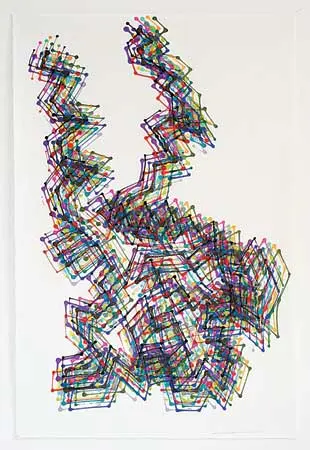
Sculptural Possibilities of a Still-life 02 (2012) consists of a group of 175 photographs that depict all possible ways to assemble four everyday objects in any given home: a cup, a can, a plunger, and a plastic lid. On another wall, a black pencil was completely used to create horizontal—swinging—movements. The fallen dust generated by the action accumulated on the baseboard as a witness of the occurrence. Several notebooks are placed on a shelf with some of their pages stained in various ways by a water-based pen. Visitors can manipulate them and find how many pages absorbed the ink before the colors vanished into soft nodules. The last notebook confirms that ink from a water-based pen is enough to run a line across all the pages of a notebook. The installation entitled Esculturas con Materiales Inestables/Huevos (Sculptures with Unstable Materials/Eggs, 2012) shows several videos in which Nunes tests the limits of equilibrium with eggs placed one on top of the other and joined by the wax from a melted candle. He empirically begins with only one egg and gradually adds more—placed horizontally and vertically on top of each other—until the imminence of the fall establishes the maximum capacity. The series Desplazamientos (Movements, 2013) contains works in which permanent markers were used on paper and arranged in groups with different speeds and directions, resulting in colors with different degrees of intensity and different compositional outcomes. Their titles described their respective procedures, like in Saliendo a la Carrera, Parando, y Volviendo, Yendo de Arriba Hacia Abajo Bien Despacito (Leaving in a Hurry and Coming Back, Going Up and Down Very Slow).
In earlier works, Carlos Nunes was already exploring this obsession with pushing the envelope and exhausting the possibilities of the materials used; as he did with a full spray can on a rectangular area or the yellow ink from a printing cartridge: he transforms the final product into something that transcends its characteristics—the ethereal spray gains consistency and reaches three-dimensionality and the yellow ink gradually vanishes with each page printed as evidence of the passing of time. In Llené el Tanque del Carro y Anduve Hasta que se Acabara la Gasolina (I Filled the Car’s Tank and Drove Until I Would Run Out of Gas, 2010) the “lab” is no longer the artist’s studio and the use of everyday materials disguise the lyricism behind Nunes’s modus operandi, as he is determined to extract from these objects all of their expressive potentials, like a Hermeto Pascoal of the visual arts.1 What Nunes reveals is solely the final result of small rituals—like if the group of works actually constituted a monumental performance organized through persistence and divided into small, carefully recorded, research acts.
Born in São Paulo in 1969, Carlos Nunes is the youngest member among the roster of artists at the Galeria Raquel Arnaud, one of the oldest galleries in the city and an important cultural referent. It privileges consecrated names identified with geometric abstraction, as well as young artists with innovative aesthetic languages. Nunes graduated in Visual Arts from the Fundación Armando Alvares Penteado (FAAP, São Paulo) and studied in London at the Saint Martin School of Arts. He lived in Buenos Aires for three years and returned to São Paulo in 2008. During this period he participated in his first group exhibition at the Centro Cultural Borges in the Argentinean capital. He also exhibited his work in Lisbon, Berlin, and several Brazilian cities. As part of the Atelier Fidalga (São Paulo), a space for discussions and exchanges among artists from several currents was directed by Sandra Cinto and Albano Afonso. There, Nunes developed several solo and group projects. In 2009, he presented his first solo show—Until the End…—at the Museu de Arte Contemporanea in Curitiba. In 2012 he was recognized with the Award from the English Culture Festival for his exhibition Triumph of Colors, Love and Music over the Wicked Blues at the Centro de Cultura Británica.
The work by Carlos Nunes, his performances in countless acts through the attentive observation of the artistic in everyday life, is aligned with the conviction of others that preceded him—like Marcel Duchamp and Joseph Beuys—that what transforms an object or an action into a work of art is precisely the decisions and choices made by the artist. In the end, just as Beuys said, “everything under the sun is art.”
NOTE
1. Hermeto Pascoal is a composer, arranger, musical producer, and multi-instrumentalist virtuoso from Brazil. He is regarded as one of the most important figures in the history of Brazilian music. N.T.
SYLVIA WERNECK