
Action and Cult was the title of the most recent exhibition by artist Deborah Castillo at La Caja. As in her earlier exhibitions, Castillo developed a project characterized by the unflinching exploration of socio-political realities from the Latin American context. It is a blunt vision of reality, a constant quality that has been present throughout her body of work. From her earlier pieces until her most recent proposals, Castillo relies on her own body to show alienating aspects of the human condition. It is perhaps because of this she stands out for her honesty, given the virulence of her performance acts, videos, and photographs. She indistinctly approaches gender themes or political mythologies, the latter a prevailing presence in Action and Cult. Castillo has relied on many mediums to recreate situations, parody being the most commonly used. As a performance artist, she has taken on social roles associated with the themes that she explores. Thus, for a decade she has presented performances as a maid-prostitute (South American Cleaner, 2005), as former secretary turned Minister of Culture, the protagonist of her first fotonovela (story illustrated with photos) El Extraño Caso de la Sin Título (The Strange Case of the Untitled, 2006) in which Castillo narrates a detective story that centers on situations associated with the artistic environment. Through these roles, the artist has appropriated codes established in pornographic images with the objective of disrupting values associated with the role of women in a market of male consumption. In the exhibition titled Private Collection presented at the Espacio España in Seville, Castillo questioned the conditions of South American immigrants as she cleaned the entire exhibition space during the performance La Supersudaca (Super South American Woman, 2008). In the exhibition Caracas: The New Circus, Bestiary of Curators and Artists (2008), prominent artists and curators became Castillo’s subjects in a photographic installation that satirizes situations that represent aspects of the current artistic context. These and other projects unequivocally define Deborah Castillo as one of the most conceptually lucid artists from a new generation of emerging artists.
In Action and Cult, Castillo succeeded in defying several power structures: the political-military power—with its inherent mythology—and cultural power. Before entering into the dark exhibition area, viewers had to negotiate a Penetrable de Machetes (Penetrable of Machetes, 2013). Two monitors in the background showed a video entitled Sísifo (Sisyphus, 2013). But instead of depicting a Greek hero condemned to carry a rock up a mountain forever, we observed the face of Bolívar printed on a stone and destroyed time after time with a chisel. These images are charged with symbolic force precisely because of what Bolívar represents in Venezuelan history and because of the manipulation of his image in the media amid the current context of Venezuela; as his memory—and body—has been desecrated by representatives from the Bolivarian process that uses his name to identify themselves. This video by Castillo is not about exploring the historical role of the Liberator, but rather about the trivialization of his image for populist reasons.
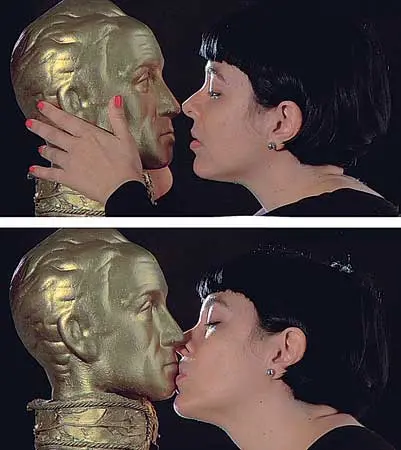
On the other hand, in this exhibition Bolivar is depicted in various facets: the epic hero, object of cult, and sexual object, depending on the rhetoric used by Castillo. In the video El Beso Emancipador (The Emancipatory Kiss, 2013), the artist lovingly approaches the still Bronze face of Bolívar to give him a passionate kiss.
Another theme is the deterioration of Venezuelans before the military power. This controversial political subject is addressed in the video Lamezuela (Bootlicker), presented on a previous occasion at the Velada de Santa Lucía in Maracaibo, in 2011. The video in question depicts Castillo licking the boots of a military officer out in the street before passersby. It is an action that sheds light on the submissive and degrading attitude of a country alienated before the cult of military power. Another piece that also questions the hegemony of military power along with its economic wealth is Lingotes (Ingots, 2003). It depicts a column formed by one hundred military boot soles completely painted with gold enamel that is elevated as objects of veneration.
In the face of the museum crisis in the cultural sector in the hands of the government during the Chávez mandate, Castillo once again approaches that other side of deterioration with a new fotonovela titled El Secuestro de la Ministra de Cultura (The Kidnapping of the Minister of Culture). One thousand covers of that pamphlet were placed on a wall in the gallery. The image shows a paradoxical image of the minister, her legs on the desk and the telephone in her hand. The story narrates the kidnapping of a maid turned Minister of Culture. Her ransom is paid with Matisse’s Odalisque in Red Pants—a painting that was stolen more than 10 years ago from the Museo de Arte Contemporáneo in Caracas and that is currently being claimed.
With her videos, installations, and several three-dimensional pieces, Castillo questioned values like freedom and individual integrity at the mercy of a false notion of patriotism. She arrived at the root of the drama of Venezuelans, who have been wanderers subjected to neglect now find enticements in false totems and new myths. Action and Cult is a critical portrayal of the social, political, and cultural tragedy Venezuelans are going through today. It is also one of the best art and political projects created during the Bolivarian Revolution. With this exhibition, Deborah Castillo was awarded the AVAP (Venezuelan Association of Visual Artists) Award for Best Emerging Artist.
SUSANA BENKO