
With the promise of permanent memory, Artist Édinson Quiñones (La Plata, Hulla, 1982) exhibits solo for the first time in Cali a selection of works that trace his life experience seemingly under no aesthetic mediation. Memoria Permanente (Permanent Memory)is the title of this exhibition, where the artist puts on display some of his most controversial works, in which life itself is what produces a number of marks and the desire to make them indelible. This raw kind of activism has brought Quiñones to a variety of showcase opportunities, among them Colomborama at the Musset Stenersen in Oslo, and Coyoacán, at Valenzuela and Klenner Gallery.
The series of objects related to the Popayán municipal exhibit at Casa Proartes speak of the vaporous idleness of time behind bars. The photographs embedded into the gallery walls are vestiges of the unbearable weight of dead time. These samples belong to an over-aesthetic order, a production where text and figure fuse in small ideograms. Anonymous hands illuminate the jail cell walls to create veritable windows into the outside world that resides inside the head as a promise and a graph. The photographs function as thresholds, with their very installation attesting to the artist’s metaphorical violence: he scratches the wall through the whitewash in order to set them, framing them in glass afterward. On the other hand, Quiñones also exhibits a poster with the image of the jail and an original cell bar placed at the center of the space, both objects intended to replicate the confinement space, which is already reproduced and vaguely stylized. The poster presents the warring cry: Permanent Memory. A paradoxical state of suspension and isolation that can cause an impasse, since more than a documentary testimonial it is an emotional interaction slanted by some facts and powered by the intervention of playfulness.
The emotional freight of Quiñones’ work transcends a simple testimonial of a direct victim of Colombia’s armed conflict; as an individual who has found himself affected by a number of social problems such as crime and the cultivation of coca leaf, his subjectivity has driven him to collect all the necessary traces to create metaphors and begin to erect an oeuvre that, albeit with many ups and downs, has been able to position itself in the art field perhaps thanks to the spontaneity of its gestures. It is worth noting that the value of the work does not reside in the fact that the artist himself has been a coca-leaf harvester, a convict, and certainly a victim. In other words, it is not necessary to have such a direct experience in order to speak about the subject. In Todd Solondz’s 1998 film Happiness, Helen Jordan (Lara Flynn Boyle) cries and laments deeply the fact that she wasn’t abused in childhood and as a result will never be a good writer. Traumatic experiences must not be confused with artistic talent.
Included in the exhibition are works from the series Trabajo con las uñas paisajes escamosos, photographs where little figurines ski on Colombian snow: Cocaine as a landscape. In these everyday tableaux with plastic dolls, the alkaloid comprises the entire scene and brings to the foreground that which many would like to keep out of sight. This operation is present in Quiñones to the point that his work has been deemed unbearable because it shows things that no one wants to see. Such is the case of his work for the 8th Performance Festival in Cali, La herida sana y la cicatriz queda, where the artist rips off his own skin a tattoo of the god of Coca in a gesture in which pain is part of an initiation ritual. The recording of this action goes beyond photography, since the body of the artist becomes the document of multiple experiences that leave a mark and give shape to a subjectivity intent on not forgetting.
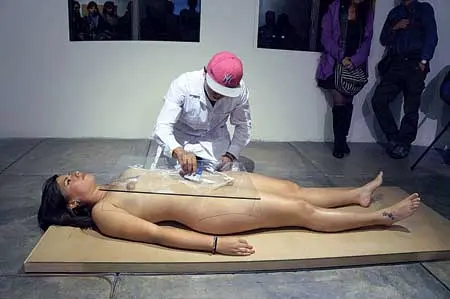
Entre polvo y piel is perhaps one of the most interesting performances in the history of Colombian art. Safe from its own obviousness, this happening takes place in a non-site, a landscape of illegality where guests and artist interact openly, inhale the “damned” drug, and even use it to draw on the glass. This fact transcends all obvious readings of women and drug-trafficking issues, as the glass, situated between the cocaine and the skin, is the true central object of the work. Once again, as in the embedded photographs, we encounter a threshold and a promise of a place beyond (the block, the ritual, the orgasm).
The recordings of Quiñones’ performances are accompanied by photographs of coca plantations and little harvesters, which at the formal level end up taking away from the show’s impact. This is also the case of the placement of a slide projector and some visors with drawings made on leaves from the “sacred” bush, which do not achieve the materialization of a conceptual intention. In that sense, it is important to recognize in Quiñones an artist of gestures whose spontaneity is even stronger than his formal propositions, but who opens the way for metaphor and, above all, for the rawness that can be achieved by contemporary art.
BREYNER HUERTAS