
Two concepts were strongly present in Echar por tierra, an exhibition of works by Eduard Moreno (Bogotá, 1975): memory and archive. In the artist’s reflection, the reconstruction of memory is rather different from a nostalgic gaze upon the past; far from that, it is a space conceived from the present intended to prevent forgetting what is still taking place. The relationship between memory and oblivion shows how both ideas constitute a framework more than content since content varies according to who builds it. Moreno explores what strategies are to be used to indicate that both concepts are connected to the various interpretations of the past, never losing sight of the fact that the results will be a consequence of the way in which we interrogate them from the vantage of the present.
On the other hand, given today’s generalized archival furor, a number of questions emerge that are similar to those that we formulate with regards to memory. What is archived? What can be constructed on that basis? Why is it that they become sources of power? What do they memorialize, and for whom is it that they make memory possible?
Confronted with this interaction between memory, oblivion, and archive, what is it that the artist intends to “bring down” (echar por tierra)? Focusing on the process of exploitation of basic resources, with the mining industry as one of its most reiterated examples in neo-colonialist practice, Moreno joins the what to the where in order to point out what in his judgment has been the frustration of the modern project in Colombia.
Tierra en la lengua (Dirt in Your Tongue) is the title of one of the works, an impression made on continued carbon paper shapes that repeat a line of men practicing open-pit mining. The figures in the profile that emerge from the paper holder on top of their heads the receptacle used to separate gold nuggets from gravel and sand. A material like carbon paper, destined originally to mediate between the original and the copy, constitutes a discarded archive in spaces of power such as ministries, tribunals, jails, and other such entities. Imprinted on them are half-words, words erased by the passage of time and the deep blackness of the material that contains them. Carbon and extraction both allude to mining activities, and the images of miners waiting in line for their turn to enter to work, arise to remove stripping material in a dot-matrix printer and are built as traces, as that which remains after extraction. Moreno’s handling of the chiaroscuro reveals the strongly pictorial character of his work. Regardless of the material used to construct his images, a pictorial concern remains central support in Moreno’s work. This intention is on view in Rompimiento de la Gloria (The Breaking of Glory), where photography is added to his work with carbon paper and an allusion to detail of Michelangelo’s The Last Judgment is eroded by open-pit mining, a technique associated by the artist with the idea of rupture, of bodily loss, in a critique of the social situation generated by such practices wherein individuals are treated as a product in response to the economic needs of the extractive practice.
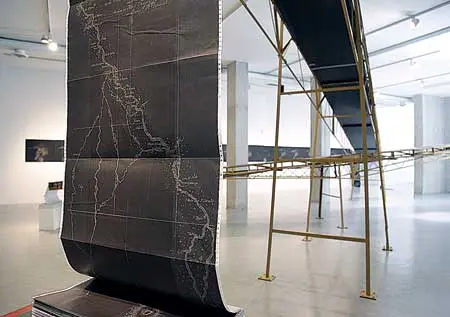
Regardless of the significant economic resources generated for a given country by large-scale mining projects, Moreno’s concern is the inequities involved in the mining practice for those who work in the extraction process itself, as the latter creates displacement, a loss of water sources, zones where the weight of toxic materials affects the most vulnerable populations. Thus, in an installation like Materia oscura. Materia negra, (Dark Matter. Blak Matter)” Quiñones challenges us to consider who are the ultimate beneficiaries of the mining activity. A mining machine of the kind used to transport the extracted material is sent in continuous motion, but what circulates is not the product but maps of Colombia’s various mining regions. The maps, obtained from different archives and printed on the same kind of carbon paper we mentioned before, were created by foreign cartographers, and with the utilization of those territories by large monopolies the work once again insists on the issue of colonialism. The maps move, as does the population dedicated to mining. The continuous shapes go back and forth in a metaphorical allusion to bureaucracy, which archives the information and repeats actions that do not generate change.
The crossing of these two intertwined realities, that of those who enjoy economic and technological power and that of those who are contracted for the extraction of the mineral, is brought to the fore in Mal aliento (Bad Breath), where five terrariums contain beetles and red caps embroidered with gold thread. The caps are of the kind used by miners but are embroidered with gold thread in figures allusive to Europe’s baroque tradition with Olympian deities, titans, richly adorned mythological figures, and beetles that walk over them as they extract the soil on which the caps are set. Two different, evocative worlds that once again meet to demonstrate the permanence of colonial domination and the frustrating bankruptcy of the utopias contained, in theory, in the modern project.
IVONNE PINI