In Eduardo Climachauska’s latest exhibition, at Laura Marsiaj Gallery in Rio de Janeiro, a text by Samuel Beckett was distributed; it was part of Endgame, staged for the first time in 1957. Four male characters are contained inside a shelter, observing the passage of time and reviewing their lives. They all have some kind of physical impediment (blindness, paraplegia, mutilations); they converse and kick a ball melancholically and metaphorically. In the text’s introductory sentences, in the description of the scene’s setting, we find elements that echo in Climachauska’s exhibition. Beckett describes the space as an unfurnished interior under an ashen light. There are two windows to the back, but their curtains remain drawn.
I believe it is possible to approach the works selected by Climachauska for this exhibition based on the stage lighting and the closure of any light from outside those windows. It is not by chance that in the Beckett fragment selected by the artist we read a discussion of apprehension to the outdoors. Two characters, Clov and Hamm, discuss the lead waves that can be seen through a periscope. One of them asks whether it is dark, and the other, at first, says that everything looks “gray” (three times in a row, raising the pitch each time), only to immediately describe the universe as “light black.” It also seems useful to connect the title of the exhibition and the title of the book: Climachauska’s “bottom of the well” dialogs with Beckett’s “endgame.” The game is shifted, as is its expansion through a condemned space where motion occurs vertically.
In the series Calle Belgrado, begun in the year 2000, viewers are confronted with large canvases, more than two meters in length. Using materials like oil applied directly onto the canvas, tar, and coal, we find formal constructions that could very well be seen as “geometric abstraction,” but whose more important feature is chromatic experimentation. Like Beckett, Climachauska seems concerned with the border between black and gray; in other words, what is the location of the “light black” mentioned above. The monumental scale invites us to perceive up close materials that are at the border between drawing and painting.
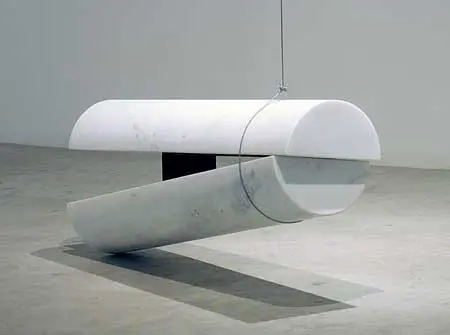
The materiality of tar and coal, two artistic techniques used in mineral extraction, is connected to the other three-dimensional presences in the exhibition. In Ho-ba-la-lá III, a granite cylinder is carved. Half-open, a small metal structure placed in its center transformed this sculpture into a kind of matteric drawing with its configuration provided by a steel cable that connects it to the ceiling. Arranged in the gallery’s second space are small cubes surrounded by paintings, also with black backgrounds However, instead of contrasting with less traditional painting materials, the option is to create on the canvas lines that resemble sketches of polygons. There is defragmentation of the form that dialogs with the broken-up granite cylinder of the previous room.
The sole solid and complete elements in the exhibition are these three cubes made in different materials: granite, wood, and iron. The same cables are found on top of these sculptures, but they have a new meaning. In each of their extremes are plumbed that dialog with the materials of those objects that, from this perspective, seem more like expographic bases. As measurement instruments, the plumbs can be used to verify the verticality of the solids of the depth of a concentration of water. The latter use seems coherent with the title of the exhibition, El fondo del pozo (The bottom of the well), taken from the title of that same series of works. The verticality of the relationship between man and that depth remains, the perforation of the iron cable in the material opening does not. There are no wells, only the certainty of the plumb’s failure in conflict with cubes that take us nowhere.
As Beckett’s fragment puts it, the Sun is a “zero”; “condemn the Sun,” says Clov with his spyglass. In this exhibition by Eduardo Climachauska, there is room only for that plumb-colored spot between gray and light back. It is, in my view, a commentary that dialogs with the immanence of matter and with an apprehension of life that is similar to Beckett’s stage indications—everything is economical, precise, without surplus or extensive annotations. Granite is granite; wood is wood; iron is iron. And wouldn’t it be possible to see in those relationships between materials, objects, and their inertia, the very physical state of the characters in Beckett’s Endgame, who are battered not only in their bodies but also in their biographies and their psyches.
Pondering the artist’s relationship with music, especially with samba, I remembered a João Nogeuira and Paulo César Pinheiro composition, As forças da natureza (Forces of Nature), made famous in Brazil by singer Clara Nunes. This song talks about nature’s rebellion against the evils of mankind. In its final verse, it says: “plagues and harmful weeds, weapons and evil men, they will all disappear in the ashes of a carnival.” I have the impression that, precisely in the opposite direction, Eduardo Climachauska invites viewers to observe Carnival’s only certainty: its ashes, its end.
RAPHAEL FONSECA