A retrospective exhibition by Mexican photographer Enrique Bostelmann (1939-2003) is underway in one of the exhibition halls of the Museum of Modern Art in Mexico City. It was inaugurated in May and it will remain until September 8 of this year. Curated by Eugenia Macías and Elva Peniche, the exhibition offers a fresh look at Bostelmann’s work and showcases his constant interest in experimentation within the photographic medium. The decision to initiate the exhibition with the piece Camino de Luz (Path of Light, 1976) evidences such a curatorial approach, as this work consists of a serigraphic print based on a photographic image that was created in a collaborative effort between Bostelmann and printer Andrew Vlady. As the result of exhaustive research, the exhibition transcends the usual chronologic approach often used for exhibitions of this type and proposes an articulation that rescues the discursive pillars that characterize Bostelmann’s work. In this manner, Enrique Bostelman. Image, Endless Space presents three nuclei that structure the walk through the exhibition.
The first nucleus titled Paisaje del Hombre (Landscape of Men) consists of photographs in which the landscape is portrayed from the perspective of the influence and presence of the subject itself. In this part of the show, it is possible to observe photographic pieces created during the multiple travels by Bostelmann across Mexico, Latin America, and Europe. For instance, some of the lesser-known photographs come from his time as a student of the Bayerische Staatslehranstalt für Photographie in Munich—in what then was West Germany—where he studied under a scholarship during the end of the 1950s. There are also examples of images that were part of the photobook titled América. Un viaje a Través de la Injusticia (America. A Journey through Unjustice, 1970) with an introduction by Carlos Fuentes, in which it is possible to appreciate Bostelmann’s preoccupation with portraying the reality of marginalized communities. Nonetheless, in these works, it also becomes evident a gaze that underscores the relationship between the subjects and their context, in such a way that many of the images emphasize the relationships between the subjects and the architectural structures and objects, as well as the presence of the marks and traces that mankind has left in his surroundings. Such is the case of the well-known series titled Espacios Habitados (Inhabited Spaces) from the 1990s in which Bostelmann records multiple abandoned objects and scenes where, although the subjects are not physically present, their interventions in the environment are. This nucleus also explicitly reveals the curatorial core of the exhibition, because it shows works that reflect the author’s interest in experimenting with photographic techniques, through strategies like partial toning, multiple exposures to create photomontages, transgressions of traditional formats, interactive works and cut out photographs mounted on stretcher frames of various depths to suggest volume.
The second nucleus is called The Wave is Water and Also Sculpture. It is a phrase written by Mathias Goeritz from a text he wrote about a work by Bostelmann entitled La Ola (The Wave, 1976) in which the photographer created a photographic print on a malleable material. By doing so Bostelmann gave the support a three-dimensional characteristic, as he turned a photographic take into a sculpture. It is worth noting here the correct decision by the curatorial team of presenting a contemporary reconstruction of that work, as it allows the public to understand the transgressions and vanguard exercises that Enrique Bostelmann was working on.
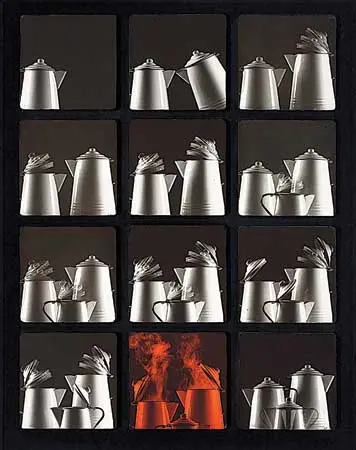
At this point in the exhibition, there is also an emphasis on the intense relationship between Bostelmann and artists from other disciplines like Mathias Goerlitz, Manuel Felguérez, Arnold Kurtycz, and Sebastián, among others. Some portraits by Bostelmann of some of these artists are included in the show. These were based on the selection and montage of the most symbolic objects connected to these subjects. Felguérez, for instance, is portrayed through his pipe, while Belkin is suggested through the covers of his paint cans. A part of the project entitled Estructura y Biografía de un Objeto (Structure and Biography of an Object), created in collaboration with sculptor Sebastián, in 1978, represents an example of the collaborations between this photographer and other artists. In this project, both artists collaborated to present the formal education and the imaginary biography of a coffee maker. The union between these two proposals resulted in photographs, sculptures, and projections of the formal synthesis of objects from a geometric perspective.
Lastly, the third nucleus presents that which the curators call the “unfolding of the image.” It is a demonstration of Enrique Bostelmann’s complex, complete, and unified take on visuality. It was an approach that the author would indiscriminately apply in his job as an industrial and advertising photographer or in the creation of his artistic projects. This section shows that Bostelmann’s experimentation and innovation also permeated the advertising world and the record of modernization projects and the construction of infrastructure in Mexico.
The exhibition is an intelligent take on the work of a photographer who was always interested in transcending through his work the limits of purely photographic.
JOSEFA ORTEGA