
“Oh my soul, do not aspire to immortal life, but exhaust the limits of the possible.”
Pindar
Recordar, Disponer, Resistir, by Eugenio Espinoza (Venezuela, 1950) and Andrés Michelena (Venezuela, 1963), represents an entry in the well-known roster of Venezuelan artists whose work has as a leitmotif a reevaluation of modernity (or its failure). The show suggests the need to continue thinking and reworking matters concerning the issues and resonance that emerge—from two perspectives—in a country where, one, abstraction has been made into a dominant and overwhelming discourse, with serious implications concerning domination and power, and, two, there is a recognition that the modern project was never admissible in the terms in which it was proposed at the time. The artists establish this dialog hand in hand with Canary-island semiotician Roc Laseca, who recently relocated to Miami, and the curator of the exhibition, who proposes that thinking about modernity makes it possible to subvert the canon. Laseca seems to wonder like Lyotard did about modernity: When is a statement true?
In Recordar, Disponer, Resistir, Espinoza, and Michelena put in practice an exercise of conceptual and experimental correspondences around the legacy of abstraction and the failure of modernity on Venezuela. Modernity and abstraction understood as a system of beliefs, reasons, and strategies that possibly emerged from an identity imbricated between the avant-garde and the ravages caused by dictatorship and democracy alike over the past 50 years. Monochromatic, minimalistic, and conceptual, both artists play in this exhibition with the square as the measure of all things: unhinged, dissociated, broken, crumpled, softened, the reticule appears indolent and the measurement disjointed, in dialog about nature as it subverts both matter and space.
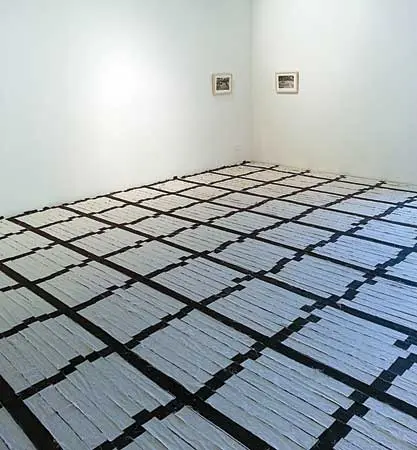
Close in age, both artists put together and take apart white monochrome squares and other geometric shapes that are defined, outlined in black, attacked from starting points that are considered apart from the learned techniques of abstraction. On the one hand, Espinoza, more connected to a critique of totalitarianism in art, institutions, and politics, and also concerned with the exercise of freedom and with creative space as a subversive element. On the other hand, Michelena explores drawing and installation, starting with the idea that for artists of his generation Modernity is genetically entrenched, and works from the standpoint of what could be deemed a liturgy of art as practice and process.
Eugenio Espinoza, conceptually aware of the possible tensions that emerge between the four corners of a square, opens the exhibition with the installation Negativa Moderna, from 2008, where, at floor level, a black grid painted on a raw canvas cut into strips and put back together, is repeatedly intervened by the viewer who breaks randomly into its rigid geometry.
The paradox of breaking the grid, impeding it, destroying it, hanging it—turning it, if you will, organic—has been a constant in Espinoza’s most incisive work, as a postmodern response to the profound interrogation the artist has posited since the 1970s of abstraction and power in Venezuela. Besides other installations, two historical photographs were included in the exhibition, Participaciones II and V, both from 1973, both suggesting, by means of human presence, the playful and participatory element that promotes that idea of human resistance to abstraction defended by Espinoza.
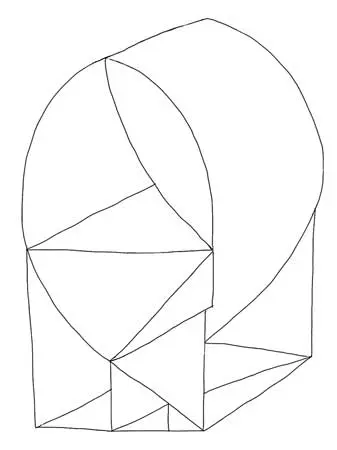
In his two- and three-dimensional installations from the series Countervision, 2013, Michelena emphasizes the importance of the physical process of drawing the idea of the support, and the resistance of paper and other media, as well as the work of repetition on a given idea or theme. At the same time, he underscores his proposal through the use of technology (iPads) and industrial materials (Ikea tables), and encases his exhibition in a minimalistic, clean-cut proposal that allows the viewer to understand his posture regarding a geographical-artistic interrogation such as abstraction in Venezuela, seen from outside. To that end, Michelena intervened the space with drawings of geometric shapes, imitating possible three-dimensional volumes while at the same time insinuating the impossibility of volume itself and the homogenization of standards as a clear legacy of Pop Art. The table—or square—becomes in Michelena’s drawings the support for something else, and leaves behind its multiplicity of uses. Industrialization, massive systems of order, and a gaze to the past are brought together in Michelena’s installation from the vantage of a contemporary vision that is, at the same time, perhaps somewhat more nostalgic.
There is in Recordar, Disponer, Resistir a study and critique of modernity and abstraction, as a contingent that makes it possible to analyze Man’s alienated discourses or to think, as Massimo Desiato would put it, about that very modernity which constantly generates a dual disenchantment. It would be accurate to say that in Venezuela, both modernity and abstraction connect with the myth of Sisyphus, which Camus identified as modernity’s most representative symbol: the place to which we return, time after time.
AMALIA CAPUTO