
The nude in sculpture has perhaps been one of the most visited themes in the medium. The examples abound, from classic and Greek sculpture to the Renaissance, where human anatomy was rendered with meticulous detail; through Duane Hanson with his lifelike works that appear to be alive; to the most contemporary works, like the gigantic, often grotesque, hyperrealist characters created by Ron Mueck.
The Venezuelan sculptor James Mathison (Caracas, 1966) belongs to this group of artists that have opted for the nude. Mathison prefers the male figure as a subject and renders it in a manner conceptually reminiscent of the work by Auguste Rodin, in his use of the human body as a pretext to explore complex philosophical themes.
In this exhibition, his very first in Miami, Mathison presents a selection of works created during the last two decades, that is, from 1992 to 2012. Despite showing a group of works created throughout a large span of time, this exhibition is not a retrospective per se, but a selective representation of the work by this artist during a vast period of time. Entitled Homo Mesura (Man is the Measure), unavoidably refers us to the book On Truth by Protagoras, whose unique thesis enunciates that man is the measure of all things. According to this Greek philosopher from antiquity, there is no one objective truth as everything is subjected to man’s perception. Mathison appears to subscribe to this principle and in focusing on the male figure in his work he refers us to other themes.
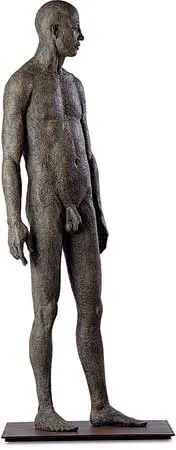
This sculptor takes pleasure in his impeccable technical mastery, as he achieves admirable anatomic perfection even as this is not precisely the most important aspect of his work or of his main intention. Mathison takes the most delight in the ambiguity of his figures. It is a conscious decision given that his interest goes beyond achieving an exquisite completion or showing off his technical skills. He does not limit himself to complete figures but also “dismembers” some of them to present us disperse elements like a torso without a face, an arm, a fist, or ahead. The internal force of each piece is concentrated through this fragmentation. This fragmentation is intentional and the artist emphasizes the characteristics of each piece.
The serenity of these works is quite unsettling. Their seemingly passive attitude and expressionless faces actually serve as a restraining force. These are faces in a state of introspection, with their gazes aiming at a faraway point in the horizon as if they were lost in thought. With this immovability, Mathison comments on the diverse emotional states experienced by men. To a certain extent, it implies conformity or the impossibility of resolving a problem; the frustration that can be felt in the face of the impossible.
Mathison’s men are generic, although some well-defined features could be interpreted as an intention of identity. Although the artist dedicates one of his series to “Asian Men,” these are not really the focus of his attention. He is not interested in elements that are specific to a region or ethnic group. He approaches man as a universal being affected by problems shared across the planet. He emphasizes the principle by Protagoras and takes his man as the one that determinates the surroundings and is in control of the ability to change.
Some of his men may appear defying as a result of their postures or because of the way in which they stare back and challenge their alleged opponents. But their gazes actually call attention to a specific anemic state, a specific gesture that stops time perpetuated in bronze.
In some works like Hombre Texto II (Text Man II, 2006), Mathison uses texts to convey his message. These allude to the spiritual state men go through; thoughts that summarize anemic changes.
One of the most intriguing pieces is Personajes I al V (Characters 1 to 5, 2007). It consists of five complete male nudes in different postures. A phrase begins with the first one and ends with the fifth one. The sculptures have been rendered to look very similar physically, suggesting that they could perhaps be the same person posing in different positions.
The sculptures by Mathison implicitly contain references to Greek art and Roman statuary, particularly to pieces like Torso Levitante Grande (Large Levitating Torso, 1999). His proposals work on two levels. The primary one is perceptual while the second is conceptual. The former seduces us with the aesthetic beauty of the pieces while the latter elicits inquiries of a philosophic nature. Perhaps, just as Protagoras described reality centuries ago, Mathison sees his surrounding reality as something relative where subjectivity predominates. To him, the states of mind and existential conflicts are the factors that define certain actions and reactions. This is the reason why he places man at the center of the universe and as the determining factor. Through his works, James Mathison questions cosmogonic principles. The eternal ontological questions become themes for reflection and, once again, men are the center of this debate, in this instance, with himself.
IRINA LEVYA