Throughout his career, Argentine artist Jorge Macchi (1963) has developed a prolific visual career that reflects on time extended in space and its connection to chance. This obsession by Macchi about a time that is different from the real one was exhibited at the Alexander and Bonin Gallery, from May 4 through June 15. Titled Loop, the exhibition consists of 10 works that range from projections, objects, and watercolors. Approached with a sensibility connected both to conceptual art and to the pictorial expressionism of Kuitca, Macchi stops the seconds to indicate that in the human experience the infinite repetition of time can be interrupted by chance. In Loop, the mystery is about to occur, just as in the stories by Cortázar in which the supposedly normal is transformed through observation into something strange.
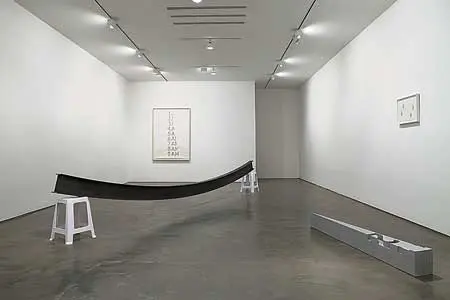
Following a large number of exhibitions both in Latin America and Europe, in this first solo show in New York, Macchi has divided the gallery into three parts: the gallery as such, its back area, and its second floor. Upon entering the first section, we observe glass with adhesive tape in the shape of a cross. We read fear, grief, and rage. The red typography printed on the tape spells the words “fragile” or “danger” that we symbolically associate with the possibility that something unusual could occur. Thus, Macchi warns us about the fragility of things and, with that, about the presence of chance in Loop. Created with the spontaneous brushstrokes that characterize this artist, two watercolors of the same bottle are placed on the left side of the glass. In one of the images, the bottle is full, while in the other the bottle is bent and almost empty. Macchi points to temporal states that allude to the endless changes that the same object could undergo. And so we continue to observe… A large double T iron beam rests on two plastic stools. When we learn that it is titled Péndulo (Pendulum) we become more aware of the endless momentary and repetitive positions of its arch, and we are reminded of the most popular method to measure music and time. With similar logic, First Second captures a moment in a material; the work represents through a concrete prism the first second of a minute or the six indicators of a watch. Counterposed to these stopped objects we hear a sound coming from the southeast section of the room. It is a white metal ceiling fan that is so close to the corner of the room that its blades clash against the walls as they produce a repetitive sound. Thus, we can observe marks in the architecture, in the space, in time. This repetition appears once again in a drawing in which the acronym AM gradually becomes spatially and metrically complete on the plane. There is also a watercolor that makes that regularity problematic through a compass rose entitled No News. Another theme that Macchi has consistently explored throughout his career, the news is not predictable like the measurement of time.
As we enter into the second part of Loop we find the image of a watch. Projected on a corner, the watch’s hour and second hands align with the boundaries between the walls and the floor, while the minute hand is right on the line that divides the two walls. Once again, these are marks of and in the architecture. A watercolor that represents adhesive tape with the word “fragile” on it was placed right beside the projection and, thus, based on a dialogue between the static and the weak, the drawing and the projection, we once again are led to ponder about the mystery that gravitates in time.
Lastly, we enter the second floor and third section of the exhibition. A two-channel video that Macchi took from the movie From Here to Eternity, repeats two scenes from that Hollywood classic. Each loop shows the seconds during which the title and the phrase “The End” remain in the original context of the movie. The beginning shows a group of soldiers and the end shows us the ocean. As each projection has a different duration, the loops are superimposed in an unequal manner to produce a chaotic sound mix as if it were the rehearsal of a forgotten concert. In this work—his most recent collaboration with musician Edgardo Rudnitzky—Macchi creates a third sound channel in real-time. It is a third moment that emerges from the opposites; from a new dimension of the real, that reminds of the character of time in the twentieth-century Argentinean storytelling tradition. It is in this third moment where Macchi’s poetic could be found. Thus, there is no doubt that Loop had to be the title of the exhibition.
Through the central elements of sound, silence, chance, and fate, Macchi invites us to a contemplative act in which we pay attention to time and not what occurs in it, as he offers viewers an experience where the frozen time coexists with the architecture and chance.
FLORENCIA SAN MARTIN