
Nobody will leave this exhibition feeling disappointed. No matter how many years they have been awakening the curiosity and interest of people, or how many exhibitions around the world they have been part of, Los Carpinteros have maintained the vitality of their artistic language and the principles they started with, as they have also introduced other elements into their work and expanded their ludic, ironic and critical components. One perceives that they walk through a double path of remaining Cuban in the structure of their perception while also expanding their take on the influx of globalization—they are prisoners of it but they choose not to ignore it. It should be mentioned that while the current exhibition is intense and important, so it is the environment in which it is presented: the new address of the Sean Kelly Gallery establishes a dialogue with Los Carpinteros from one monumentality to another, as it also offers differentiated spaces for each chapter of their exhibition titled Irreversible.
Nowadays, Los Carpinteros is a group formed by Marco Antonio Castillo (Cuba, 1971) and Dagoberto Rodríguez (Cuba, 1969). Alexandre Arrechea was also part of the group until 2003 when he decided to follow his own artistic path. Although they still have a studio in Cuba, today Los Carpinteros live in Madrid. Because of globalization and faced with the scarcity of materials to work within Cuba, the news was bound to permeate. Nonetheless, they never remain far from their origins or create works solely based on what they find in each place. They continue to be insular, Central American, Caribbean, and Cuban. One must remember that just before they emerged in the Cuban art scene there were already solid and thunderous languages by other Cuban artists that abandoned the island despite the fact that they aesthetically parade it around the international visual art world. Curiously, the boat, island, palm tree, water, and all those autobiographical elements gave rise to an aesthetic of enormous Central American dimensions. Los Carpinteros entered the arena at a very young age because, at the time, there was a need to fill the gap at the 1994 Biennial of Havana left by the established Cuban artists that had gone into exile. And ever since, Los Carpinteros do not play with the same components unless they alternate them and make sure not to repeat their use unless a long time has passed.
They studied in the Instituto Superior de Arte de la Habana and began working with wood using carpenter’s tools. They would create objects and furniture-like pieces that established a connection with the realities of everyday Cuban society. They were not interested in becoming stars or censored artists as they only wanted to produce objects in the same manner that, for instance, cigar makers do. Their works constitute a dynamic triangle: on each vertex predominates a discipline that flows toward another two to form a trio that includes architecture, design, and sculpture. They conceive utopic-utilitarian sculptures and create gouaches, watercolors, and drawings on paper. In their collaborations, when the plan is to share ideas about a project, they use drawings to communicate among them—according to these artists the drawings are also the result of collaboration. It is as if the drawings were letters that they write to each other to discuss the projects. Some drawings are turned into sculptures; others remain on paper, while others yet become sketches to serve as the basis for installation projects. None of the other three-dimensional projects end up looking like their source drawings, as these have their own spatiality and meaning. Irreversible reveals an inseparable horseman and horse that exchange roles and contribute their rhythms expressed through time. A surreal thread intertwines the works in an accelerated action from the dreams of these Quixotes devoted to their own type of windmills—built by them—amid the vertiginous reality in which they live.
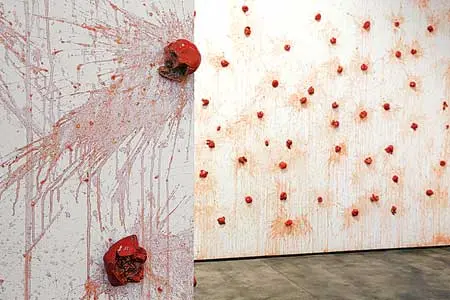
Art must modify the perception of viewers. This exhibition offers confirmations, evidence, and a mirror to the frustrations of political programs. In Irreversible, Castillo and Rodríguez integrate inverted monuments of the former Soviet Union in Robótica (Robotics), Podgaric Toy, and VDNKh Toy. Cachita y Emelino (Cachita and Emelino) represent the Cuban reflection—where they use LED instead of neon tubes. And from Spain, there is the installation Tomates (Tomatoes) that mediates in this geopolitical journey. The watercolors on paper titled Sombrillas Azules para Reflejar (Blue Parasol to Reflect) and the triptych Knin Lego—that together with the video Conga Irreversible represent the only two works from 2012 while the others are from 2013—are severe and ludic pieces. Conga Irreversible was presented in the most recent Biennial of Havana. With their populous articulation in reverse, from music to dancing, everything occurs backward. If carnivals already boast contagious and vertiginous rhythms, this video represents a new physical and intellectual system—in which a memorably critical written dance lends itself to be read between the lines. Has the Cuban motto of a left that used to promise a future to become rebellious and frustrated and an instigator of silence. The hieratic element of the Soviet monuments that Los Carpinteros currently present also attends to a similar utopia no longer sustainable. The sterility that emerges from the impeccable perfection of each work is surprising and even leaves viewers speechless in a political metaphor.
GRACIELA KARTOFEL