
The difference between meridians and parallels is a basic one. The former is like longitudinal cuts we make on an orange in order to eat the pieces directly; the latter is like the cuts we make on an orange before extracting its juice. In sum, meridians are arbitrary, as we never know exactly what spot in the orange we will make a longitudinal cut, while parallels are nature since all oranges have an equator between their poles. While Greenwich was a political agreement, parallels are geographic: the equator could not be located anywhere else on the globe, and neither could the tropics—Cancer and Capricorn—which are the lines where every summer or winter solstice the Sun reaches its zenith, a position of 90o relative to the earth, under which objects forget to project their shadows.
During his 1-day residence at Plataforma Atacama, in Chile, in the middle of the desert, Marcelo Moscheta executed an action that required time and effort: creating a stone path whose 15-meter length followed and at the same time accounted for the Tropic of Capricorn, so that the stones will be exempt from any shadow during the solar zenith that occurs every year.
Leaving a trace implies imagining a future that in the extended and apparently still a time of the desert, could come to pass in a single day or 10,000 years when another traveler treads on it with his or her steps. A future traveler who, finding those rocks, will know someone else was there, and who, if not lacking in patience in his observations, will also realize what line Moscheta intended to mark: the Sun will take care of showing it.
The action of building the line piling up the rocks has a dual connotation. On the one hand, it operates as the memory of a past event; on the other, it functions as a message sent into the future. Now, what is interesting in Moscheta’s work is the fact that the future becomes a present, while the present becomes a past. Let me explain. Moscheta leaves a trace to be read later on; at the same time, he is reading remnants from the past, of the earliest inhabitants of Atacama, whose traces were followed by the artist with the help of archaeologist Ana María Barón, who holds a collection of rocks with 10,000 years of history. In that order of things, Moscheta seems to conjugate two places in time, since, on the one hand, he leaves his trace for a future traveler and, on the other, assumes the place of that traveler in reading the traces of an ancient civilization.
A dual location in time that ends up eclipsing time itself, rendering it a present in full, devoid of shadows. Moscheta is the future of the past of the region’s ancient inhabitants, and at the same time, he is in the past of the future possible visitors of his rocks.
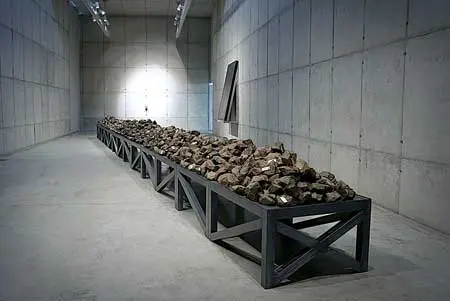
The exhibition 1000 km: 1000 años, curated by Alexia Tala, is the result of this experience. It comprises three works. The first one, titled Línea: Tiempo: Espacio, consists of a large accumulation of rocks on an elongated base, which involves already an index of the action in the desert. Now, looking at this work it is possible to note that the number of rocks used is not too large; in fact, they are ceramic duplicates of a single rock, each one featuring a small plaque indicating coordinates. These coordinates imply a variety of locations for the object however since it is a single rock, this becomes a contradiction since it is impossible to find the same rock in two different points, just as we cannot be here and there at the same time. A tangible paradox that reminds us of the play with time commented above, reinforced by this fact: the model rock is not just a rock, but a stone tool used by inhabitants of the region several millennia ago.
The next work, Atacama: 28.04-06.05/2012, is graphite on PVC image, a technique skillfully employed by Moscheta throughout his career. It is a map of the artist’s desert explorations, a vista captured from a great height over the surface of the globe. Lastly, Timelapse is a small box holding sand and rocks from Atacama, accompanied by a metal plaque that resembles a message to the future, addressed perhaps to an extraterrestrial visitor who suddenly finds our relics and remnants. Present again in this work is the mechanism of juxtaposition, now in terms of scale, since the box presents in a small number of square centimeters the landscape of the entire desert; it all depends on one’s point of view (this is to say, on a scale).
Moscheta brings together in convergence the notions of far and close, of past and future. In this way, here and there, before and after being made to share, in Moscheta’s work, a single substance; it is left to the viewer to decide what position to adapt, whether they see in the Timelapse box just some sand or the extension of an enormous territory; whether they see in the rock left in the desert a future yet to be, or a past is already gone.
JULIA BUENAVENTURA