
Since its creation in 2000, the Galerie Espace Meyer Zafra principally promotes Latin American and European artists with a slight preference for Venezuelan art. This solo exhibition by Argentinean artist Martin Blaszko (Berlin 1920 – Buenos Aires, 2011) was jointly organized by the gallery and Susana Blaszko, the artist’s daughter. A founding member of MADÍ, Martin Blaszko represented an exception to the rule by presenting works of great quality: fifteen small-size sculptures (1950-2007) are exhibited alongside thirty-six drawings and collages and four oils (1989-2008) carefully selected. It was about time to pay homage to one of the most discrete and yet most constant and prolific artists of this artistic movement from the beginning of modernity in Río de la Plata, whose influence over Latin American abstraction and geometry is undeniable. But this first exhibition also constitutes a risky gamble for the gallery given that, while Blaszko is widely known in South America, he is unknown in France.
The series of small and medium-size drawings confirm—as if it were necessary to underscore the point—the coherence of a body of work in which sculpture is, before anything else, drawing and speculation about form, equilibrium and a play on its contradictions and, second, volume in the space, all approached with the same enormous constructive spirit. Created in 1989-1995 and 2007, on beige cardboard that measures 6.5 × 13 cm (2.56 × 5.12 in) by an 85-year-old artist, they are subtle exercises—reflective and spontaneous at the same time—for a probable three-dimensional piece. The controlled explosion of the structures in the space—lines, geometric masses, and stains—are markedly reminiscent of some drawings by Kandinsky, and confirm, with regard to Blaszko’s reflections on movement, the close relationship between drawing and sculpture.
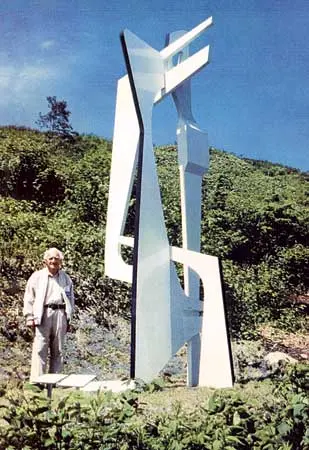
If most of the bronze sculptures were created after the glorious days of MADÍ, when the fragmentation of form/color and deconstruction prevailed—during the 1940s—we cannot forget that this artist, researcher, and restless worker, worked with wood during the beginning of his artistic career. Small in size (21 × 57 cm or 8.26 × 22.43 in), each sculpture speaks to us about Blaszko’s “mastery over the gesture,” his sense of equilibrium in the arrangement of forms that “draw” more than what they “fill” in the space—as sculptures are supposed to do. Other equally extraordinary elements are the relationship between dimensions and emptiness and the theme of proportions. Indeed, despite their small size, all of the sculptures in the exhibition present the same characteristics: being works with full rights, for their design and format, and for their ability to elicit the idea of a possible monumentality because of the—so very rationally harmonious—the relationship between full and empty areas, and it successfully achieved spatial cutout. Out of the very many monumental sculpture projects that Blaszko drew in life, solely one materialized and is at the Hakone Museum of Art in Japan—painted aluminum, 4.40 × 2 × 2 m or 14.43 × 6.56 × 6.56 ft, 1991).
We will stop before three remarkable sculptures, but particularly before the most important work in this exhibition, the orange and red painted aluminum sculpture entitled Conquista Espacial (Spatial Conquest, 1989) that measures 77 × 50 × 57 cm (30.31 × 19.68 × 22.44 in). Attached with rivets in the manner of Alexander Calder, the pieces construct an architecture that is static and mobile at once, in which form appears to be stretched to its limits, as it trims and contrasts wide and narrow fragments. There is nothing unnecessary here; every aspect has been carefully thought through so every angle of vision is possible and harmonious and offers a “new sculpture” to every gaze. Measuring 32 x 20 x 7cm (12.59 x 7.87 x 2.75 in), the bronze sculpture entitled Órbita Congelada (Frozen Orbit, 2007) showcases a rotation of geometric planes crossed by a cylinder that confirms that Blaszko’s lesson in Suprematism was well learned. Occasionally, a round form, like the shape of a disk, alternates with the geometry and breaks with the rationale induced by structure in order to introduce an organic dimension. This is the case of an oval-shaped base integrated into the bronze Antagonismos (Antagonisms, 2005), a piece that measures 25 x 42 x 22 cm (9.84 x 16.53 x 8.66 in) and is characterized by a simple and depurated form that is similar to a musical key: light and stable at the same time.
The formal complexity of Martin Blaszko’s work is only equal to the simplicity this artist searches for to achieve an artistic expression that is free from any “anecdotic” element of superfluous detail. The constructed rhythm that “animates” his sculptures and drawings make him one of the must-see artists when it comes to the constructivism from Rio de la Plata; in the same manner that one must know to incorporate in any analysis that has to do with his work, the European aesthetic reminiscences that also impregnate his work.
CHRISTINE FRÉROT