The Centro de Arte Contemporáneo in Quito, Ecuador, inaugurated in June the anthological exhibition titled Theory to Act Ahead of Time, by artist Pablo Cardoso (Cuenca, 1965). The exhibition is part of the first edition of the Mariano Aguilera Award for an Artistic Trajectory. According to Ana Rosa Valdez in the text, she wrote for the accompanying catalog: “This anthological exhibition aims at analyzing the different moments of the creation of Pablo Cardoso, from 1987 to this day, as it emphasizes the aesthetic reflections that are present in his work in a more or less constant manner. These explorations for the most part center on the representation of time and experience, the process of the gaze, and the sensitive perception of reality.”
Everyone involved in the Ecuadorian art scene is aware of the country’s poor artistic projection at the international level. But then, why does Pablo Cardoso’s work appear to be so different and attractive? The answer is simple: he knows how to take the pulse of the context, as he has deconstructed a cultural chronotope that he still has not completely crystalized, as he must contend with political and individual interventions that volatize any promising theory about Ecuadorian art.
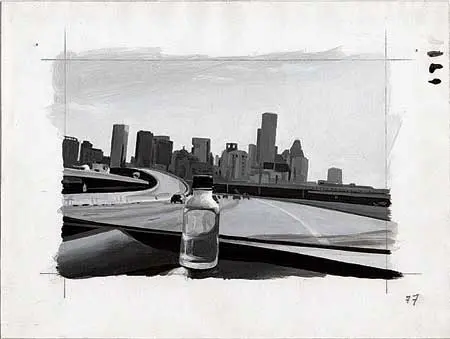
Some accuse him of making art that is too commercial, cold, and rational. A first gaze could perhaps confirm that reductionist view of his discourse. But looking at the bulk of his works and conversing with the—almost completely self-taught—artist, the perception of an apparent coldness soon vanishes. From a seemingly serene posture, Cardoso proposes veiled visceral pronouncements that contrast the American vision imposed by Western teleology. Several series from the last six years corroborate his proverbial endeavor and the emphatic spirit with which he approaches inquiries that result in the anthropological questioning of our societies. Dissimilar points of reference that—by virtue of an estrangement added by the author—are not recognizable, but nonetheless belong to Ecuador’s eastern geography and the Galapagos Islands, among other places, are captured by his characteristic photographic realism to allude to notions of time that crystalize his intention of revitalizing the gaze to the extent that the space from which viewers observe permits.
Cardoso’s methodology consists of “retouching” his photographic images through a process that the artist calls a “literal brush.” It is an act that reincorporates the primal aura and mystery into contemporary life. With the rapid pace, the nomad wanders as a result of the constant migrations and the distorted ideas of progress developing a superficial and false identification with nature, the environment, and other people that the mass media obscenely contributes to reinforcing. The “idiot box,” the internet, social media, and advertising remove the average population from contentious issues like the pernicious exploitation of mines in our countries or any other activities that damage the environment. Cardoso’s approach is possible because of his travels, as they constitute a means and an end for his ideas about the image and the landscape in that which is a reciprocals construction. Another underlying theme in Cardoso’s poetic recalls lucid concepts proposed by Lezama-Lima in his essay titled American Expression. I refer to the configuration of an image that corresponds not to the identifying narrative that Europe imposed in our societies through reason, but to the outlines of borders that include a magical space-time that is mobile and permeable.
So, there are two notions of measurable time in this discourse: the one forcefully constructed for us by the West, and another that we still can intervene according to our potentialities. The series Sábanas (Sheets, 2005-2006) presents us with the vision of those possibilities that depend on us and that are revitalized by establishing similarities that suggest their fragility. Several invertebrates wander through simulated landscapes suggested through the undulations of these territories that can signify surfaces, exteriors, and the material world. Instead, the diminutive animals could represent the unstable outside world or the soul. Here Cardoso attempts to reinterpret the baroque concept that identifies with the alternating presence of lights and shadows, chiaroscuros, intricate elements, in his eagerness to immerse himself in the complex construction processes that involve being Latin American.
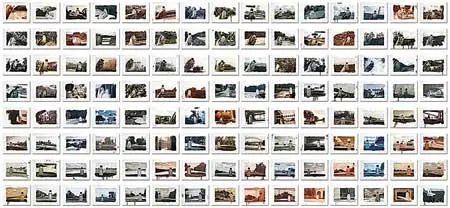
Photography bears witness to the decapitated passing of time. This is why it is associated with the notion of death. The shutter only succeeds in slowing down our spectrality. Cardoso returns to this idea in his works AM-PM, Allende (presented at the 2007 Venice Biennale), Isla # 1 (Island #1), and Serie Nowhere. The first work captures in a 24 frame sequence (numeric obsessions that remind me of the passions of the Pythagoreans) his version in acrylic on the wood of a mountainous horizon captured between 6 a.m. and 6 p.m., and in Allende, Cardoso asks an Italian volunteer to select and send him by internet images of a specific point in Venice.
Pablo Cardoso was awarded the Creative Arts Residency by the Rockefeller Foundation and worked for three months at the Bellagio Creative Arts Fellows, in Italy, in a proposal that represented the continuation of Lebensraum. Lago Agrio is one of the areas in Ecuador that suffered the expansionist politics of Texaco from 1967 to 1990. The oil company caused the destruction and contamination of huge areas of the rainforest. In 1993 the affected indigenous communities sued Texaco in what turned into “the environmental trial of the century.” To develop the project, Cardoso visited the area on several occasions. The gathering of photos, documents, and testimonials, completed the vision of the infuriating theme that culminated with a performance of ample movement.
Theory to Act Ahead of Time reminds me of that saying that goes “Who Gives First Gives Twice.” And this is exactly what Pablo Cardoso has achieved with his landscapes of uncertainty through the wisdom to have—as Henri Michaux wrote—the sense of what is missing.
AMALINA BOMNIN