There are artists who defy classification. Pablo Siquier is one of them. The literature on the wake of his works describes them as both figurative and abstract. Indeed, some of his earlier works bear a resemblance to deco architectural motifs, while some others, to peculiar urban cartographies and electronic circuitry. At first impression, the viewer might also see in his oeuvre some resemblance to the work of artists who have explored geometry for its own sake, or for the production of movement and perceptual titillation. Indeed, many of his works use the lessons of Gestalt psychology about how certain black-and-white forms are perceived as background and/or foreground, mass, and shadow. Finally, although many of his works are abstract, in the sense that they do not have a referent other than themselves, it is a moot point whether his latest ones are.
What is certain about his works is that there is a method to his madness, a reason to his rhyme: hence, the words “algorithm” and “obsession” in the title. The former is a term typically used in mathematics to denote a process or set of rules to be followed in problem-solving operations. In Siquier’s case, the repetition and generation of geometric forms often occur with the aid of a computer. Even in Siquier’s Rorschach symmetries and controlled asymmetric doodles, there seem to be recursive rules to extend a pattern. On the other hand, his technique is meticulous, one might even say, obsessively precise.
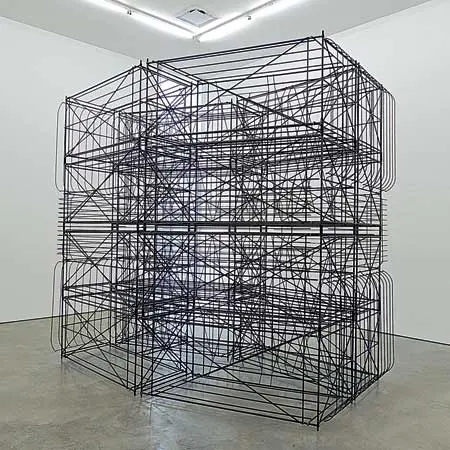
Structure, Siquier’s recent exhibit at Sicardi Gallery (Houston) consists of basically two main works: a sculptural piece and a nine-feet tall mural drawing. The sculptural piece titled 1308 is an intricate construction of steel rods that resembles the structure of a building to be, or one gutted by a natural or artificial disaster. A local critic described it as “cage-like” and compared it to Donald Judd’s minimalist boxes. However, the extravagance of 1308 is more baroque than minimalist, and in spite of an external resemblance, lacks one of the fundamental traits of a cage; namely, an empty caging space. However, there is something to that comparison worth pursuing. 1308 has a density of crisscrossing rods that traverse the inner space of the structure. It is more Piranesian than anything resembling Minimalism. Indeed, in the diagonally ascending and descending rods that crowd the inner core of 1308, there is an echo of the Carceri d’Invenzione (imaginary prisons) of Giovanni Battista Piranesi (1720-1778). Of all Piranesi’s works, it is the sixteen prints of these dark and awe-inspiring Carceri that he did between 1745 and 1761 that have most impacted many artists for whom the sublime is more important than beauty. Comparing 1308 to a cage may therefore not be so farfetched after all, because its claustrophobic interior creates a sensation of unease similar to the one resulting from Piranesi’s Carceri.
1301, the charcoal drawing on the wall, is a mural with ephemeral material existence. Its image persists in the computer-generated file from which Siquier projects it onto a wall before he traces it with a charcoal stick. It will stay there until the wall is cleared up for the next exhibit. Eventually, it may reincarnate on a different wall. Thus 1301 has a dual ontological status: a virtual one as a computer file that endures, and a material one executed by the hand of the artist or one of his accomplices. Its labyrinthine structure is obsessively symmetrical except for one inner rod. It is not abstract, nor non-denotative; what happens is that it represents something that has no name. 1301 could very well be the design for the next tri-dimensional structure, in which case the latter becomes its referent.
In parting, it is worth mentioning Pablo Siquier’s two murals at Los Molinos Building in Puerto Madero (2008), his largest work to date. It suggests a context for the kind of setting his works may engage. These murals have the apparent symmetry of a Rorschach blot and the look of an aerial photograph of a city. However, upon careful scrutiny, there is no such symmetry and no representation of a city. The symmetry is broken by the fact that one side of the drawings is hit by “light” coming from the right and casting shadows on the left. In fact, when everything in a work is working out into some kind of perfect symmetry, Siquier finds a subtle or not-so-subtle way to disturb it. A notable difference in the two murals of Los Molinos is that one uses curving, wavy lines, while the other is made up solely of straight lines. Puerto Madero is an ideal setting for Siquier’s works because it is the newest and most thriving part of the city. An area that has been built on the remains of something that was there before. Its modern and postmodern architecture is a perfect correlate to Siquier’s deceptively modern oeuvre.
FERNANDO CASTRO R.