
The painting titled Albergo Mediterráneo (Mediterranean Hostel, 1012) by Spanish-Ecuadorian artist Santiago Carbonell reveals a frequent strategy in the poetic of an artist whose works express the constant and refined technique of a hyperrealist discourse: the detail, which appears enriched by the visual attributes the artist generates through an approach that rests on the counterpoint between painting and reality and which conveys with precision the brushstroke as a visually alive discourse.
Carbonell allows for the inclusion of several interpretations through strategies that give free rein to our perception of details. Generally, many of his works follow this pattern. The works presented in this exhibition depict bare female backs and a combination of elements: enigmatic backgrounds and cloths of several colors that cover the models’ hips, paired with visual commentaries that characterize a ludic universe, achieving something beyond any possible simulation effect and where—with the help of details—everything serves as alternative evidence.1
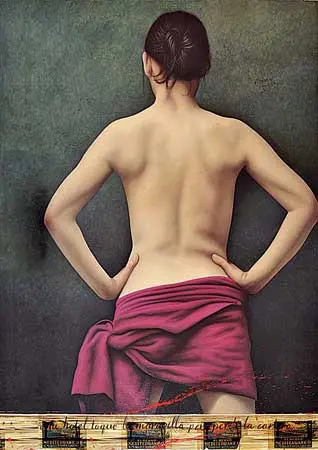
Nonetheless, it is important to point out that once we dismiss it in favor of regular reading, the studied detail is integrated into the work as something normal through a transition in which “the enigma is resolved and the element of surprise is erased.” 2 Carbonell’s works reveal a complex exercise of superimpositions between art and reality within the work of art. From the dramatizing set of gestures—lexically and visually powerful—one can infer tensions and evocations of content. Details show deviations and dislocate the mechanism of representation for their own benefit, as they become a powerful dialogical center that gives new meaning to the act of representation. Details appear to have the function of transmitting fragmentary information that is different from the global message of the work or indifferent to it, as it remits us to a moment of intimacy.
In the work under study, the concentrated expression of the title Albergo Mediterráneo (Mediterranean Hostel) must guide the uncertain figuration of details and control the very condition of uncertainty in the image. Such a situation helps give Carbonell’s images their unsettling qualities as soon as they are observed and named. A principle is fulfilled: if the interpreter names that which the detail shows, he/she cannot continue to perceive what the image depicts.
Through this operation of magnification and selection, the piece Albergo Mediterráneo becomes an autonomous work with an expressive significance that is greater than the work it comes from or its title. It is now capable of revealing the hidden forces that would have never come to light in the work under study without such operation.
NOTES
1. See: Jean Baudrillard, "Lo Lúdico y la Seducción Fría" (The Ludic and Cold Seduction). In: Baudrillard, Jean, De la seducción, Ed. Cátedra, S.A., 1989, Page 149.
2. See: Arasse, Daniel. El Detalle. Para una Historia Cercana de la Pintura (The Detail. A Close-up History of Painting), Abada Editores, Madrid, 2008.
MADELINE IZQUIERDO DE CAMPOS