Art theorist Hal Foster1 has insisted that post-structuralism imposed, since the 1970s, what he calls “a textual turn in art.” This turn is part of the “textual culture” that brings forth a new conception of the sign in the face of the crisis of representation. Such a crisis of representation is a matter of modernity itself, already announced by a young Georg Lukács in his theory of the novel. Walter Benjamin, influenced by Lukács’ theory, inaugurates an important reflection about the crisis of narratives and the impossibility of telling what occurs. In an essay titled The Storyteller (1936), Benjamin proposes narration as an alternative intended to salvage memory. Confronted with the silence of tragedy, one must attempt to narrate it. This crisis of narratives affects modern and contemporary art to a great degree, with the border between literalness and evidence, between art and literature, being erased in its entirety.
The Luis Angel Arango Library’s Casa Republicana presented, between May and July of this year, an outstanding exhibition curated by Selene Wendt in collaboration with Gerardo Mosquera. Its title is Habladores, and it included a large section of what was initially shown at the Stenersen Museum in Oslo as The Storytellers. The exhibition revisits Jacques Rancière’s concept of les contours, which can be translated as “the tale-tellers.” This concept is closely connected to the idea of the “viewer’s emancipation, which implies a community of tale-tellers (narrative-makers) and translators.”2 Indeed, this community seems comprised of contemporary artists, according to my reading of the curatorial proposal and the works on exhibit.
Gerardo Mosquera insists on a different narrative, or, in his own words, an “un-narrative” where the central issue is not a linear or literal telling in the strictest sense of the word, but an almost oral narrative where speech becomes the central object: here emerges the figure of Mario Vargas Llosa and his 1987 novel El hablador (The Storyteller), which articulates a symbolic and a mythic language, and of course the very figure of the writer as a nomad of language and words. Such condition seems incorporated into the works on exhibit, where, Mosquera says, artists do not illustrate in any way the texts to which their art alludes, but rather reinterpret them and break down the initial narrative in order to create new ones by literally intervening the text: un-narrating it. In turn, Selene Wendt says that these artists “found inspiration in literature and poetry” in order to make their works. This confirms that in fact, literature is the true pre-text for the work of the artists included in this show: Milena Bonilla, Cristina Lucas, Ernesto Neto, Marilá Dardot, Alfredo Jaar, Liliana Angulo, Elida Tessler, Rosana Ricalde, Georges Adéagbo, Nina Yuen, Eder Santos, William Kentridge, Sergio Vega, Rayan Brown, Monika Bravo, the Young hae-Chang Heavy Industries collective, and the Eloisa Cartonera collective.
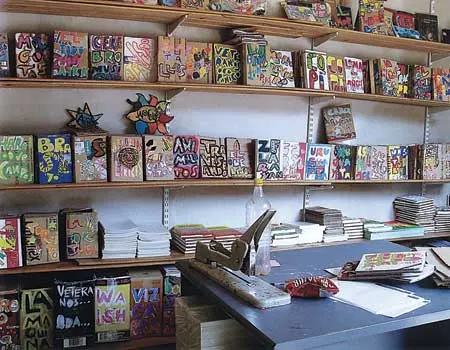
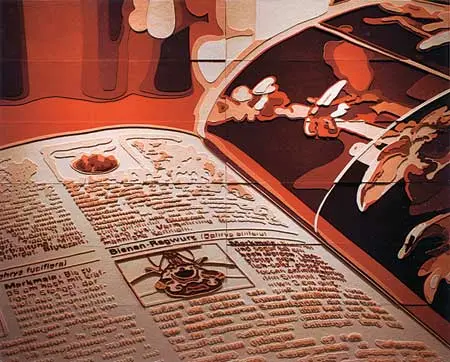
We encounter works that assume a certain literalness, such as Love Stories V (2008), by Valeska Soares, and Algunas consideraciones sobre flores silvestres: Orquídea ableja (Ophrys apifera) and Flor tablero de damas (Fritillaria meleagris) (2011), by Mónica Bengoa. The former presents five shelves attached to the wall, holding books bound in earth, sienna, and white hues and arranged in an almost pictorial manner; on the spines of the books we can read and recognize in some instances titles that speak of love. In the latter work, we see an extreme close-up of the open pages of a botany book; it alludes to painting, but does so with felt fabric in sienna and red, superimposing layer upon layer in the manner of a topographical model. Another work featuring books is Proyecto editorial para Los Habladores (2012), by Eloísa Cartonera, Cooperative Editorial Latinoamericana. This co-op, born during Argentina’s economic meltdown of a few years ago, is based on the democratization of culture through the production of low-cost books, and its recycling of the cardboard that is used on book covers was able to open a space in the publishing industry. A large installation covered with their books turns them, with their hand-painted covers, into objects of art. The idea of a universally accessible, exquisitely illustrated book reminds us of the utopian adventure of culture for all.
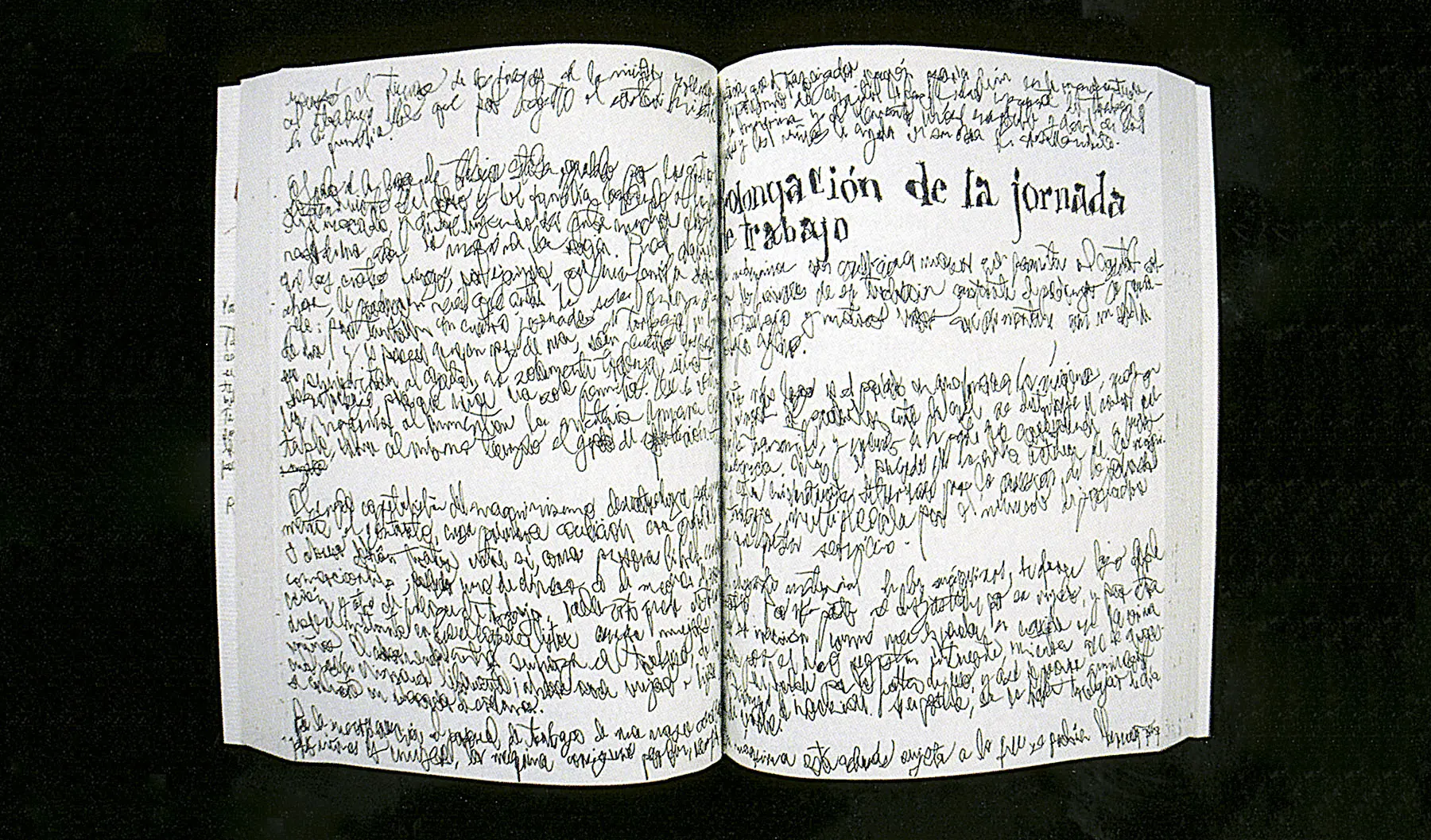
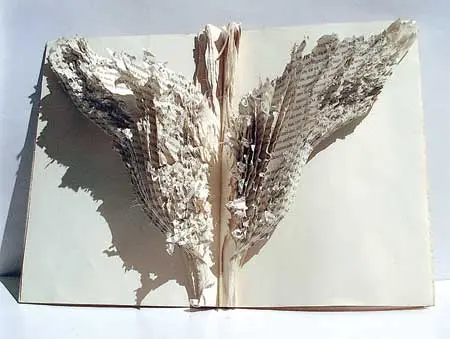
Included in the exhibition are also other works that problematize socio-political aspects from a historical standpoint: Milena Bonilla’s Lo siniestro escrito con destreza (2008) revisits Karl Marx’s Capital (1867-1894): two large canvases hanging from ceiling to floor allude to one volume of Marx’s magnus opus. The artist copied several chapters by hand, using her left hand. This is a reflection on the idea of manual labor, manufacture, the concept of idleness and free time, among other topics that can be identified in one of the exhibition’s most important works. In Negritude (2007-2009), Liliana Angulo achieves a well-conceived installation where the walls are covered by phrases written in white on a black ground. These phrases are about matters of racial segregation, and are accompanied by a series of images taken from texts that speak about the condition of black populations and the construction of their image based on stereotypes of inferiority used to justify slavery during the colonial era. A dancer, his features exaggerated to the point of caricature with a large afro, dances to the salsa music that floods the space. Added to this sound and visual device are some mirrors, which push the viewer to reflect on the matter of racial discrimination. Fabio Morais’ Migración (2006) uses a number of books whose center pages have been trimmed in irregular shapes; the books seem to transform into birds. The topic of animal migrations is directly linked here to human migration, which in this globalized world is in effect controlled and regulated by the developed countries that create increasingly more impassable barriers.
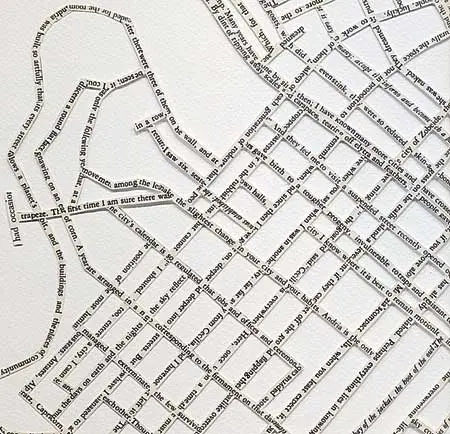
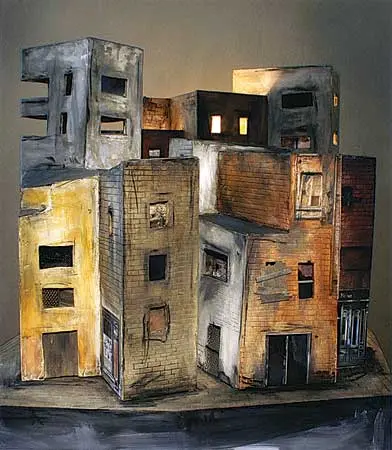
Mapa Mundi (2011), by Rosana Ricalde, uses literary texts that speak of cities. Using phrases that she carefully cuts out, the artist recreates a map of the world and generates a kind of universal cartography on the basis of words. National boundaries have been erased and all the continents are united under a great narrative where “the streets” form a large city but in the manner of Italo Calvino’s 1972 Invisible Cities. Tracy Snelling’s Niña Mala (2012) is inspired by Mario Vargas Llosa’s Travesuras de la niña mala (2006). A model that recreates the spirit of some cities, where buildings are the protagonists inside which a projection shows an actress interpreting several roles with a degree of erotic content, reflecting in a visual way about the relationship between cities and pleasure. Windows become veritable screens where we, the viewers, glimpse scenes of the private realm. The idea of evil or badness ascribed to women who sell pleasure is the work’s central axis.
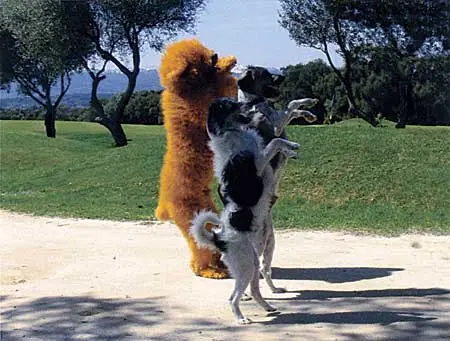
Cristina Lucas’ video Tú también puedes caminar (2006) presents an excellent visual reflection about the condition of women and their everyday labors in a Spanish town. The town’s dogs share those locations associated with women: beauty salons, kitchens, homes, stores, etc. But the dogs are not just lounging on a corner or resting on a sofa: they walk on their hind legs, creating a procession. In the end, the procession traverses the entire town. What surprises us is that the audience for this unusual procession is the women themselves.
Dublin (2010), by Elida Tessier, is an installation using a large number of empty bottles to create a perfect rectangle arranged on the floor of the gallery. The bottles are carefully capped by corks on which viewers can see words like “Reading.” This work makes a direct reference to James Joyce’s Ulysses, whose protagonist, Leopold Bloom, moves about the city for an entire day. His journey is related to Ulysses’ Odyssey, which according to Homer lasted for ten years. The city is the perfect setting, and the bottles put us in mind of messages sent by shipwrecked castaways. This work has a great poetic charge, and it doesn’t illustrate the Irish writer’s text but recreates it.
Already in 2009 Mosquera had developed an exhibition for Pan American Art Projects in Miami, titled Desnarraciones. Mosquera seems to have found inspiration in Gerald Prince, who coined the term unnarrated in 1998, and in Jaimes A. Parr. The former alludes to that which is insinuated in a text, with what is actually narrated relegated to a secondary position. The latter gives the term a positive dimension. In principle, according to Mosquera’s proposal, the unnarrated is the fullness of something yet to be narrated, and Habladores is able to show it in an outstanding way.
NOTES
1. Foster, Hal. The Return of the Real. Cambridge: The MIT Press, 1996. See especially Chapter 3, “The Passion of the Real.”
2. Arcos-Palma, Ricardo. "La estética y su dimension política según Jacques Rancière". In Revista Nómadas, no. 31, October 2009, Bogotá.
RICARDO ARCO-PALMAS