
The exhibition presented at Artist’s Space in Soho of Zilia Sanchez’s work was a well-selected retrospective of her artistic output. It highlights the importance of a continued presence of series in her work as branding of her artistic output. It also elucidates the process of her work, sometimes stretching for long periods of time, with pieces begun as early as the 1970s, finished as late as a decade later. Alongside the sensual qualities that emanate from her suggested forms, there is an important reference to gender issues in her work, within the structure of hard-edged minimalism. Her references to the classical and mythological past in her titles, such as Las Troyanas (The Trojan Women) or Amazon Series directly point to a historical reference to women’s long struggle for their own voice against the repression of traditional societies where such was considered the natural course of things. As a woman artist in Latin America, Zilia Sanchez was well aware of the struggle for a foothold in the artistic landscape. Zilia’s choice of titles is as deliberate as the female body forms it suggests, and her work evokes the strength of the legendary warrior women who stepped forward into an area traditionally belonging to men, where they stood their ground and became a beacon of hope for later generations.
Sánchez is a Cuban artist who studied and developed in Cuba where she was a student at the well-known San Alejandro Academy. Her early work in Cuba developed her own branch of abstraction through paintings and drawings, as well as the design of theater sets. She was closely associated in Cuba with a group of artists and intellectuals known as Sociedad Cultural Nuestro Tiempo which formed part of the avant-garde in pre-Revolutionary Cuba. As a strong element of importance in her formation, it is to be noted that the group was determined in maintaining freedom of expression, without prejudices from politics or religion. This last part in particular directly applies to Zilia’s work which reveals freedom with themes of the body and gender that is in contrast to Christian repression that had characterized Colonial production in Latin America and continued to exert considerable influence after independence from Spain. Also important is the fact that freedom of expression at the time had become, in the area of politics, already an impossibility under the Batista dictatorship. This Sociedad also had an important publication, NuestroTiempo, which counted amongst its contributors the important writers and poets of the time, and was also illustrated by the Cuban artists of the earlier, modern avant-garde, like Portocarrero, Peláez, and Lam, who actually designed the first cover.
Her first exhibit was at the Lyceum in Havana in 1953 and she later worked and studied in Madrid in the late 1960s, before moving to New York in 1964. Living in the city for a period of eight years, she started using the canvas’ support to build interior wooden contours that were then sealed inside the canvas. These forms press against the canvas and protrude, reshaping the surface and incorporating an additional dimension of shadows on the surface into the composition. The simplicity of her design and social gender issues reminds us of the Arte Povera Generation in post-war Italy. There is an evident reference here to the work of an older artist, Lucio Fontana, in the treatment of the canvases and the color choices, although Zilia has a preeminent preference for white and softer colors. More importantly, she shares a similarity of architectonic qualities of construction with the work of Enrico Castellani who is her close contemporary. Although they achieve quite different results, these moves to abstraction, which are present from the start, clearly place her work within the network of the international artistic tendencies of the time. The projecting forms in her work organize the space around them into semi-circular, rounded areas. However, the re-arranged stretcher frames produce shaped canvases designed to emphasize the sculptural abstraction of suggested bodily forms, a factor that also links Zilia’s work with a strong and assertive feminist aesthetic that was burgeoning at the time in the visual arts as well as literature.
In 1971 Zilia Sánchez moved to Puerto Rico, where she still lives today. Between 1972 and 1975 she worked on designing the literary journal Zona de Carga y Descarga (Loading/Unloading Zone), a very influential literary publication edited by well-known writer Rosario Ferré, who herself established, through her writings, a prominent platform for feminist and women’s issues in Latin America. This publication was also highlighting a seminal moment of experimentation in Puerto Rican literature and from Latin American writers.
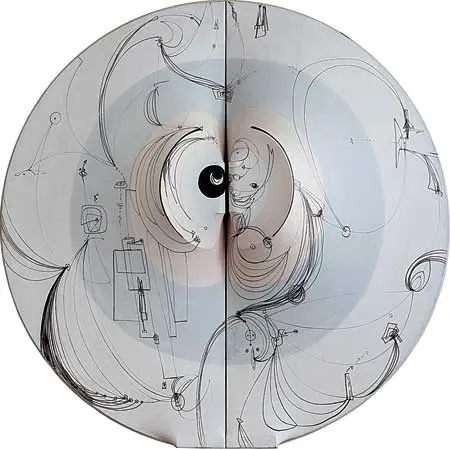
In the first space of the exhibition, Zilia’s design work for the magazine was highlighted in vitrines. Sánchez used photomontages, and typesetting, somewhat reminiscent of Dada texts, in that featured text inscribed into the publication as a chaotic, baroque fusion that diverged radically from formal art publications of the period which were more apt to display that complexity within the arcane elaboration of the text itself. She also incorporated some script-like design to some of her canvases of the time; her circular canvas Lunar con Tatuaje (Moon with tattoo) from 1968 is a great example of the incorporated elements that seem to float above the canvas surface and create the illusion of an outer space mapping.
The exhibition as a whole is excellently displayed and her canvases exude a serenity in unison that clearly makes it understandable that the separate works are part of a larger vision of contemporary spiritual reality The works create a strong impact as individual pieces, but the impression of seeing them together makes it feasible to realize that they are a sequence in a diagram of complex design, or musical parts of a large, complex symphony.
ALBERTO BARRAL