
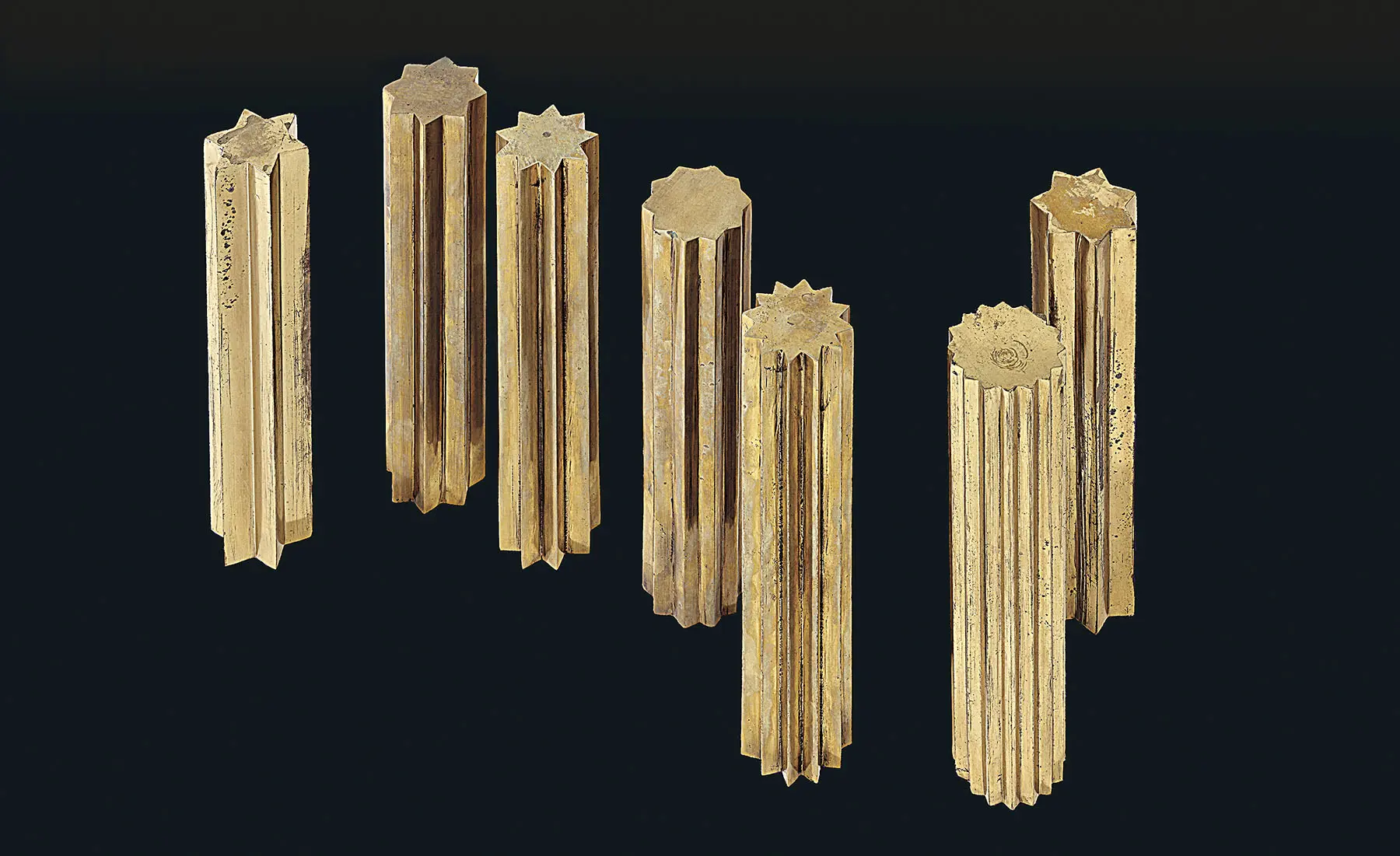
How and when did abstraction emerge in Mexico? There is no single cause or specific date, and it isn’t something imported, either; it is a process that moves forward from both endogenous and exogenous roots in Mexico City itself. In the 1940s, Mexico’s celebrated muralism is reaching a point of exhaustion that coincides with social changes in the country and with the Second World War. The dissolution of muralism is not complete, however; some of its practitioners continue forward alongside a number of younger artists and others of more mature age and aesthetic will who begin to establish an interest in the synthesis of form, in experimentation—different from Siqueiros’—in abstract expression and other styles. The majority of Mexican artists do not accept the change, clashes of opinion and reductive mentalities are not lacking and neither is a desire to retain privilege and power in the artistic-governmental sphere. The earliest shifts take place in painting because sculpture in the city and in government buildings depends on commissions from the government, and such structures are more difficult to change.1
Decade after decade, Mexico was to produce many artists working in abstraction and geometry. These are artists who opted for synthesis and experimentation in theme and materials, moving away from narrative and historical lessons. It is in small-scale sculpture where risk and variety began to manifest themselves. These shifts can initially be located in the 1950s, with some precedents in the 1930s, for example with Germán Cueto, who returned from Europe imbued with the spirit of the avant-garde movements with which he had interacted. Young and restless mid-century artists must be mentioned, like Juan Soriano in Guadalajara, a painter, draftsman, and sculptor who was among the first to make sculpture in ceramic materials, and José Luis Cuevas in Mexico City, who, although a figurative artist, was an enfant terrible who understood the need for renewal before he had reached the age of twenty. These were the foundations for the process that started with the arrival of Mathias Goeritz in 1949, hired to teach Visual Education at Universidad de Guadalajara’s Architecture School, where link by link the chain is built that leads towards abstraction in Mexico. Goeritz’s synthetic Orozco head, created as an homage to the great master, resulted in him having to leave his position at the university; he moved to Mexico City, where at the time—thanks to the activity of this expressionist painter, installation artist, and fledgling sculptor—artists and artworks from abroad were beginning to arrive. Goeritz received with intelligence a comment made by architect Barragán, with whom he was to work in several projects: “you are more of a painter than a sculpture, which is a shame because there are so few sculptors in Mexico.”2 This motivated him to accept from Barragán a first sculpture commission: El Animal del Pedregal, 1951, which exemplifies the emerging synthesis even as it incorporates certain pre-Columbian legacies and Goeritz’s expressionist roots. In this artist, the will to experiment expressed itself not only in terms of themes and forms but also in terms of genres and materials, as we note when we hear him describe his work with “reinforced concrete and other construction materials for my sculpture projects.”3 Also in the 1950s, Mathias Goeritz conceives and built the Museo Experimental El Eco. This multidisciplinary work, sponsored by Daniel Mont, included drawings, dance, and other elements such as sketches by Tamayo and Henry Moore; although the name includes the word “museum,” its purpose was not to present works of art in the traditional manner but to stimulate emotions. El Eco is connected with the Manifiesto de la Arquitectura Emocional, one of Goeritz’s signal creations. Also, Goeritz taught at UNAM’s Architecture School, educating several generations of architects, visual artists, and designers that went through those classrooms. We will inescapably run into him again.
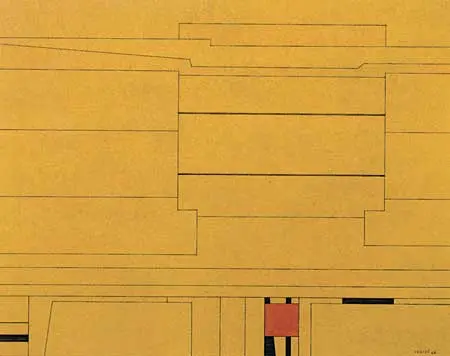
In Mexico, one of the initial vectors for geometric art was provided by Guatemala-born Carlos Mérida. Inspired by the Maya world, Merida began in 1950 his third thematic-stylistic period, creating murals, paintings, objects, mixed-techniques, and prints that experimented with an expanded geometry, as he would continue to do until his death. Also to be mentioned among the early practitioners of the artistic synthesis are Federico Canessi and Luis Ortiz Monasterio. Their works, especially Ortiz Monasterio’s, occasionally feature geometric abstractions of a constructive character. Also in the first half of the 1950s, Gunther Gerzso made the decision to become a full-time painter, abandoning set design as his means of earning a living. In his previous periods, Gerzso had created figurative-surrealist paintings, but starting with the mentioned professionalization of his activity, he entered a period of landscape-architecture abstraction with unique geometries that do not ignore the pre-Columbian element. It is only many years later that he begins to work in sculpture, as he put it, “with the same sensibility as in painting.”4 In 1960 Rufino Tamayo returned to the country, confirming an era of unique personalities among which we find also Manuel Felguérez, Lilia Carrillo, and Vicente Rojo, all of them belonging to what is known as the Ruptura generation that had been on the forge since the 1940s. This Ruptura was a spontaneous and flexible grouping that had nothing to do with the nationalism of the revolution; on the contrary, a variety of worldly and apolitical aesthetic proposals coexisted within it. Vicente Rojo established himself in Mexico since childhood with actions that are different yet related. He is an outstanding graphic designer and headed the best space in the genre. Meanwhile, he paints Mexico bajo la lluvia, an unending series to which he later added others. Vicente Rojo explored sculpture in ceramic materials, metal, paper, bronze, and any material he may have come across, with increasingly more powerful results.
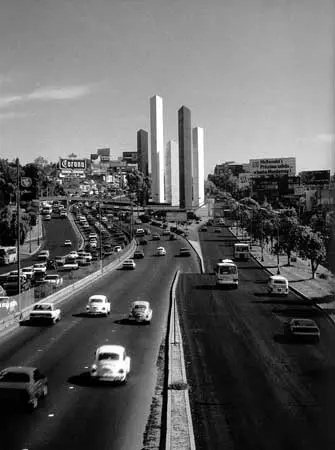
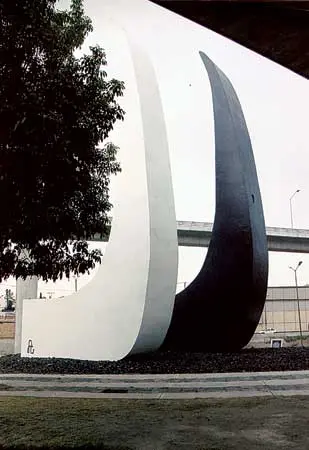
Society has changed, and among the changes are the establishment of art galleries, competitions, and, in the following decade, the opening of the Museo de Arte Moderno (1965). We should note that the establishment of this museum only makes sense in the context of the drive for renewal that some labeled, erroneously, “foreign” to Mexico, not noticing that such shifts were essential elements of a century of change. The 1960s present many contradictions, social tragedies, and their emerging aesthetics. The year 1968 alone saw the student movement, the tragedy of October 2nd, the Olympic Games, and the Route of Friendship. Given this, the intense contradictions in an increasingly more diverse country come under a new light. The Cultural Olympiad, commissioned to Goeritz, was intense and encompassed many genres: dance, science, painting, sculpture, poetry, seminars, and more. Many guests arrived from abroad. The Friendship included monumental and urban-space works by well-established artists from different generations, which marked Mexico as one of the first countries to have a sculpture in cement, urban, public, and monumental. Moreover, the concept created a sculpture route, another novelty. “Architect Ramírez Vázquez commissioned me with the Cultural Olympiad, and when I presented my ideas he said: ‘Better make a park.’ I told him that Mexico already had many parks and that having this Route of Friendship in a newly developed space in the City would be original. That was the worst mistake of my life! I hadn’t considered how much Mexico City can grow. The Peripheral Ring, which had been built only a few years back on unpopulated areas, was soon incorporated into the fabric of the city. The sculptures that were so large are now (1985) absorbed by the city’s great expansion.”5
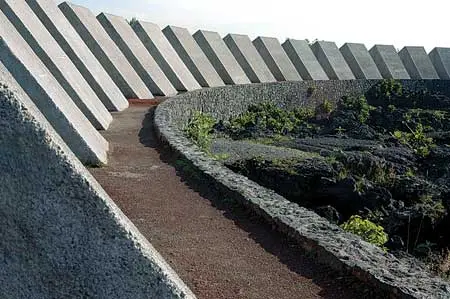
The Route of Friendship was installed along the Peripheral Ring (a ribbon-like geometric shape encircling the city), the city’s first large-scale road-infrastructure project, originally planned in 1964. The metro that was to be inaugurated two years later as public transportation, and the government’s repressive actions, which had not yet come to an end—as demonstrated two years later, already in the Twentieth Century’s seven-decade, the tragic Corpus Thursday—corroborate Mexico’s urban and cultural thicket. Meanwhile, in the arts, the 1970s are characterized by conceptual art in the group activities of Grupos, which are another vector of powerful coexistence in Mexico during this era. Espacio Escultórico I and II, created as a team by Mathias Goeritz, Helen Escobedo, Sebastián Hersúa, Federico Silva, and Manuel Felguérez, were inaugurated in 1972. These are two natural lava spaces on land that is part of UNAM (Universidad Nacional Autónoma de México). One traces a crown of cement parallelepipeds around the lava space as a tribute, protection, distinction, and early ecological marker. The other contains a large-format sculpture by each of the artists mentioned above. With this, the sculptural space calibrates the intense level reached by abstract and geometric art in Mexico in the late 1970s.
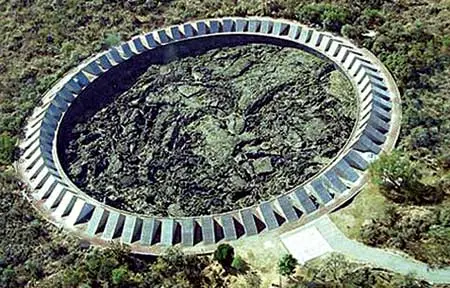
Helen Escobedo studied with Germán Cueto and devoted herself to sculpture and installation, drawing, and paintings in a variety of directions, with emphasis on an ecological/social line of work and on geometric art. Manuel Felguérez, as he puts it, was always curious and inquiring in his proposals; he worked with iron-on his abstract-materialistic murals for a city movie theater and created an elegant sculpture of quadrangular shapes in gray and black for Espacio II. Federico Silva was strategic in selecting the location for his work, a sculpture of opposing volumes and proportions: suspended solids and lightweight shapes that swayed with the breeze. This swaying construction was part of a series by the artist; one of the series’ components is located in the park around the Museo de Escultura Contemporánea Federico Silva, in the city of San Luis Potosí. Mathias Goeritz created La Corona de Bambi, a pyramidal structure annotated in segments that become narrower as they rise upwards. Ballet functions were presented there on numerous occasions, as they were in Espacio I, on the volcanic lava.
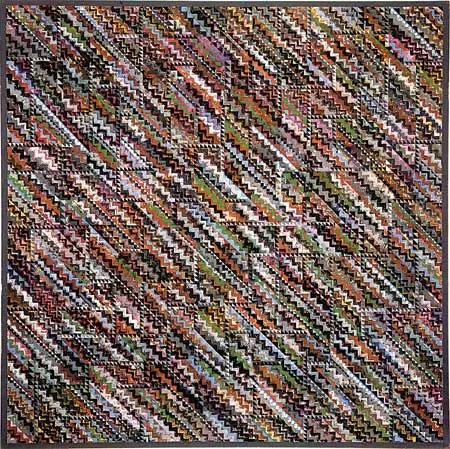
Geometric and abstract art expand intensely, change, self-recycle, and in some instances, the artists are aware of the degree of repetition that occurs. To quote Mathias Goeritz again, “we who work on geometric art must be careful not to be boring.” 6 Who are those we? To mention a few: Artists like Ángela Gurría, Jesús Mayagoitia, María Lagunes, Kazuya Sakai, and Fitzia in Mexico City; Rafael Villar in Xalapa, Veracruz; Jorge Dubon in Chiapas and Paris. During the same decade, conceptual art is articulated by groups, while artists like Fernando García Ponce and Enrique Echeverría, who began their careers practicing figuration, redirect themselves towards a very personal, different abstraction that even included material elements and collage on occasion. In two-dimensional art, Fitzia worked on abstract collages using a technique that few artists embraced: cut and glued paper that creates transparencies and saturations, applying wax to the finished surface to create the pores and protect the painting. Fitzia also created abundant sculptures, such as the great central column for a downtown hotel and many geometric bronze works. María Lagunes understood urban sculpture in combination with architecture, both functional and otherwise, and created important applied-art works. Rafael Villar is a master of form; curves, waves, and edges coexist in this artist’s works on wood (his preferred species, especially sapodilla). Villar also contributed the use of recycled wood-and-glue paste, as well as painted sculptures and some bronzes. The key for this entire movement is that geometric and abstract artists are able to express and refer without the use of narrative and that the works achieve independence when this occurs.
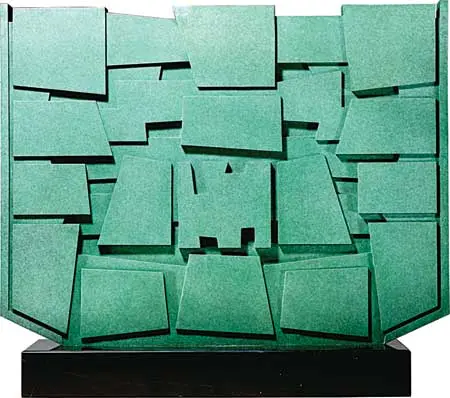
Some geometric-art practitioners have also worked in teaching and research. Noted among them are Manuel Felguérez and Jesús Mayagoitia. By the latter, the following paragraph from one of his academic works reveals an artist who is intensely committed to sculpture (which is the subject of his college-level teaching): “Everything that exists is entirely subject to space, time, and matter—which of course is what gives meaning to the other two. In fact, the most immediate example of this is ourselves, who are comprised of borrowed or recycled matter, and move through space in a limited span of time.” Manuel Felguérez, for his part, created constructive sculptures using flat planks and moved early into the investigation of digital technology—which he titled Multiple Spac—in order to apply a meta-language to painting, print-making, and sculpture. More recently, his sculpture language has diversified substantially, as can be seen in the Museo de Arte Abstracto Manuel Felguérez, located in the city of Zacatecas.
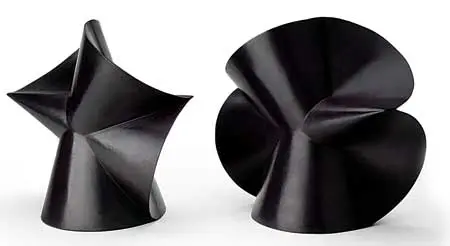
Until now, we have been using a generic definition of abstraction and geometry, and some mentions of the sources for a number of artists. But the pathways opened by these major figures have bifurcated. There are those who began exploring modules and never moved beyond that exploration, creating geometries in metal, mostly painted in flat and intense colors. Others worked and continue to work in iron and steel, also in stone, granite, bronze, wood, and silver. There are artists who codified form, others who explored the articulation of parts of works as a whole. Abstraction and geometry found ways to go hand in hand in some cases, and in others, they were two chronologically distinct stages. It can be discussed how intellectual can geometric art is in comparison with figurative, realistic, or naturalistic works. At both extremes of the universe of visual discourse, reason and perceptual emotion coexist. In both cases, systems, studies, knowledge, and revealing practices are applied.
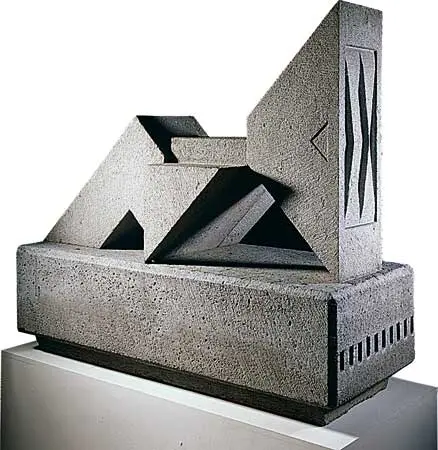
Let’s go back to our review of the artists who built, from their steps into abstraction, the present of the arts in Mexico. This historical progression is not only a fleeting chronology but also the indispensable presence of the names that lead to an understanding of the process. Alongside the artists already mentioned, Feliciano Béjar developed figurative and geometric languages in glass, paper, wood, and paint. His glass loupes, presented with recycled iron, were a contribution to geometric-art developments and adjusted the viewer’s gaze to kinetic games. In sculpture, we must mention the poetic geometric Francisco Moyao and Fernando González Cortázar (whose works are in Guadalajara and in Mexico City); in painting, Arnaldo Coen, who contributed geo-pop and geo-surreal games in idyllic and pastel-like palettes. Although from a younger generation, yet in contact with his elders, Rubén Valencia must also be mentioned; he established connections between geometric art and design, as well as between geometric and neo-conceptual art, and developed original parameters in his brief and intense life. Agueda Lozano—who lives in Paris since 1971—is a painter, a graphic artist, and (to a lesser degree) a sculptor. Her work features gelid abstractions, uninhabited worlds, and imperceptible layers of matter.
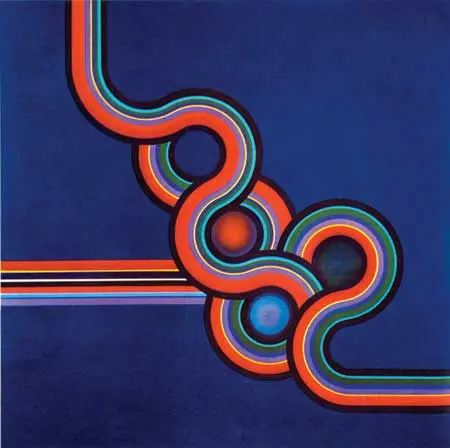
In 1976, Mexico City’s MAM (Museo de Arte Moderno) presented an exhibition that recognized geometric art as the most important movement that emerged in the country after muralism. As we move closer to the 1980s, several tendencies coexist. Abstract and geometric art, the highly personal magic realism of Toledo and other, more local and popular artists, new mexicanismos, de-oxygenated surrealism, neo-Conceptual art in its various guises (including artist’s books, installations, and actions), some yawn-inducing versions of muralism, archeological revisions, little kinetic art, object art, experimentation (serious and otherwise), and divisions by materials used that expanded work in textile, glass, and ceramics. Mixed techniques are developed, there is a brief presentation of frameless paintings that almost don’t register, large-format and urban-space sculptures begin to gain a foothold. All of this coexists in Mexico twenty years before the end of the century, at the precise moment when speculation takes over the international commerce in works of art, a financial contagion that Mexico almost catches but from which it is saved in the end. Great private collections emerge, and the government presents on the international stage several mega-exhibitions of pre-Columbian art and of works by a highly select group of still-active artists.
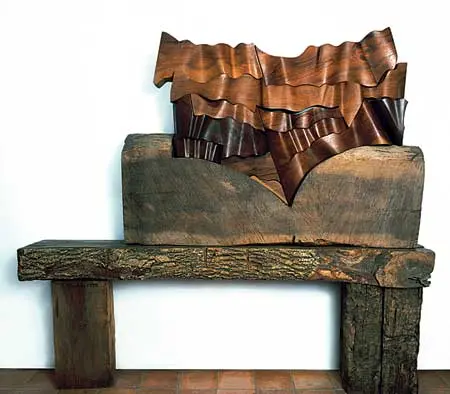
Art has always been a social necessity, but as far as we can tell commercial activity has dominated it in the past 40 years. In Mexico, during this period dominated by abstraction, a singular pattern has emerged: deities and liturgies are not reproduced, created, or copied. The contemplation of nature and its reproduction give way to respect for the environment in the placement of monumental sculptures. Ceremonial cities are not painted; rather, signs of encounter are commissioned and established in large metropolitan centers, as in the monumental Mexico City. Geometry can be a means for analysis, projection, and design, for offering an organized description and creating sensations of visual analysis. At the same time, geometry—like figuration—exists also in a decorative and digestible form. We are coming close to the first 100th anniversary of these initial steps of abstract-geometric art in Mexico. What will we see in 2040? Impossible to tell at this point. As we understand our complex present, in the second decade of the Twenty-First Century, it features the multiple coexistences mentioned above. Let’s start by saying that nothing has ceased to exist; that there are artists working in every mode, and an audience for each of them. There are unexpected changes in scale, abstraction, and geometric art survive and even appear in renewed form; like the pop artist Madonna, the internal is no longer cause for blushing and disguise: for some people, speculation is a marketing ploy, wars are watched on TV, and digital media undress us all, while multi-disciplinary productions are the order of the day. This has been a profile of the origins. Left unmentioned is an important set of artists—three generations—who surprise us with their geometric art. Most of them produce forceful, different works, and leave the field wide open for an essay that analyzes them in specific. Mexico is an inexhaustible source.
NOTES
1. With regards to print-making let’s remember that the renowned TGP (People’s Graphics Workshop, in its Spanish initials) had already been established, in coincidence with the political concerns animating muralism, so that renewal didn’t happen there with the exception of two artists who deserve mention: Alfredo Zalce and Octavio Bajonero. The former was always interested in seeking new alternatives, despite his strong social and political commitments. The latter created synthetic xylography that corresponded to the 1968 student movement and a series of Abstracciones in 1970.
2. Conversations between the author and Mathias Goeritz, presented in several books and in the German TV documentary for which she acted as an advisor in the 1980s.
3. Ibid.
4. Conversations between the author and Gunther Gerzso, in the latter’s studio.
5. Conversations between the author and Mathias Goeritz, presented in several books and in the German TV documentary for which she acted as an advisor in the 1980s.
6. Ibid.
GRACIELA KARTOFEL
Art historian, critic, and curator.