
To describe Aldo Sessa it becomes essential to address his many facets: as a photographer who is passionate about the urban theme, as an author with a predisposition toward angular and elegant compositional tendencies, and as an artist who values volume and in-between spaces as if they were musical zones and silences. In a prolific and perfectionist artistic production, Sessa has focused his attention less on people and storytelling than on those aspects that convey the strong personality of New York. Although his work has also approached other cities like Buenos Aires, his talent reaches the heights of the Manhattan skyscrapers when it comes to rendering New York.
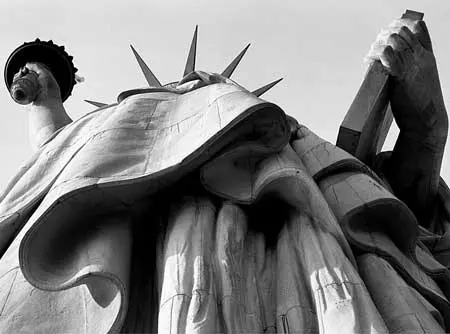
Born in Argentina, Aldo Sessa is an unconventional photographer in the context of his country. He is not an author that focuses on portraying artists or writers from the local scene—as most great modern photographers from Argentina, like Annemarie Heinrich, Horacio Cóppola, and Sara Facio, have done in Buenos Aires. While Sessa is the author of portraits, in them he emphasizes the maturity of angular volumes, of the street defined by modernist architecture, as he also records the less frequent angles from ballet. He often avoids frontal approaches, and, instead, looks for the hidden places within the urban landscape found between light and shadow contrasts and rides exalted perspectives with the mastery of a daring horseman.
Sessa’s ongoing exhibition at the Spencer Throckmorton Gallery consists of twenty-five works. The selection of pieces and the mounting of the exhibition are excellent. About the selection, it is important to mention that the show includes photographs of New York City that were taken by Sessa during his yearly trips to that city. About this, the artist has said, “My passion for New York remains as intact as the very first time I saw the city fifty years ago.”
The forms in his work are charged with the symbologies possessed by several of New York City’s buildings, statues, and bridges. But it is not through the subject that Aldo Sessa attains his high level of originality—something that would be impossible considering the infinite number of images taken of every element found within this urban landscape—but rather through his unscathed photographic, stylistic, and personal approach. Through sharpened forms, like those present in the notable depictions of the Chrysler Building (1989), the Twin Towers (1991), the Chrysler Building Rain (2008), and the Chrysler Building (2010), architecture has played the same central role since the beginning of Sessa’s career.
Less than half of the works that are part of this exhibition include the human figure, and those images are characterized by the anonymous appearance of the individuals that appear in them. That is, with the exception of one work that pays tribute to the great Hungarian photographer, André Kertész, and to which Sessa gave the title of Kertész on 43rd St. & 6th Ave., NY, an address near the International Center of Photography. In keeping with the Kertészian notion of giving meaning to mundane events, the image by Sessa plays with a succession of three persons and a giant shadow. In both Kertész’s and Sessa’s works the theme of the shadow becomes in itself a well utilized and enjoyed vehicle—not solely by the authors but also by the spectators. Among the prominent elements at play, the shadow acquires a mysterious, symbolic, authoritarian, and evocative place. In 5th Avenue, NY from last year, Sessa articulates three ruling principles: verticality, oblong or elongated forms, and shadows. While most human figures are unrecognizable—particularly due to the lack of physiognomic details—in some of the photographs it is possible to observe a hand or a head masterfully shown in all their detail.
Cosmopolitism provides a varied language. We are reminded of the international nature of the work when contemplating photographs like Man & Empire State Building, NY—a double exposure image. There are only a few color photographs and most solely rely on black, white, and tones of gray. The expressive force of Sessa’s black and white photographs—or B&W, as they are usually known—is highly noticeable.
Carousel, Bryant Park, NY is incidentally one of the five printed shots that use a variety of pigments. It is a highly theatrical image, just as the other four-color photographs are. The effects caused by the reflections of one type of architecture over another are motifs that are dear to Sessa’s aesthetic, as it is also the utilization of modules. The perspectives generated by his inquiries also represent good technical contributions; the Statue of Liberty, NY (1991), being one notable example. While most of the photographs are of an architectural nature, there are also some that set manmade forms in contrast with natural agents, like rain. In conclusion, the images by Aldo Sessa are full of energy and emotion.
GRACIELA KARTOFEL