
Cristóbal Lehyt’s most recent solo exhibition, Iris Sheets, featured four works. Two of them referred to identifiable Chilean topics, while the other two proposed relatively hermetic, personalized codes that were in good measure unintelligible for the viewer. A printed interview with the artist provided important points of reference and announced a show catalog, still in the works. Three of the works, dated in 2013, were inside the gallery; a fourth, dating from 2006 and consisting of a printed banner, was placed on the exterior façade of the Americas Society building, facing 68th Street.
The banner (Violeta. 2006) appealed to its communicative function with a design that combined image and text. It was a photographic portrait, in profile, of Violeta Parra, the celebrated Chilean singer, and composer associated with the social movements of the mid-Twentieth Century, accompanied by an English-language rendition of the chorus of her best-known song: “thank you life, for giving me so much.” The banner was vertical, but not so the orientation of its most salient visual element, Parra’s portrait, which appeared overturned and facing downwards, looking on the curbside and its pedestrian traffic on one of New York City’s most expensive areas. The photograph, in red-saturated hues, was printed across the banner’s central band and framed by two sections of text. The text itself was printed in orange against a scarlet red background. The resulting design was monotonous, almost monochrome. In its capricious combination of elements, the banner seemed ambivalent: sophisticated in intent (the support was in polyester poplin), yet aesthetically clumsy.
Such seeming clumsiness is not the product of chance. For years, Cristóbal Lehyt has explored the effects of poorly executed images and the way in which their disagreement with our expectations impacts our perception of them. In his series Proyecciones dramáticas, a selection from which was recently acquired by MoMA, Lehyt created several drawings while in a trance state, emulating the automatist technique of the Surrealists. These human figures, characterized by their linearity against neutral backgrounds, are dominated by a sensation of nervous anxiety or of altered psychological states. Their similarities with a child’s graphic expression underscore the ambiguity of liminal images.
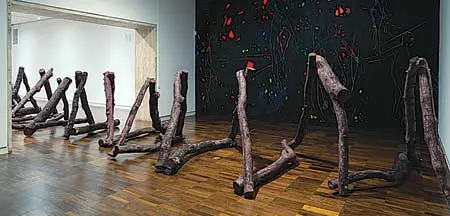
In the exhibition under review, Lehyt used five figures of the same kind to compose the mural painting that lends the show its title, Láminas de Iris (2013). Distributed along the wall against a black background and without contact with one another, the figures seem to wander in a space suggested by their own placement at different levels of the pictorial plane. A few horizontal and diagonal lines also contribute to the illusion of depth. However, Lehyt also painted many color areas, in irregular circular and oval formats of different sizes (from simple dots to human-sized shapes), emphasizing their two-dimensionality. In this mural, Lehyt’s gamble was for establishing a more sensorial relationship with the viewer, appealing to a saturation of the gaze through the high contrast between his bright, neon-colored figures and the black background.
Lehyt’s other two works appealed tour the sense of smell. On the one hand, a strong liquor aroma irradiated from a monumental wood sculpture soaked in wine (Untitled, 2013). It resembled a giant snake, identified by the curators as a reference to Juan Downey’s 1975 Anaconda, mapa de Chile. To the back of the gallery, two cube-shaped fishbowls containing wine, sand, water, and sulfur (Aquarium, 2013) could or could not contribute to the olfactory saturation (I said this because the fishbowls seemed to be sealed shut). The intense wine smell certainly helped visitors experience the space of the gallery as a unit. However, this experience, comfortable to a degree, was countered by the dramatic and playful placement of the works.
Inadvertently, Lehyt’s wood installation established a playful relationship with its viewers. Upon entering the gallery, viewers had the option of choosing one of two parallel paths along the palisade. Moving into a second room, it became obvious that the space had been cut in two since a series of announcements on the walls insisted that the sculpture was not to be touched or crossed (towards the other side of the gallery). In this way, if the visitor took the path to the right, she reached towards the back of the gallery a section with the mural and, almost hidden in a corner, the two fishbowls placed on the floor. If, on the contrary, the visitor followed the path to the left, she was trapped in the section of the gallery with only the mural, too close to be fully appreciated. From this vantage, the fishbowls were visible only partially, behind the mural.
This radical transformation of the space and the perceptual experience emphasized the viewer’s involvement as the exhibition’s key element, beyond the reverberation of Chilean-specific themes. At the end of my visit, I thought I had been lucky to choose the path to the right, a puerile and fleeting notion created by Lehyt’s handling of the space. Besides being able to look at the fishbowls from up close, from that position I could see the mural from a more appropriate distance. It was difficult to separate the painting’s image from the sculpture’s. In fact, the amalgam was enhanced by the fact that the placement of the human figures at different levels echoed the snake’s undulating rhythm. With his games of vision and illusion, Lehyt reiterates that our perceptual experience of a work of art is inseparable from its context, itself comprised of numerous layers that are in the end juxtaposed in the viewer’s iris.
ELVIS FUENTES