
Because of its historic-cultural value and as a result of its semiological specificity as a symbolic sign, language has been a theme approached by contemporary art through several mediums and with different purposes. Saussure understood that the units of language could only be defined through relationships. This very concept is conveyed by Damián Ortega in his second solo exhibition at the Barbara Gladstone Gallery in New York City.
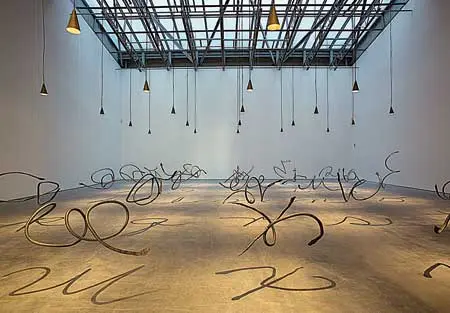
In one of the spaces of the gallery located on 21st Street, this renowned Mexican artist that reached notoriety for his celebrated Cosmic Thing during the 50th edition of the Venice Biennale, presented two of his most recent works: Harvest and Tool Bones, both from 2013. Harvest is a large installation placed in the gallery’s main hall. It consists of 25 steel forms suspended in the space. Occupying the second floor of the gallery, Tool Bones consists of a series of seven bronze sculptures of hybrid objects made with tools and bones.
By possessing a vast body of work characterized by a constituent formal, material, and discursive continuity, the presence of earlier works does not escape the viewer’s gaze, given that, aside from the language, the concepts of weight, equilibrium, and space also appear in this exhibition through the Ortega’s deconstruction of traditional sculpture. Thus, one could argue that the gravitation on the space of a fragmented object found in Harvest is reminiscent of works like Cosmic Thing (2002) or El Hombre es el Controlador del Universo (Man is the Controller of the Universe, 2007). Conversely, when confronted with Tool Bones, we are reminded of the project Homologies (1991) because of the hybridization of objects into a single form. In one instance the object is fragmented and in the other, it is brought together. Decomposition and hybridization; based on these two states Ortega warns us about the duality and capriciousness of language.
A word formed by letters can only exist and mean something according to the specific relationships generated by the units of language. And it is precisely vocabulary that Ortega fragments; the symbolic knowledge we possess that allows us to communicate within a culture. Such fragmentation is nothing other than the alphabet and, thus, Harvest denotes a vast writing system of a Latin origin. Nonetheless, there are no tangible images here that iconically represent symbols or letters. Instead, there are shadows, projections that form letters, as if the units of language depended solely on the light. We observe 25 twisted steel forms that create a grid of five rows by five columns. Each form hangs from threads that, while invisible at first glance, become evident as one gets closer. Most times they use two threads and sometimes even three. Equilibrium is once again a component that Ortega makes us aware of. At the same time, the forms are organic like the roots of a tree and, although they appear to be descending, they never touch the floor. Twenty-five black lamps that begin near the high ceiling of the gallery spread through a cord until they reach a distance that permits them to illuminate each form, each root. In this manner, through zenithal and targeted lighting a scenography is created, a stage; a play with a cast of 25 actors or 25 letters. Ortega indicates to us that language, like art, is also represented.
An oblong photograph at the entrance of the gallery emulates an inventory of the forms found in Harvest and, below, there is another of the shadows; of the alphabet. Besides it, we observe three tools on a plinth: a saw, a hammer, and a pick; tools physically or poetically used by Ortega to create the shadow alphabet. A signal indicates to us that the exhibition continues on the second floor. There the series is called Tool Bones and, unlike Harvest, is not about floating objects as a result of the force of gravity, but rather about bronze sculptures arranged on the floor. Measuring not more than one square meter each, the sculptures are not units separated by zenithal light, given that light is homogeneous, as we regard the sculptures as text because of the relationship between the parts. In Tool Bones we once again see the tools with which Ortega worked the steel in Harvest. Nonetheless, this time the fragments (or tools) are united, hybrids as if they were words that resulted from the relationship between units. It is an osseous portrait that allows us to think about the economy as well as the semiological meaning of language. Thus, viewers react, each according to their own experience of the text on the second floor, as they delve into Ortega’s language. Deconstructing and reconfiguring everyday objects encourage spectators to reconsider the object and its function around the world.
FLORENCIA SAN MARTÍN