
The exhibition Digital-Analógico. Ensayos Visuales. Colección Mercantil, a reading of the use of photography and video as the technological codification of the image and an unequivocal sign of the contemporary era, is on view at Espacio Mercantil since June.
The curatorship, by Tahía Rivero and Emilio Narciso, hinges on four thematic sets: La aplicación del método—on the free appropriation of the scientific method in the arts—with works by Mariana Bunimov, José Antonio Hernández-Diez, Yucef Merhi, and Claudio Perna; Sistemas de referencia—on the citation and revision of meta-artistic referents—with works by Iván Candeo, Mauricio Lupini, Pedro Terán, and Javier Téllez; Márgenes de coexistencia—reflections around the topic of place, cities, and public spaces—with photographs and videos by Ángela Bonadies, Zeinab Rebeca Bulhossen, Paolo Gasparini, Daniel González and Julia Zurilla; and Mecanismos de verosimilitud—where the works of art replicate the codes of the mass media to construct their message—with the work of Déborah Castillo, David Lamelas & Hildegarde Duane, Juan Carlos Rodríguez, and Sandra Vivas.
The exhibition’s trajectory moves fluidly following these sections, so that the viewer encounters still and moving mages, audios, and projections in a seamless flow, without abrupt surprises: contemporary society’s quick assimilation of these languages has ended up molding its response with the “New Media,” inscribing them in a zone of comfort and familiarity.
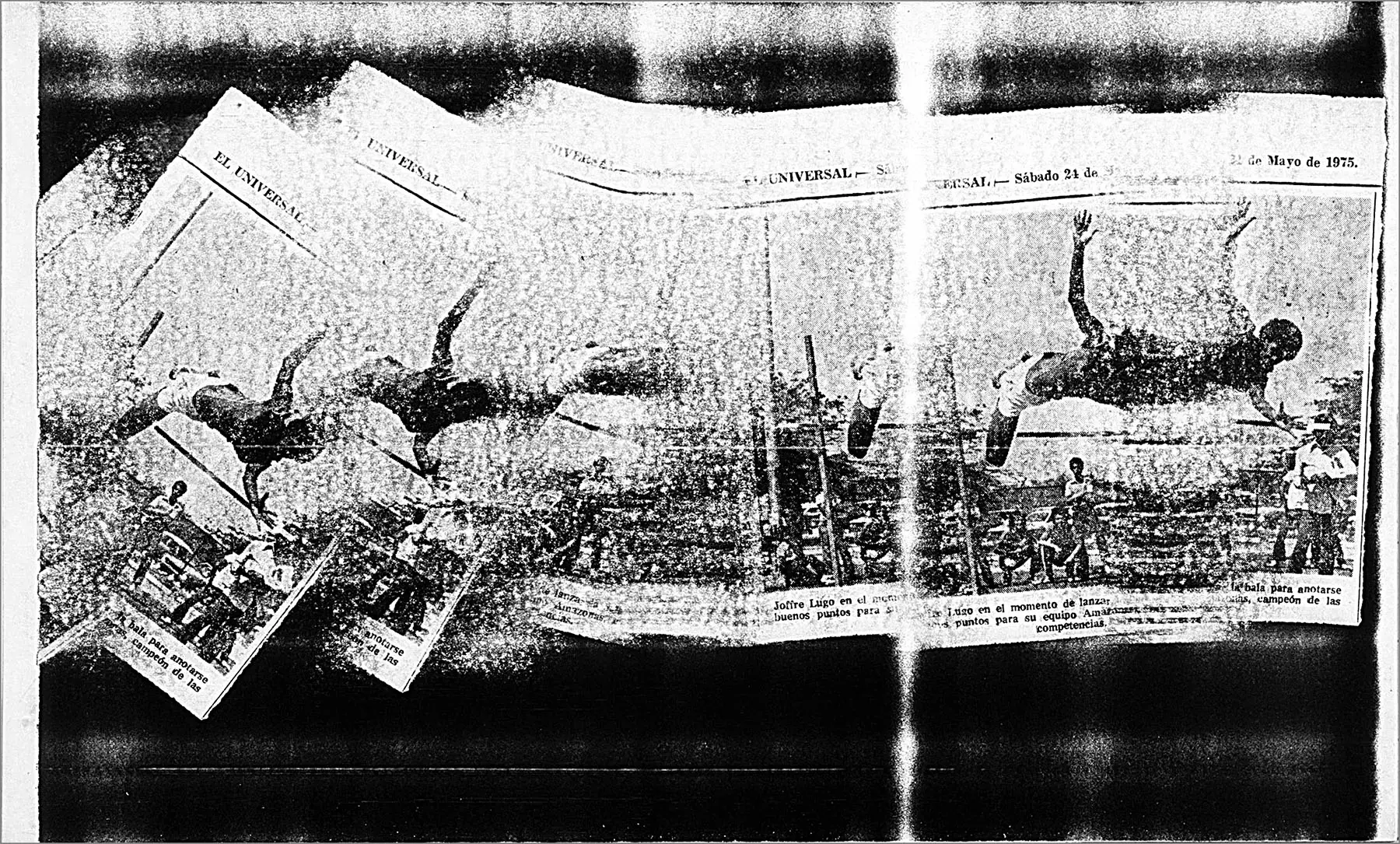
In some cases, the work we see is a reflection around the medium that defines it, as for instance in De la serie Lanzamiento de la bala, by Claudio Perna, which brings forth one of his most persistent concerns: the illusion of motion created through the manipulation of the image in Xerox machines.
Perna produced these nine 1975 works by means of the physical displacement of a newspaper’s pages of the photocopier screen, generating the illusion of movement by the high-jump athlete photographed by the paper and doubly countering the paradigms of the photographic medium by eroding, on the one hand, the notion of the photograph as a fragment of an unmoving, unchangeable reality, and, on the other, our perception of the copy as an identical reproduction of the original.
Almost thirty years later, Zeinab Rebeca Bulhossen’s video El Metro helps us reflect on the same idea from a different point of view: through a video register of a hand moving rapidly over two parallel lines, sequential photographs of Caracas’ underground train coaches. Here, the illusion of movement reveals itself fictitious: the video doesn’t show the “real” object in its trajectory, but the recording in motion of a recording of motion. This is the course of audiovisual time as a document of the induced, mechanical locomotion of many still fragments of photography.
In other works, the link between the video and the installation space is the object itself, a characteristic feature in many Venezuelan video-art works from the 1990s and early 2000s. Such is the case of Mano Poder, by José Antonio Hernández-Diez , and La extracción de la piedra de la locura (Hospital São Pedro), by Javier Téllez.
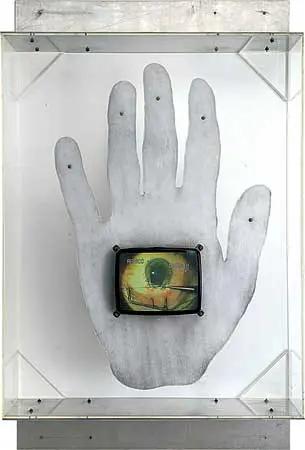
In Hernández-Diez’s Mano Poder, a large aluminum hand—ascetically framed by an acrylic box—holds on its palm a TV monitor, which in turn presents an eye undergoing a cornea transplant operation. The object harks back to the Arab-Jewish amulet known as Jamsa, albeit hollowed of any divine significance to appear as an embodied, visceral version of a paradoxically blind organ.
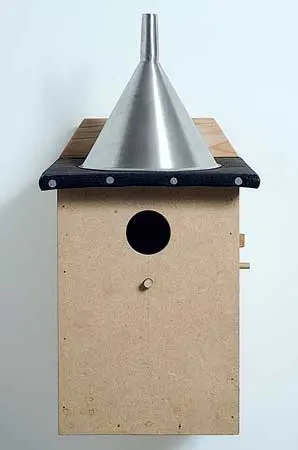
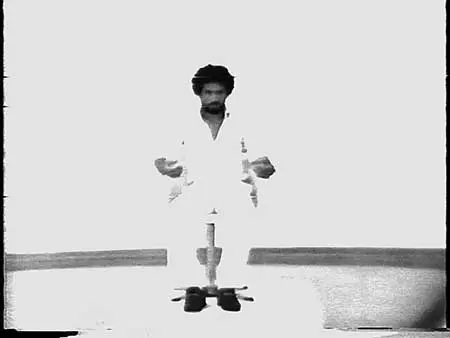
In Téllez’s La extracción…, a birdhouse and a metal funnel are both a direct reference to the work by Hieronymus Bosch that accompanies them—the celebrated Extraction of the Stone of Madness, here intervened with pills—and the container for a recording of the repetitive movements of a psychiatric patient in a Brazilian hospital.
This triad image-object-video establishes a trajectory for the gaze, which must peek into the birdhouse in order to see the video and back out of it in order to see the work as a whole. This replicates the interior-exterior motion between mind and body, between essence and appearance, sowing doubt in the viewer as the thin line that separates sanity from madness is blurred.
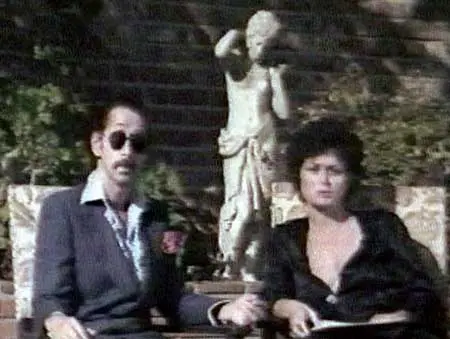
In other works, the medium has been used as reflection centered on the art world’s own power structures, and the participation of the viewer in them.
Pedro Terán’s Blancas paredes is comprised of two projections on adjacent walls: the first one is a recording of empty walls as the Museo de Bellas Artes—part of a similarly titled exhibition at the MBA in 1976; the second one is a real-time capture of the viewer watching the video at Espacio Mercantil. What is, then, the work of art? An object hanging from a wall? Or is it perhaps an interaction, a dialog between audience, space, and artist at a given point in time?
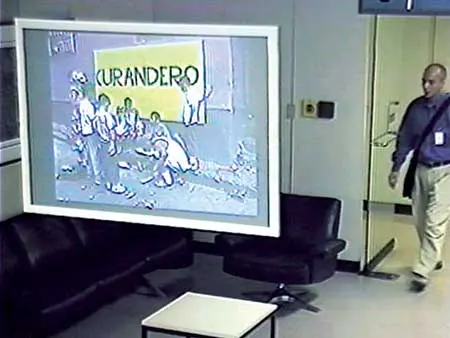
Circuito cerrado. Estética de la seguridad (2004) is a recording of an action by Juan Carlos Rodríguez, who positioned throughout Banco Mercantil’s closed-circuit surveillance system recordings from Con la salud sí se juega (2001-2002), a community experience with the people of La Plazoleta neighborhood, centered on the state of the public health system on the basis of the words curar (“to cure”, but also “to curate”) and curaduría (“curatorship”). In this way, Rodríguez posits a parallel between the protection offered by the security system and the care that a collection has with its works of art.
This exhibition—across the different generations of artists it includes—asserts, on the one hand, the radical currency of audiovisual media, and on the other allows us to follow an interesting path through the various means of expression used by the photographic support and by video over four decades of artistic investigation.
* All images in this article are photos by Walter Otto. Courtesy: Colección Mercantil.
COSTANZA DE ROGATIS