
The exhibition is on an open stage. Without walls or museographic elements to fragment it, the space unfolds and operates as a laboratory, ideal for experimentation and for the interaction between artwork and audience. Noticeable from beginning to end is an environment that eschews the museum’s didactic, informative tone and instead moves towards the display strategies characteristic of stores or workshops offering their public a large repertoire of products. Without technical cards, thematic nodes, or explanatory texts, our observation focuses on that which the works themselves express through the materials used, and on the distortion the art generates between form and function. We are free to walk around the space, but the presence of a red wall in the back of the gallery is perceived at all times; it seduces and attracts like a large magnetic field. As we come closer to this scarlet-colored surface, it becomes clear that Edgar Orlaineta (Mexico City, 1973) has worked on every element of his exhibition in painstaking detail, and that this is the result of many years of investigation on the history of industrial design and on the many connections between this discipline and modern art, as well as manual craft. This kind of long-term, the meticulous historical investigation is often a double-edged sword in a contemporary artist’s practice. In some cases, stasis is evident and there is no more resource than to repeat, with slight variations, the same conclusions reached years before. In other cases, this insistence on a specific field of research and its visual potential generates, suddenly, a rare capacity for freedom, for breakthroughs, and especially for play and for disrespecting in a way every achievement so safely tucked into the comfort zone provided by the recognition garnered by the artists. In this exhibition, Orlaineta has freed himself from Orlaineta, and he has done so in an unimpeachable manner. The sources remain clear, as do his references to period designs and their authors: Charles and Ray Eames, Harry Bertoia, Marcel Breuer, Tapio Wirkkala, among others. Nevertheless, Orlaineta’s intervention on these furniture items, especially chairs, has moved from being a conceptual gesture that subtly cancels functions and refers to a post-war ideology, to being an artistic oeuvre that expresses, interrogates, and captivates us beyond its historical referents and beyond any association of its language with minimalism and conceptualism.
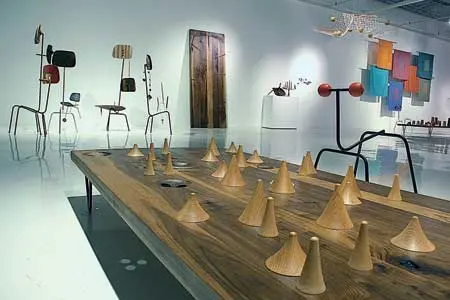
A key point in this turn is the frank dialog established by Orlaineta not only with the industrial designers mentioned above but also with visual artists like Alexander Calder, Constantin Brancusi, Isamu Noguchi, Joan Miró, and Paul Klee, among others. And the new assemblage doesn’t end there: also present are a number of elements and materials from the world of handicrafts. The coexistence of all these elements flows throughout the exhibition like a festive gathering of characters and families in a public park. The expressiveness and spontaneity of each one of the works function like an irresistible invitation for the viewer—who in this case is more a citizen than a viewer—to join this gathering, the playful nature of which does not exclude but rather reaffirms the political dimension of industrial design and its connections with other disciplines. In a way, Orlaineta’s hybrid characters and the way in which they break down and multiply the implications of a “simple” everyday object remind us of these words by American political scientist and philosopher Sheldon Wolin: “Design is a professional euphemism to talk about control of people and things. A euphemism for power.” 1 Underlying the naïve nature of Orlaineta’s work is a critical posture that signals precisely towards the parameters imposed by a system that understands design as a tool for domination, both at the formal and the intellectual level. His works, or to be more precise the installation of his works in this exhibition, create a series of topographies and archipelagoes in which it is possible to detect and appreciate the undeniable aesthetic, sculptural dimension in the design of functional objects.
Another relevant aspect of the show is Orlaineta’s incorporation of a variety of elements rooted in the Surrealist legacy: through it, Orlaineta gives his work an oneiric, psychological veneer, in strong contrast with the functionalist discourse. In the same way, this decision gives the work a psychoanalytical side connected to the creative act and to childhood. In that sense, there is a connection with this testimony by Louise Bourgeois: “The source of all the work I have made in the last fifty years, of every theme, is rooted in my childhood. My childhood never lost its magic, or its drama.” 2
Finally, Daniel Garza Usabiaga, curator of this exhibition, remarks on the connections established here by Orlaineta with Isamu Noguchi’s key ideas. “The project as a whole seems to hark back to Noguchi’s notion of the ‘free form’. More than a merely formal matter (like biomorphic solutions), the concept of the ‘free form’ contemplated the design of objects with solutions that are capable of evoking multiple references and allowing free associations.”
NOTES
1. The Great Method. Casco Issues XX. Edited by Peio Aguirre and Emiliy Pethick, 2007, p. 57.
2. L’artiste et le psychanalyste. Joyce McDougall. Presses Universitaires de France, 2008, p. 119.
VÍCTOR PALACIOS