
Enrique Ježik (Córdoba, 1961) is one of the contemporary Latin American artists whose work centers on the multiple processes of violence and power and the relationship between both concepts. Ježik relies on the use of heavy machinery and armament to complete his pieces. The resulting industrial aesthetic stamp conferred to his entire work serves him to question the most representative elements of modernity.
The exhibition entitled Six actions offers a selection of pieces created by Ježik between his arrival to Mexico in 1990 and 2013. This production includes the very first piece he created in Mexico in 1990, four actions from the 2000s, and the piece Aguante (Resistance) from 2013, which received the arteBA – Petrobrás Award.
One of the pieces included in the exhibition, SOS (2002), was originally created for the Le Confort Moderne art center in Poitiers, France, where Ježik perforated the floor of the gallery—with the hydraulic hammer of an excavator—as he used the noise created by the hammer strikes to reproduce the Morse code call for help. In this piece, as in many others, the artist showcased the tension between the imposing action performed by the heavy machinery and the subtle abstract gesture involved in the Morse code language.
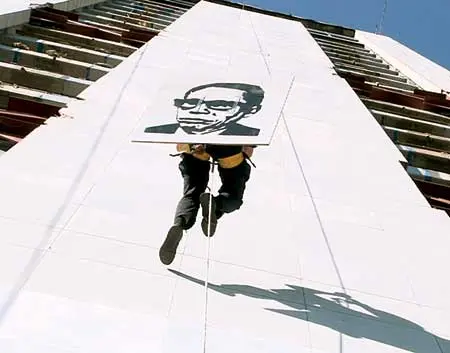
Another work that is part of the show is Acción dos de Octubre (Action October Two, 2009), a piece that Ježik created as an exercise in criticism and historical memory that involved remembering the 1968 massacre of students in Mexico. For this project—created in collaboration with Redas Diržys—the artists climbed the building that was once the headquarters of the Mexican Ministry of Foreign Affairs located in the Tlatelolco neighborhood in Mexico City at the plaza where the massacre occurred in 1968. They carried images of Gustavo Díaz-Ordaz and Luis Echeverría—at the time the President and the Interior Ministry, respectively, and the two persons responsible for the massacre. When he reached the top of the building, the artist destroyed the image of Díaz-Ordaz. This action achieved important symbolic value because it was performed in front of the participants of the yearly march, organized to commemorate the event, and to maintain it in the collective memory to prevent it from happening again. The building that they climbed has a symbolic meaning of its own. Created during the 1960s, its modernist architecture embodied a moment in the history of Mexico under an apparent economic growth that crumbled, like the building—by 2009, at the time of the action by Ježik, all of the building’s windows were broken and it was perceived to be in a complete state of disrepair.
During that same year, Ježik exhibits Seis Metros cúbicos de materia orgánica (Six Cubic Meters or Organic Matter, 2009), a work that relies on citation for its formal structure. The artist directly references the work Asphalt Rundown (Italy, 1969) by Robert Smithson, where a truck spills asphalt on a hillside. Ježik’s version substitutes the asphalt with animal remains, obtained from the municipal slaughterhouse in Ciudad Juárez, to pay tribute to the victims of violence in Mexico. The piece was created in one of the cities (Ciudad Juárez) with the worst rate of violence in recent years. Thus, the impact caused by looking at that organic mass in a ravine of that city, irremediably calls for reflection about the meaning of so many deaths and of that reality, both for the society at large and for those in power.
Lastly, there is the record in the video of the piece entitled Aguante (Resistance, 2013), in which Ježik and others create five “exercises” of opposing forces—human force against mechanical force—that propose the possibility of social resistance against excessive power. This piece reflects on the asymmetrical nature of power relations but, most importantly, it deliberates about the organizational possibilities of individuals to build a collective resistance against the exercise of excessive power. It should be pointed that this is the first time that this piece is presented in Mexico.
The exhibition Six Actions by Enrique Ježik represents a good selection of works that enable visitors to understand in a comprehensive manner the conceptual and aesthetic proposal offered by an artist that throughout his career has expressed concerns and interests surrounding reflections about violence and power, through metaphors in which the great power that the State sometimes is able to accumulate, is embodied in large machines capable of squashing the individual, as collective action becomes the only option left to counteract such power.
JOSEFA ORTEGA