
The Los Angeles County Museum of Art built an important bridge across the Mexican border to stage this exhibition, part of its new emphasis on the art of cinema. Across 11 projection screens and 9 video monitors, the museum presented the creativity of Gabriel Figueroa, Mexico’s best-known cinematographer. The exhibition included 350 items, archival documents, posters, stills, paintings, and prints, in an effort to place him in a context that included other arts. With a few minor reservations, the show is an absorbing success.
Curator Alfonso Morales of the Televisa Foundation, which holds Figueroa’s archive, divided the material into nine thematic alcoves. Some of these are Revolution, Landscape, El Charro, Metropolis, and Color; each had at least one monitor and projection screen. The exhibition shows that Figueroa was one of the most important figures in the Golden Age of Mexican cinema (the 1940s-50s) when he worked on the majority of his more than 200 films. Twenty complete films were also projected in a series in the museum theater.
The exhibition highlights important conjunctions between Figueroa’s cinema and the visual arts: Producers commissioned Leopoldo Méndez to create linocuts based on memorable shots, which served as the background for the title credits for six films; several of these prints are displayed along with clips from the films. We also see some of José Clemente Orozco’s lithographs on revolutionary themes, near screens where scenes from films such as Los de abajo are projected. Scenes from the 1944 María Candelaria, a radiant tale of a poor family of flower-sellers, are on view near one of Rivera’s paintings on the same subject. The cinema that Figueroa created, working alongside directors such as Chano Urueta, Emilio Fernández, and Roberto Gavaldón, probably did as much as mural paintings to form the Mexican consciousness. The film is, after all, a highly popular and available art form. Rivera himself recognized this, as he once described Figueroa’s work as “murals in motion” (murales ambulantes). This exhibition potently supports that point, elevating cinema to a level equal to the painter’s art. Figueroa also said that he learned from the muralists, describing them as “my teachers in the manner of seeing men and things” (maestros míos en el modo de ver a los hombres y las cosas).
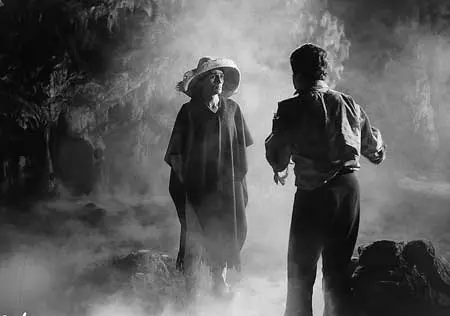
Many of Figueroa’s scenes repay this attention because they are wonderfully composed and beautifully lighted. His 1960 film Macario is based on a tale by B. Traven about a poor woodcutter who longs to eat a freshly roasted turkey all by himself. When he finally gets it, he is visited by three spirits who ask for a share: the Devil, God, and Death. Macario’s final encounter with the latter is the most poignant, as the hollow-cheeked figure appears under a tattered straw hat outside the misty cave of Cacahuamilpa in the province of Guerrero. Figueroa crafted this location shot in a highly expressive fashion, with finely adjusted light that falls on the back of Macario, on the passing mist, and on the craggy cave wall.
One of the thematic alcoves tells the story of Figueroa’s ambivalent relationship with Hollywood. He had perfected his trade north of the border, as an apprentice to the master Greg Toland in 1935. Returning home, he took those skills in a more expressive direction in films such as Noche de los Mayas, Los de abajo, and María Candelaria. In the years after World War II, he shot two important films in Mexico for U.S. distribution: The Pearl, based on John Steinbeck’s novella, and The Fugitive, which director John Ford frequently described as his favorite of all his movies. On the death of Toland in 1948, Louis B. Mayer invited Figueroa back to Hollywood with a lucrative contract, but Figueroa preferred to remain in his homeland. Elia Kazan also invited him to shoot a new film about Emiliano Zapata with Marlon Brando in the title role, but he declined that as well. Soon after, Kazan denounced Figueroa as a communist sympathizer before the House Un-American Activities Committee. Because of Figueroa’s commitment to union labor practices, the FBI also investigated him. In later years, he worked with North American directors on films such as Under the Volcano, Night of the Iguana, and Kelly’s Heroes.
The exhibition makes its case in a highly absorbing and informative fashion, but there are two caveats: Most of the film clips, presented either on screens or on monitors, flow one after the other with no labeling of which film they came from. This creates confusion among the vast number of viewers who may not already know Figueroa’s work. Secondly, the museum did not publish a printed catalog, frustrating those who may have wanted to learn more. In general, however, the exhibition is a good example of how to exhibit the film in an art museum.
PATRICK FRANK