
Last year while living less than five miles from a postcard-perfect beach and spectacular sunsets, in the southwestern tip of the island of Puerto Rico, Gamaliel Rodríguez made a bleak, haunting image that probes my mind. It is the unforgettable opening scene of his first one-person museum exhibition titled Fallout. Figure 1708 (2012), the first work that confronts the viewer, shows two human beings in hazmat suits walking towards the spectator and carrying a bomb-shaped canister that is spewing white gas. Their relaxed, casual postures suggest this is a common and routine activity. This enigmatic and ominous image raises several questions that ultimately are never answered. Where are we in time and space? What is happening? What is that ambiguous black mass in the distance? This is the first and last time in the exhibition viewers will see depictions of human life, and perhaps even feel earthbound. In the next gallery, the artist sweeps the spectator up into the sky and gives him a satellite view of five industrial chemical sites.
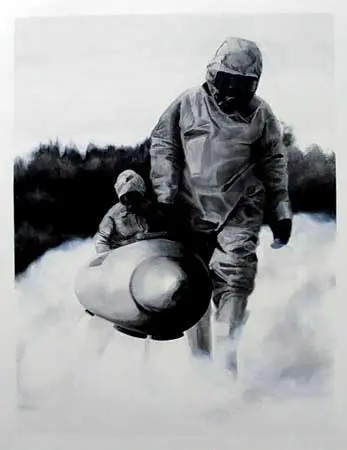
Fallout features six black-and-white, photorealist works from Rodríguez’s Dark Thoughts series. The single canvases stapled to the wall, and stretched canvases sometimes presented in a grid format, range in size from 18 by 20 inches to 96 by 120 inches. For the first time, the artist is using indelible ink markers and highly diluted carbon black acrylic paint. These materials give Rodríguez the right amount of control and freedom to imbue his work with a deeply atmospheric feel. He alternates the act of drawing and painting by first drawing on the paper-smooth surface of the canvas and then applying the watery acrylic paint with a sponge.
From a distance the canvases look like paintings, however, the artist refers to these works as drawings. Their soft, subtle gradations and deep, rich black tones recall mezzotint prints. Upon close examination of Rodríguez’s surfaces, one marvel at the artist’s exquisite technique—thousands of black lines, about one-thirty-second of an inch apart, depict everything from metal surfaces, to water, to shadows, to abstract fields. Scaffolding around tanks, pipes, and equipment seems to exist for the joy of drawing.
These retro-futuristic industrial sites question our perceptions of time and reality. All of the black-and-white works have a white border around them which suggests an old photograph. As curator Juan Carlos López Quintero states in his essay, Rodríguez’s drawings and the title of the exhibition “...transport us back to those angst-ridden years of the Cold War.” Yet, these images that combine the promises of technology and the lurking fear of what if something goes wrong, also capture our current reality.
The industrial sites are curious because they look abandoned, yet nothing has deteriorated. Perhaps everyone is underground. Environmental contamination appears rampant. Water used perhaps in cooling processes at the plants, as well as rivers and coastlines is black. Small dark clouds, like balls of cotton, suggest sparse vegetation, combustions, and polluting particles. Most of the drawings have one structure Rodríguez has seen--a tower in the Czech Republic, a church in Puerto Rico with an underground bomb shelter--but the industrial sites are largely imagined by the artist like a labyrinth of forms.
For the last eight years, Rodríguez’s installations, paintings, and drawings have posed the question, “What does military and industrial power look like?” From 2009 to 2012, for his Figures series, he painstakingly drew newly developed firearms, centers of intelligence, and massive energy-producing operations with a blue ballpoint pen on paper. Beneath the isolated object, the artist posted a kind of identification label made with a manual typewriter indicating the title of the work and a brief description of its subject, thus suggesting the drawing is part of a classified dossier from a distant past. Rodríguez’s new work in Fallout embraces mystery and leaves more to the viewer’s imagination. In the Figures series, the artist’s clinical representation of an object floating in space distanced the spectator from the subject. In the recent Dark Thoughts series, Rodríguez expands space by presenting a variety of oblique airborne angles that invite the viewer to free fall into his drawings.
As I moved from one aerial view to the next, I started to feel like I was one of the descending particles in a fallout. In the last drawing of the exhibition, Snapshot No. 10001 (2012) Rodríguez brings us closer and closer to the ground and to his sensuous inky surfaces, until we are subsumed by a dark field reminiscent of a Mark Rothko black-on-black painting. It is here where images of contamination and lifelessness are transcended by the artist’s soft, delicate lines marking time and a human presence.
CHERYL HARTUP