
New Yorkers visiting the exhibition The Diaries by Guillermo Kuitca witnessed a serene experience that also became motivating from the moment they entered the expanded space of The Drawing Center, in New York City. The institution continues to be located at its original address in SoHo, with the same façade and sober and solid interiors. It was nonetheless expanded and its real estate has increased by fifty percent. The revamped venue reopened with the exhibition by Kuitca. Spectators were introduced to an exhibition of mixed media proposals that are resolved in tondos (round-shaped artworks). On this occasion, “time” is the vector that serves as the link between the institution and the artist. Kuitca’s artistic career began quite early in his life. By the age of 13, he presented his first exhibition. He survives his early success through consistent international recognitions. Even the title of the exhibition, The Diaries, reveals an artist that is capable of visual expressions outside of his celebrated operatic series, of his mattresses and maps and everyday scenes. The Diaries are clearly more abstract works compared to his earlier oeuvre but are also freer in that they reveal in some sections an experimental element.
The Drawing Center is a non-profit organization with more than half a century of existence. It is the only cultural institution in the US completely dedicated to drawing, and as such, it has succeeded in expanding, every time with more poignancy, the notion of what drawing stands for as an artistic discipline, through the presentation of rich, innovative, and purposeful exhibitions that succeed in striking a balance between the solid with the unconventional.
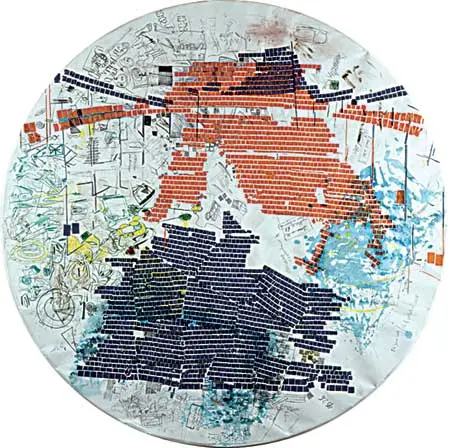
Going back to the idea of “time” as a link, let’s agree that The Drawing Center has shaped itself into a museum through its historic discourse. It has become a place for developing and emerging artists as well as for well-established masters at the height of their creative powers. Guillermo Kuitca turned documental and unfinished works into The Diaries, where doodles, date, and phone number annotations record the activities of the artist in his studio. Kuitca recycled half-finished canvases in the middle of the process and stretched them again on round tables to reveal in them the story of a number of days. These are works structured by life, by accidents, by a certain kind of loneliness where technology is not predominant. By interconnecting its parts with a kuitcanian harmony, each tondo acquires an identity that is different—and thus their reading less repetitive—from the other tondos in the series. The colors are subdued but the complementary ones interact well with the whites. There are also some works with very dark and even semi-monochromatic palettes. There are flyleaves, blueprints of concert halls with blocks of seats superimposed, as well as numbers, letters, and, occasionally, formulas.
The 17 Diaries by Kuitca are circular. No matter how obvious it may be, it is necessary to mention it: symbolically, they allude to the cosmos, they are closer to organic forms in that they lack straight angles and combine elements from drawing, painting, and some integrated papers. Besides painting, Kuitca has also worked in set design for theater. In this sense, the tondos exhibited at The Drawing Center in New York can be compared to the communication that flows when a good screenplay that is well-interpreted places both the public and the actors on the same wavelength. Kuitca spent several months working on each “diary.” Kuitca spent an average of six months on each work, doodling, scheduling appointments, logging phone calls, drawing forms while on the phone. He would also give them his undivided professional attention to finally complete them with his signature. Like in Diario (1 de Julio al 16 de Octubre de 2008) [Diary (July 1 to October 16, 2008)], with its barely ashy white surface, the grades of orange and blue alongside loose dispensing forms, everything flows with impeccable informality in all the works.
To conclude, we celebrate that after having announced that it would increase the number of exhibitions by Latin American artists, The Drawing Center true to its word reopened its doors with 2 of its 3 exhibition areas dedicated to the works of two Latin American artists: Colombian José Antonio Sánchez-Lodoño and Argentinean Guillermo Kuitca. This exhibition and its accompanying catalog were made possible with the support of Solita and Steven Mishaan, Cindy and Howard Rachofsky, Marlene Hess and James D. Zirlin, Bettina and Donald Bryant Jr., Charles Capenhoust, and an anonymous sponsor. For the Latin American programming, Felisa and Diego Gradowczyk, and Isabella Hutchinson provided their support through the Mario Gradowczyk Public Program Series. With The Diaries Guillermo Kuitca inaugurated a walk through “time” with works that had dated for titles, like the one called Diario (25 de Mayo – 20 Octubre 2005) [Diariy (May 25 – October 2005)], the same year when the artist began the series that he completed in 2012. In these tondos, the author conserves his drawings, doodles, and the consistent curve that is resolved with mixed media. Intimacy and magnitude are equally perceived in these Diaries that measure 47 ¼ in / 120 cm in diameter by 1 5/8 in / 4 cm deep.
GRACIELA KARTOFEL