
The questions posed by Virgilio Piñera in La Isla en Peso (The Island in Weight)1 are back with the relevance of the poetic inquiries and formulations of that poet’s shout; and so is the awareness and anguish of Del agua por todas partes (Of Water Everywhere). That “cursed” circumstance (or singular destiny) suffered by islanders was a central element in Offerings, the exhibition presented by Ibrahím Miranda at El Reino de Este Mundo, the gallery of the Biblioteca Nacional José Martí. The exhibition space of the national library in Havana was chosen by the artist because of its symbolic meaning: a space for the national memory, for the archiving and record of knowledge, an effective counterpart to dialogue with the chronicle that is Miranda’s work.
The monographic nature that Miranda infused in Offerings, turned it into an essay that defined the science of his discourse through images, in a manner that suggestively included several periods of his artistic endeavor along with the resources placed at his disposal. A concise synthesis that presented almost twenty years of work by Miranda that is characterized by its autobiographical nature. Thirty-six works were presented in an intimate atmosphere that sustained that moment of reflection. A narration that dated back to 1994 when the artist moved to Mexico and began working with Galería Nina Menocal, following his graduation from the Instituto Superior de Arte (ISA) in 1993. The meaning of that period in his life and work was suggested in the choice of the title of the exhibition. Offerings made a connection to the offerings of gratitude to the deities that are part of the Mexican tradition. Nonetheless, that approach has been an element present throughout Miranda’s artistic production as an offering that is appreciative of the possibility of creating and expressing himself.
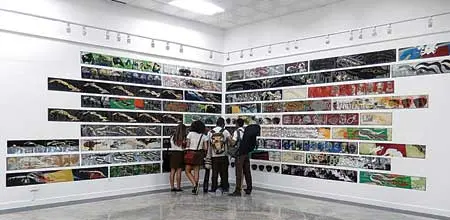
The exhibition began with a group of canvases painted during that residency that had never before been exhibited in Havana. These works addressed the cartographic image of Cuba that has been continuously transfigured by Miranda’s hand. The walk through the exhibition that pertained to the representation of the island and expanded in multiple metamorphoses also appeared as part of the recent work Miranda created at Graphicstudio in Tampa, in the US. There he worked with other types of engraving that are more socio-political in nature. The exhibition also presented works that addressed the themes of insularity and exodus in the Caribbean country and emigration since the independence wars from the nineteenth century. In this segment of the exhibition stood out the turmoil of the 2002 serigraphy titled Lágrimas Negras II (Black Tears II), the 2012 serigraphy Dumbo y los Caramelos (Dumbo and Sweets) and, also form 2012, the xylography Malentendido (Misunderstanding), a work in which it was possible to appreciate the utilization of new iconographic elements.
The paintings created in Mexico revealed the dramatic quality and mythic recreation that characterized his xylography and linoleum engravings from the 1990s, as they also shared with those earlier works—but in a different expressive order—the leading ink played; a fact that could be appreciated in the 1994 works Patrimonio Sentimental (Sentimental Patrimony), El Indeseable (The Undesirable), Adagio en la Colina (Adagio on the Hill), and Cyberspace, and in Destierro al Panóptico (Exile from Panopticon) from 1995.
Although the survey proposed in the exhibition outlined several periods in Ibrahím Miranda’s career—and from his life experiences—not all of them were explicitly shown. In addition to the ink drawings and paintings, the show also included some of his weavings, along with several transfigurations of the Cuban map arranged in groups, as well as engravings and a large installation.
Standing out among the series shown was Islands (1-6, 2000). There the island of Cuba was revealed on maps with different zoomorphic forms similar to unicellular organisms. Whether transformed into a movement-capable being—through the addition of flagellums—or fragmented, the body of the country was observed by viewers as the ink and mercurochrome were combined to achieve the expressionistic effect present in the works by Santiago Armada (Chago) from the 1960s. Nonetheless, the island—in a space abundant with works that described landscapes, beliefs, and everyday life—emerged there in more than one shape: as an alligator in Metamorphosis (2000), a bestiary in the book project Huracán (Hurricane, 2000), and migrating creatures in Adagio II (2013). The island was also multiplied in the great conglomerate of an installation that approached the public with its imposing presence. Part of the series entitled Dissipated Life (2010-2013), this installation would show Miranda’s beings-islands from time to time, thus placing us back within the boundaries of insularity, philosophy, identity, and also an obsession. The existential challenges of the islanders amid that symbolic ocean possessed a lyrical colophon of its own. The graphic image constructed by Ibrahím Miranda on the subject was influenced by the Grupo Orígenes, José Lezama-Lima, and other poets. Insular Night. Invisible Gardens written by Lezama-Lima and The Island in Weight by Piñera were among the logbooks from that journey that was Offerings.
NOTE
1. A 1943 poem by the Cuban playwright, writer, and poet Virgilio Piñera (Cárdenas, 1912 Havana, 1979).
CARIDAD BLANCO DE LA CRUZ