
The 9th Bienal do Mercosul, which opened last September 12th, presented its audience with a reflection around its motto, Weather Permitting (Se o Clima for favorável in Portuguese; Si el tiempo lo permite in Spanish), intended to suggest that different climates—atmospheric, emotional, political—are at the core of the project. Artistic Director and Chief Curator Sofía Hernández Chong Cuy explains that the term climate does not imply solely an environmental and economic concern, but also material, physical, and psychological substance that affects living persons. According to her, a climate’s impact is similar to that of a language, processing ideas into images or articulating figures of speech that express emotional “atmospheres” and political “climates.” To that end, and seeking to illuminate for the visiting audience those “atmospheric disturbances,” Hernández proposed, along with her working team,1 the shaping of three public initiatives: Portals, Forecasts and Monotypes, an exhibition of contemporary art in four separate venues; Island Sessions, a discussion and publication series taking place as the biennial was underway; and Cloud Formations, a broad-spectrum arts pedagogy program addressed to the state of Rio Grande do Sul, home to the event, in its entirety.
The 9th Bienal do Mercosul focused its strategy on the binomial nature culture and brought it together with historical artworks and contemporary creations, most of which were developed specifically for the event. This took place as part of a program titled Imagination Machines, established in collaboration with companies, research centers, and communities in Brazil to promote artists' residences and the possibility of creating works conceived specifically for the biennial. The program’s main focus was the connection between art and technology. The principal reference point was Art and Technology, a pioneering project developed during the 1960s at the Los Angeles County Museum (LACMA), in the United States. Research on exhibitions like Experiments in Art and Technology was also carried out in the archives of the Getty Foundation and Tate Modern, intended to promote the program of creation of art-and-technology works for the 9th Bienal do Mercosul.
The Imagination Machines program, says curatorial-team member Bernardo José de Souza, was a device designed to share information and to rearticulate concepts and working dynamics that are essential in the creation of works of art using high-tech elements. In that sense, the four decades intervening between LACMA’s pioneering event and the 9th Bienal do Mercosul evinced the process of transformation of notions of economic advance, scientific progress, and technological development.
The biennial’s curatorship was intended to identify and propose a reformulation of our understanding of systems of experimentation and innovation, looking at natural resources and material cultures in a new light. And it sought to speculate on what lies at the base of the difference between discovery and invention. The goal was to raise ontological and technological questions based on artistic practices.
The slogan Weather Permitting, proposed by Chief Curator Sofía Chong Cuy, moved in that direction, prompting mainly experimental works of art intent on re-thinking the scope of technology’s impact and also, in some cases, projects that spotlighted the consequences of technology for the natural world.
Commenting on some of the works on exhibit will allow us to deepen our understanding of the spirit of this edition of the Bienal do Mercosul.
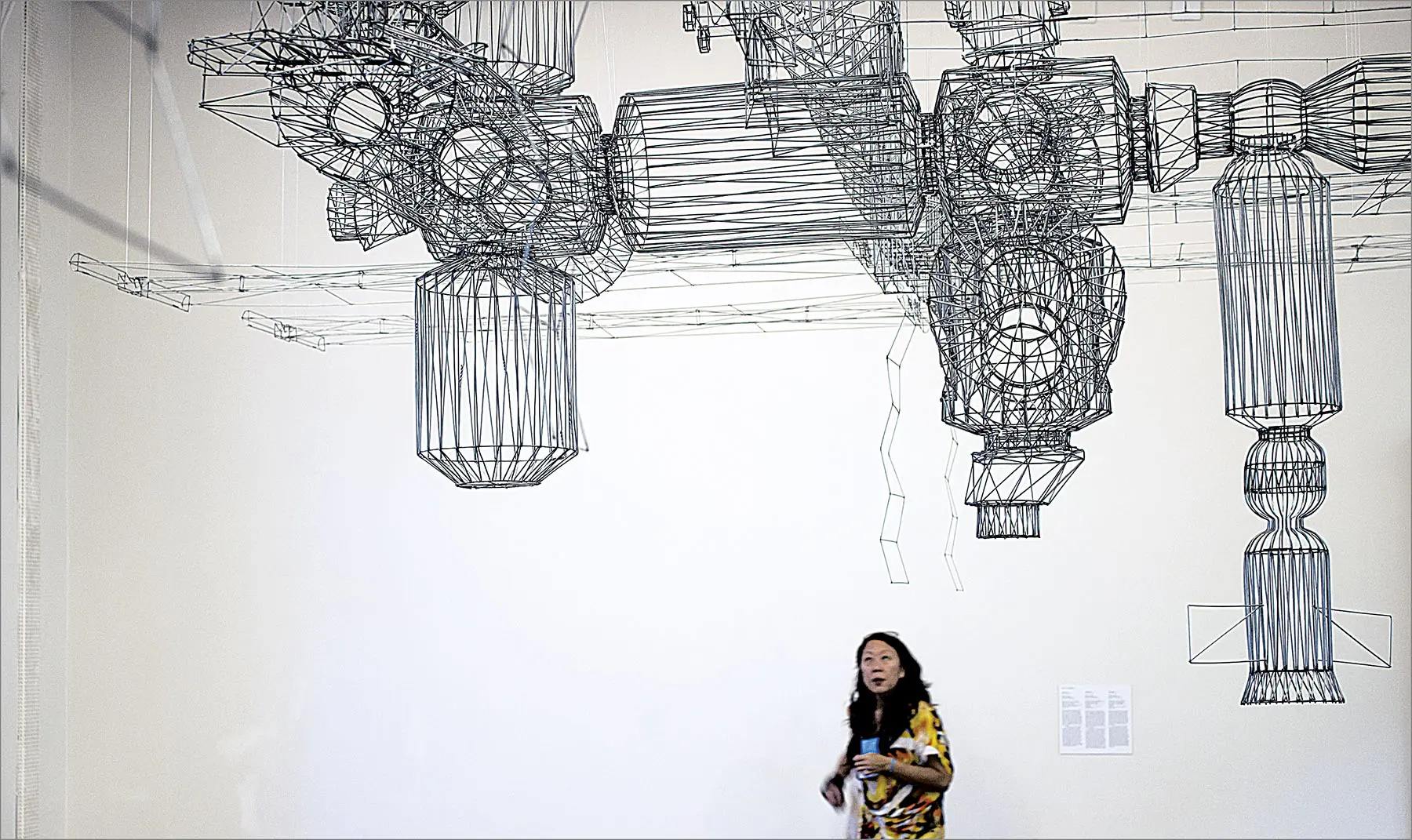
Allora & Calzadilla (Allora: Philadelphia, USA; Calzadilla: San Juan Puerto Rico) participated with Ten Minutes Transmission, from 2003: an antenna for communications with the International Space Station (ISS), comprised of hundreds of wire hangers, a radio ham system, and a computer program. It is a “sculpture-station” designed to establish contacts. Every 90 minutes, the ISS completes one orbit around the Earth and becomes accessible for ten minutes at the coordinates where the antenna is located. At that time, communications can be initiated. For the remaining time, the antenna captured radio frequencies that could be listened to by visitors to the exhibition.
This work contains a powerful critique of the control of communications in space, but it also demonstrates a non-official, non-governmental option for access to that very space that others want to regulate and control.
Another example of a proposal created in the context of the Bienal do Mercosul’s Art and Technology Program is connected to a project by Rodrigo Derteano (Geneva, Switzerland; lives and works in Lima, Peru). In his presentation for this biennial, the artist was supported by Peruvian critic Jorge Villacorta. The title of the proposal, Alta tecnología andina, refers to the program of a cultural, non-profit NGO established in Peru and focused on contributing to the development of an electronic-media culture.
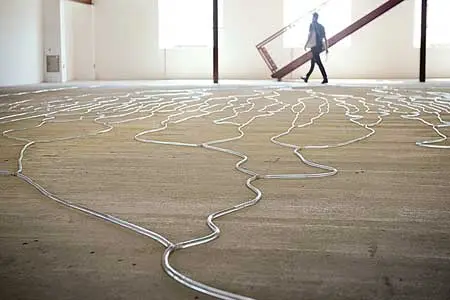
Derteano and Villacorta worked on the former’s Ciudad Nazca project, inspired by the Nazca Lines, ancient geoglyphs carved on the surface of the Peruvian desert by the Nazca civilization. The project involved programming a robot vehicle to trace the map of an imaginary city in the desert, describing its expansion. This imaginary city was traced in the area of Huarmey and can be seen from a certain height, using Google Maps tools. The drawing of the Ciudad Nazca map will be erased by the wind, and it is not intended to leave any traces.
Audrey Cottin (Saint-Mandé, France; lives and works in Belgium) came to the biennial with Operating Theatre, a proposal solidly inspired on television serials and structured in episodes that reveal for the audience aspects of her performance art. Many of her actions are derived, in part, from research on dyslexia at the Brain Institute, but the artist also took into account the activities of workers at a resin, cellulose, and paper factory that opened her doors for her project. Cottin’s work was presented as “a process of collaborative action” including artists, professionals, or communities that contributed to the final result. In this project, Cottin recruited students and faculty from film schools, as well as actors and representatives of a company called IRANI. They all performed actions in her Operating Theatre. Cottin based her proposal on an old nineteenth-century practice where surgeons demonstrated their work in amphitheaters packed with students and spectators, and also considered recent protocols in the field of e-health. Her performance was streamed live via the Internet for the audience present in the different spaces of the 9th Bienal do Mercosul.
Beto Shwafaty (São Paulo) developed his work in remembrance of Adriano Olivetti, whose company manufactured the Olivetti typewriter, a mechanical object dedicated to alleviating administrative chores that also gave society instruments for entertainment and culture. The artist considered the expansion of the company during the second half of the Twentieth Century, after Adriano Olivetti’s death, as it attempted to gain a foothold in the emerging field of computers and electronics. Shwafaty’s observations focus on the potential for communication and the transformative social impact of Olivetti’s products.
Beto Shwafaty’s work was registered under the title Studies for the project Foundations of the Design Substance: Cultural Metaphors to Design a New Future, and was based on Olivetti’s image archives.
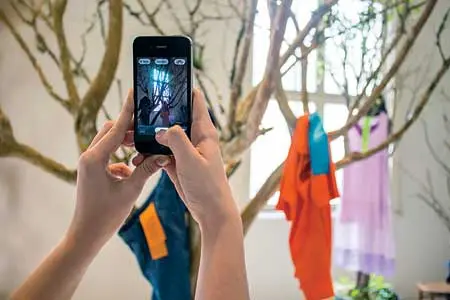
Cao Fei (Guangzhou, China; lives and works in Beijing) developed a proposal centered on manufacturing labor. He built an installation using trees from which he hung uniforms, photographs of workers, and drawings made by them between 2005 and 2006, a period when the artist interacted with employees of OSRAM China Lighting Ltd., in Guangzhou. Fei’s proposal was created in the context of a Siemens-sponsored project, titled What are you doing here?
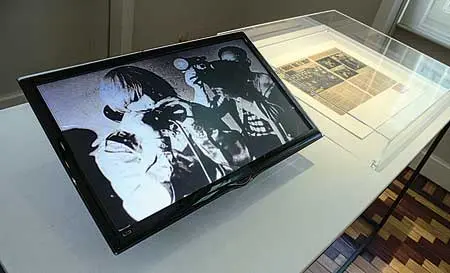
OSRAM is a Siemens subsidiary that established the Siemens Art Program in 1987 with the intention of promoting communications between its employees and Chinese artists. The idea was for the artists to work alongside OSRAM employees in that country in order to reflect on their work environment and their production system.
In Fei’s installation for the 9th Bienal do Mercosul, small texts with poems or brief narratives of dreams or utopias were on display in the walls surrounding the area where the trees with objects and photographs were located. There were also labels attached to the clothing items. All of this helped viewers imagine the lives of those workers as they took place during the period of the artist’s residence in the manufacturing plant, located in Foshan.
Cao Fei’s work also generated a video, Whose Utopia, with music intercutting the sounds of machinery at work.
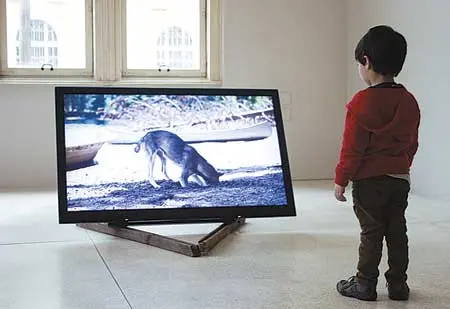
Daniel Santiago (Bogotá, Colombia) participated in 2012 in a residence program in Toronto, Canada, where he developed the project Tesoro, diálogo entre tiempos. Santiago produced a video dealing with five themes: the reproduction of a notebook used for the planning of the project, a sequence of images that catalog objects and records of a trip from Bogotá to Toronto, the action of sinking a ship and throwing the treasure overboard, a scene of a dog digging a hole as if searching for treasure. In this way, his proposal records the passage of time, coming across as a field diary with the memory of places traveled, the remembrance of lived experience where reality and fiction intertwine.
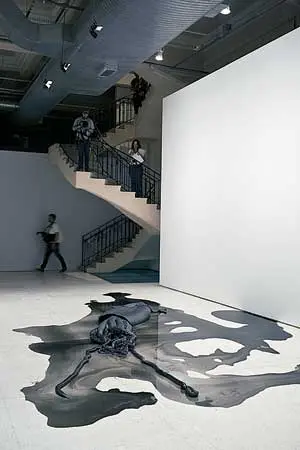
David Zink Yi (Lima, Peru; works and lives in Berlin) developed his proposal on the basis of popular fables and of the literary work of Jules Verne and Herman Melville about sea monsters that are difficult to find but, once encountered, create dramatic tensions. The character in his installation is a giant squid, a species that only reaches the shore in order to die. In truth, more than terror, the squid reveals perhaps the drama of extinction and loneliness.
David Zink’s giant squid weighs 300 kilograms and measures close to six meters. It was placed on the floor of the exhibition space, on an ink stain made from opaque resin. It is made in ceramic with copper and lead applications. The sensation of reality is intense for the viewer.
Guillermo Faivovich (Buenos Aires, Argentina) and Nicolás Goldberg (Paris, France; lives and works in Buenos Aires) have worked since 2006 with materials connected to the real and imagined story of a meteorite known as Mesón de Fierro, whose existence was documented by Spanish conquistadors in 1576 as they explored the region of Santiago del Estero and El Chaco, in Argentina. The conquistadors thought that the immense object had emerged from an underground deposit; thus the name they gave it. The meteorite has been the object of scientific speculation over the years. It is recorded in drawings, maps, and stories of expeditions, but it seems to have disappeared in 1783.
At the exhibition in Porto Alegre, the meteorite was recreated in spectral, discursive, and material shapes. Narratives from the past were revisited and read as part of the Island Sessions program of the 2013 Bienal do Mercosul. Faivovich and Goldberg created a large painting based on a 1983 drawing, which was included in the Portals, Forecasts, and Monotypes section.
This section, which featured contemporary and historical works, was held at the Museu do Arte de Rio Grande do Sul (MARGS), at Santander Cultural, at the Memorial do Rio Grande do Sul, and at the building of the Usina do Gasômetro.
To be highlighted are the historical artworks by Rauschenberg, Takis, Hans Haacke, Marta Minujín, and Mira Schendel. These were considered gravitational forces in the exhibition and their presence was highly attractive for visitors.
A series of performances marked the initial days of the biennial. They took place in public spaces, such as the Praça de Alfándega, where three of the institutions hosting the Portales exhibition; on the margins of the Guaíba river; and in other places such as the Usina do Gasômetro or the Casa de Cultura Mario Quintana.
The 9th Bienal do Mercosul presented 59 artists from several countries, not limited to Latin America. Each one of the spaces hosting the exhibition gathered between 10 and 15 participants, with wide spaces for the display of their work.
This biennial did not evince great concern for expography, a high point in previous editions, with projects developed by specialists and always adequate for the curatorial proposals. Expography is of great importance in offering viewers paths and circuits in the show, favoring the aesthetic experience that takes place during a visit. The 9th Bienal do Mercosul closed its doors on November 10th.
NOTE
1. The curatorial team working alongside Sofía Hernández Chong Cuy was comprised of Mónica Hoff, Raimundas Malasauskas, Bernardo de Souza, Sarah Demeuse, Daniela Pérez, Julia Rebouças, and Dominic Willsdon. Luisa Proença worked as editorial coordinator.
LISBETH REBOLLO GONÇALVES
Titular Professor at the University of São Paulo and President of the Brazilian Association of Art Critics (AICA/Brazil).