
El Museo’s 7th biennial marks some changes yet seems more interesting as is, than as it wants to be. It all depends on how you view it. I don’t recommend the institution’s public viewpoint, except to trust in the institutional strength of its curators Rocío Aranda-Alvarado and Raúl Zamudio, and in your own relationship with art. However, we first need to unpack some of the rhetorical flourishes and augment them with the background information variously available to avoid misdirection.
Now stripped of its (S) Files designation, this biennial is curated, the press release claims, to orient towards love and affection for materials rather than people or causes, while issues of poverty, justice, freedom, and democracy remain somehow involved. Even this year’s new subtitle, Here Is Where We Jump, a mash-up from a fable by Aesop, is used to mean “a moment of liberation” from monetary concerns and the moment and place (the “here”) when artists consciously decide to break with conventions of art and become fully experimental. Also ignore the wall labels which make the traditional claims that various works are a “subversion of,” or challenge, or intervention to, this or that tradition of art. While bloggers and news bureaus repeat any claims made as authoritative, these are reasons not to take press releases seriously. Much like Aesop and his fables, a populist romance. But romances and populism are serious affairs of heart and belief when not perverted.
Such claims are the accepted but (I argue) historically misdirected rhetoric that first concentrates on art’s relation to art, then proclaims, rather than explains, presumed yet unarticulated relations to social change and relevance. Better to display the context of art as specific intersections between individual lives and the cultures of mostly young to mid-career people who also happen to make art, bracketed by the facts that they live and work in the New York area and have MFAs, hence share changing commonalities of NY culture and life from an artist’s perspective. What is background should be made more easily accessible foreground.
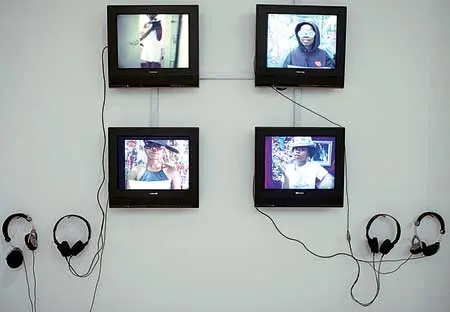
If the 2011 Bienal stressed the streets as the site and source for events and materials, the 2013 Bienal shows that the street has moved into the artists rather than the artists moving into the streets. The differentiation between the public and the private seems an end here, in a time when the art world is once again arguing its public/private distinctions. There is a wide acceptance of artists’ own lives as a continuing source and site for art which often translates less as art per se and more as artistic life. For example, Damali Abrams (b. 1979, NY) combines the commonalities of her life—her daily diary, watching television, pop music, and culture and documenting the moment through social media via a DIY (do-it-yourself) aesthetic—by making daily videos of her own commentaries on most any topic (Autobiography of a Year). The mundane is sharpened by her MFA exposure to critical theory—as is the case with most the artists in the exhibition—such that, as she notes: “Through my work, I am writing myself into history as a protagonist rather than/in addition to a subject.”
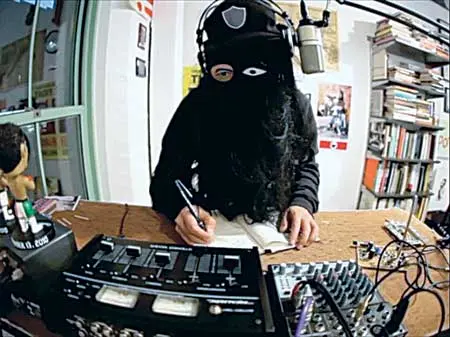
Eric Ramos Guerro (b. 1977, Philippines) also mines the momentary because as he says: “Facebook, Twitter, Pinterest, Spotify are the mirrors that we preen too.” His installation of a life-size mock-up of his Cortez Killer Cutz Radio station that he runs on a 15 watt FM band out of Brooklyn is used to locate the profound in daily life through personal interviews and rebroadcasts of late-night callers to San Diego stations (where he used to live) who dedicate songs to those incarcerated, by gangs memorializing their dead, by couples marking anniversaries and teenagers awkwardly expressing their true feelings, all making public what is private from behind the cover of the media.
Such assemblages of fragments of life rather than merely fragments of media seem to mark a major theme in our time and place in history as if the current gain in specific information comes at the sacrifice of imposing a more coherent whole. One consequence is that traditional art strategies of using mixed styles and media as equivalent analogs for conduct in life seem tired.
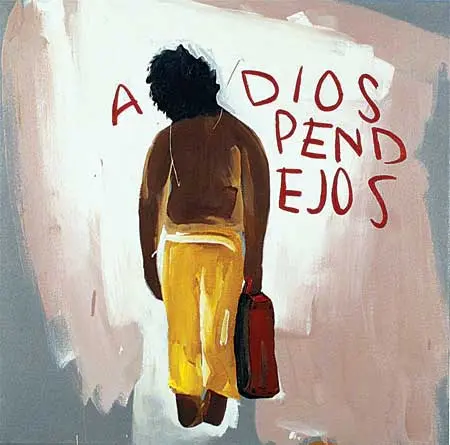
The wall of 24 uniform-sized paintings by Edgar Serrano (b. 1979, Illinois) mixes styles and sources in relatively random juxtapositions, an aesthetic that results from his professed desire to move past a collapse of high and low traditions into a more open-ended and non-linear situation. But such strategies result from the common assumption that variety produces results other than dismissal. The desired intellectual provocation does not follow. Interestingly, the museum chose his one painting for its press release, titled A Dios but he/they left off the final, more provocative, and relevant word on the painting, pendejos.
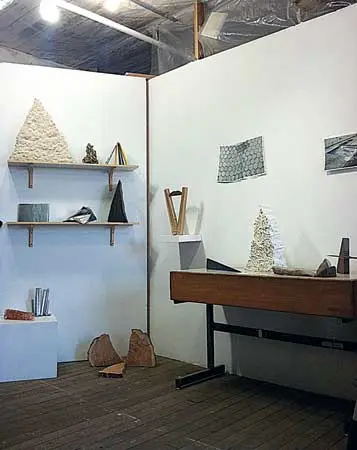
Another traditional and far earlier source for such non-linear mash-ups springs from where artists’ lives are spent. Their studios become the source as if the studio is an institutional frame that confers meaning on random collections of objects, or as with Gabriela Salazar’s (b. 1981, New York) corner installation, a collection of studio left-overs from previous projects (Even Pressure, 2012).
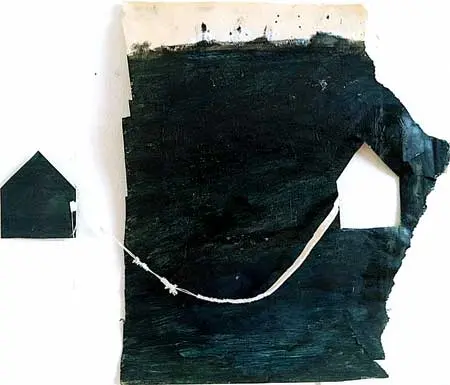
A more transformative mode was used by Julia San Martín (b. 1967, Chile) by miniaturizing her studio contents for a table-top installation (Casa de Muñeca [A Doll’s House]), with a miniature doll self-portrait sitting in a chair facing a miniaturized canvas labeled “LOL” (Laughing Out Loud) to poke fun at her own disappointments with traditional easel painting. Far more powerful is her reentry into painting via her small, untitled series of wall pieces made from ragged pieces of canvas and even a cardboard mailing box marked “Fragile.” The small, crude, ghost-like monochrome figures in oil look out, away from, and into spatial voids and small houses to parlay the poignant emotions of a universal existential condition into the everyday consequences of Pinochet’s rule in Chile (1973-1990).
Infantile self-centeredness has remained integral to the avant-garde as one way to return to a child-fantasy world charged with wonder. But this work strikes me as the opposite, in its better moments. More often the self is social and sharing. Ego-centrism is not a goal but a path meant to strengthen the self, to accomplish an integrated return to the social world. And self is a positive center for a DIY culture; a promise made to the future by incorporating the present. There is less oblique fantasy here and more the use of imaginative elements derived from pop and visual culture to address social relevancy; i.e., the artists are speaking from and in their own cultural vernacular.
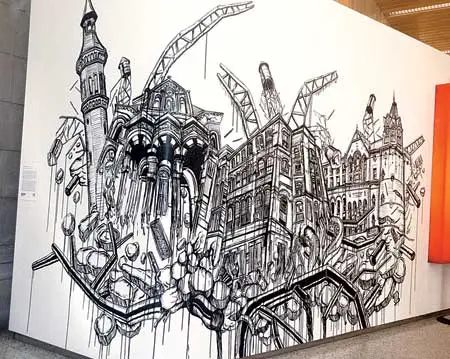
The visitor’s first sight in El Museo’s lobby is a black-on-white wall drawing titled Uptown to Oblivion by Ernest Concepción (b. 1977, Philippines), showing giant cranes and anime/cartoonish and sci-fi biomorphic tentacles uprooting El Museo and its surrounding buildings to move them, a reference to actual gentrification using visual culture. Fiction, as we have seen over the years, is one of the best vehicles to summarize reality.
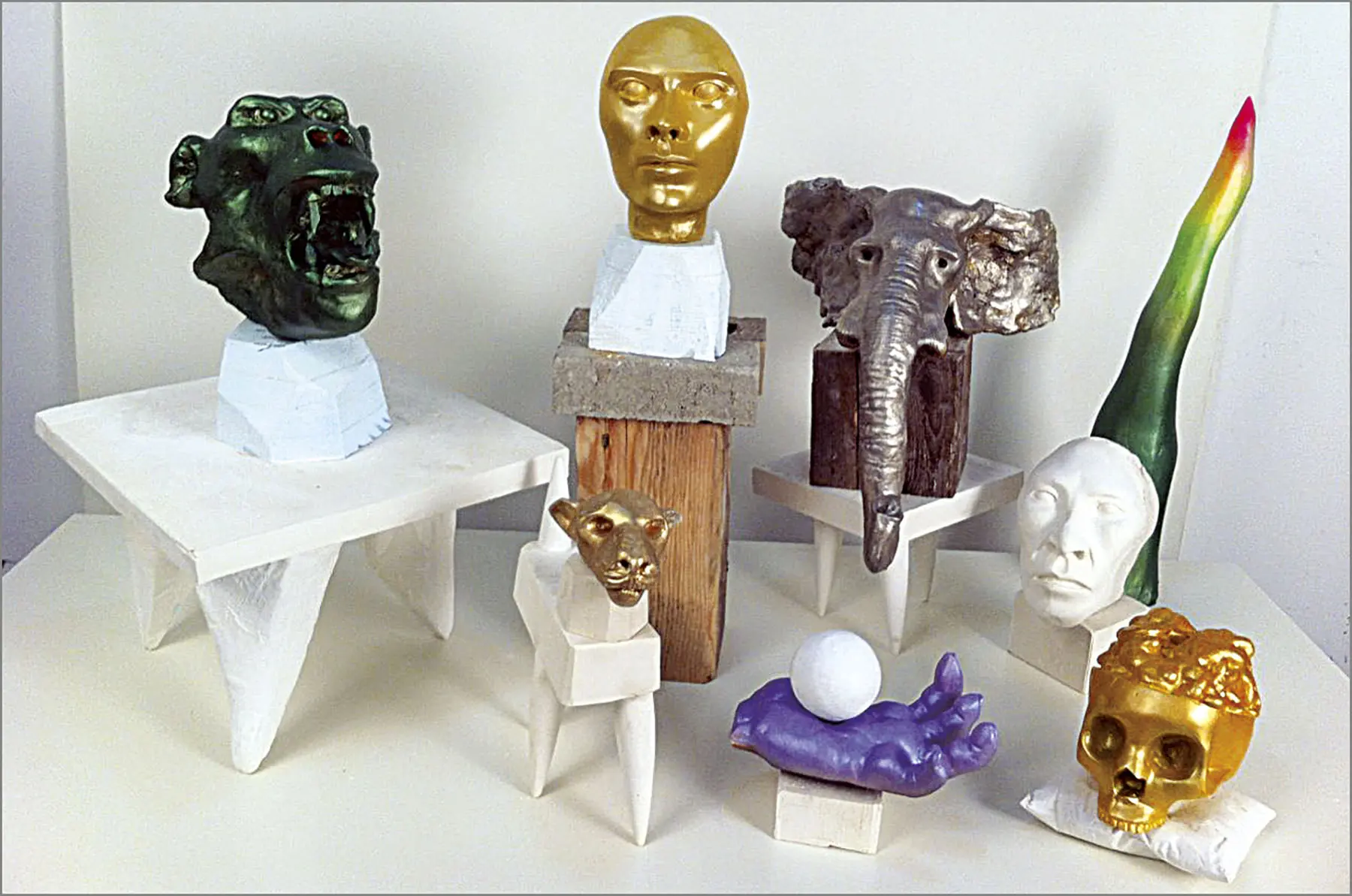
But the acceptance of the co-equality of visual culture as a vehicle also means viewers might read it as non-threatening and light-hearted. If your perspective is from that of fine arts what do comic books mean? I tended to dismiss the tabletop installation by Miguel Cárdenas (b. 1985, Bogotá) because the heads and skulls of humans and animals (The Jaguar’s Path) seemed the type of kitsch we all collect across many travels. But the wall drawings of facial parts are of finer quality and reminded me of that in an imagistic culture it is the images and their associations that count far more than their materials or means of production. But the cultural association seems clear: The “here jump” is between randomly collected kitschy décor items and/or the evocation of burial pieces across various cultures.
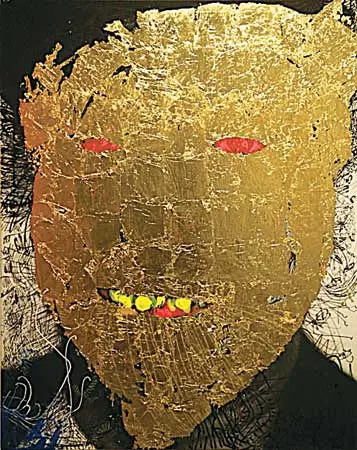
Alex Nuñez (b. 1984, Miami) seems to mix her messages in a similar way. A collage painting of a large, smiling but gold-leafed face with demonic red eyes (Untitled, 2012) is reportedly based on a photograph of the rapper Russell Tyrone Jones, a.k.a. Ol’ Dirty Bastard, a Brooklyn-born founding member of the hip-hop Wu-Tang Clan, who died of a drug overdose in 2004. Due to his erratic behavior, drug addiction, legal problems, and his free-form, if obscene, rap style he was considered a folk hero, thus someone who perhaps deserved a gold burial mask. Tacky? Yes, but so were the Mycenean Greek grave goods and the labored use of Byzantine gold still present in many Christian churches, rituals, and manuscripts, as in hip-hop bling and grillz.
There has always been a relationship between the low-culture everydayness and important religious artifacts, an old relation newly reopened and made relevant again by a socially mediated generation that returns to the value of imagery. Does a visual culture earlier characterized by Roland Barthes’ phrase of “already seen; already read” (déjà vu, déjà lú) mean a regrettable collapse of distinctions or does it become an important period of reintegration? And what problems would this raise for art and meaning? Do art critical concepts of radicality or experimentalism even mean anything in such a reintegrated view?
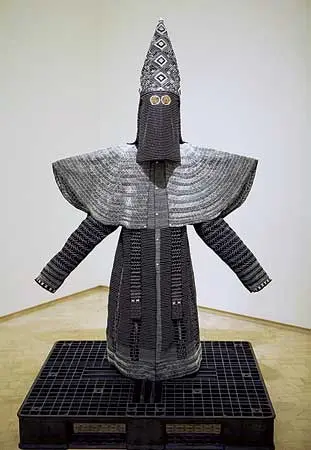
You might not think of a Klu Klux Klan robe worn by white racists as kitsch but Carlos Ignacio González-Lang (b. 1975, Puerto Rico) uses them as part of a primary concern with visual memes in vernacular imagism to redirect or at least confuse their meaning. On first encounter his Khinatown robe evokes parallels, through its construction, to masquerade costumes found among Afro-Caribbean cultures. But the title also refers to his purchase of it online from a section in New York’s Chinatown known for counterfeit merchandise, with its half-million stitches claimed to roughly equal the number of undocumented Chinese laborers. Perhaps unclear, but clarity is often in the beholder…or not. For example, his photographic grouping of composite drawings made by police artists is of faces of suspects based on eyewitness remembered accounts of 100 different crimes and perpetrators (Guess Who? 2012). But the artist then paired them based on their visual similarities and what is amazingly frightening is that each pair looks like the same person. Not incidentally, all appear to be men of color. No report on the race of the eyewitnesses or artists.
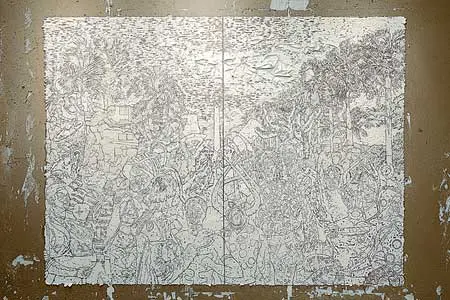
Concerns with race and colonialism are not new but here the references appear more subtle as if a parallel to their residual residences in culture. Viewers also have to fill in the blanks in Pavel Acosta’s (b. 1975, Cuba) Wallscape, a part of his series titled Stolen Paintings whose remarkable technique uses dried fragments of paint to create collages of other images. His all-white reproduction of the Dominican artist Manuel Macarrulla’s 1988 colorful painting, Goat Song #5: Tumult on George Washington Avenue, which sits on the opposite wall, moves us back to locate Macarrulla’s subtle articulation not only of US intervention but its eventual redemption. Having done so, Acosta’s collaged redirection will disappear when the temporary wall is removed at the exhibition’s end. Acceptance of art’s temporal state may be the lasting legacy of the street internalized.
My thanks to Tatiana Flores for our conversational tour of the exhibit. Two sensibilities are better than one.
RICHARD LESLIE