
To propose an approximation to the visual poetry of artist Lia Chaia requires a commitment with a creative dimension established by the conscience of a political body that may be present or not in her works but that is always a central agent for the construction of new forms of coexistence before the harsh transformations in everyday life.
In her recent exhibition titled Contretemps at the Galeria Vermelho in São Paulo—opened during July and August of this year—the artist reminded visitors of the undeniable existence of unforeseeable setbacks, during any given event, which are unavoidable obstacles that accompany the existence of every person.
The solo show critically reflects on the breakdown of social relationships and survival modes. It was presented in the context of the tenth-anniversary celebrations of the Galeria Vermelho’s involvement in the activation of exhibition spaces dedicated to the dissemination of contemporary art and the promotion of situations conducive to the debate of emerging themes in the cultural life of the city.
I will address the manner in which Chaia structured the explorations shown in the exhibition space.
Beginning with the title of the exhibition, Contretemps—chosen by the artist to name a group of explorations activated by some unforeseen mishaps that alter the perception of the environment—the atmosphere guided the gaze to the saturated scene of contemporary society.
We begin by noting the symbolism of the work titled Lanza (2013), a device constructed with thin strips glued to the walls and malleable steps affixed to the halls with adhesive material; simulation of any security, and containment measure that separates the body from life.
Instead of metal, of the ironwork that is typical of any protective fence, the artist used soft material—soft plastic—to create a false barrier, a detour from the usual perception of the object that prevents passing through and limits the condition of an autonomous body.
The steps and spearheads attached to the walls of the gallery served as a warning: straight or crooked, they were arranged across the space to warn viewers that they were expected to reflect on the variants of the daily coercive power of force and then to look back at the insistence of protection and containment measures that are so recurrent in our society.
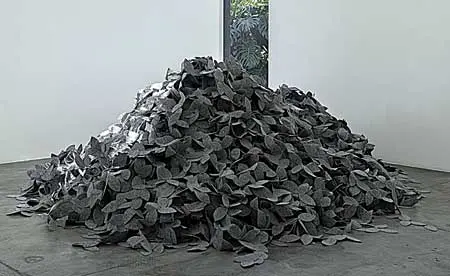
In another work, La caída (The Fall, 2013), Lia Chaia reflected on the conflict between nature and civilization in a polluted landscape; an irreversible record of aseptic, artificial, life.
With an arrangement that consists of hundreds of meticulously trimmed grayish synthetic fiber, malleable material used to cover floors, sewn to simulate the anatomy of a natural leaf—that naturally green organism—the artist placed the disorder of a landscape modified by the irreversible “progress” of successive losses.
The evident record of the disappointing relationship between “progress” and contemporary life emerges characterized by the monotonous grey tone of the meticulously trimmed and stitched leaves.
Also present in the group of works is the piece Fiação CP04 (Spinning CP04, 2013), drypoint on photography, and cables. It presented a new creation designed for the understanding of several areas of resistance improvised in the large cities, especially in the suburbs, as a testimony of a perspective marked by instability that results from political, economic, and social marginalization.
Amid darkened skies, public lamp posts, and tangled networks of overhead cables—often the result of clandestine connections attached to the electric system that is common across the entire country—Lia Chaia incorporates the manual record of drypoint in the photographs as a conscious political act.
In fact, Chaia illuminates her entire poetic with the critical conscience of a fighter that resists the instability generated by a dying, decadent, way of life: being limited by the exercise of force, the body is transformed and acquires a thinking dimension.
Her creation promotes areas or resistance, accumulates simulated steps and spears attached to the walls, stitched synthetic leaves, and images of neglected overhead cables on city streets and corners, as she invests her energy in the next assimilation of chaos.
Through the entire walk of the exhibition, there was the constant double condition that used to persist a decade ago in Chaia’s work: the interest in the awareness of the contemporary body and the distrust of a completed project that regards life as a finished work.
For Lia Chaia the strategies created in her work that resonate across the exhibition space are forms of reflecting on the world, particularly when her poetic loudly dialogs with the signals that confront the obsolete energies contained in common litanies.
By proposing viewers a double failed encounter—the consolidated expectation altered by the contact with the personality of each work, and the disorientation in finding the opposite of an everyday experience—Lia Chaia approached urgent themes necessary to coexist with the contemporary, with the dramas of her interlocutors, with adversity.
CLAUDIA FAZZOLARI