
Moth-eaten illustrations, book covers without pages, illegible book pages, photographs from periodicals, and a flag replaced by impassable electroencephalograms. These are the images that welcome visitors to the exhibition titled Manifest of the External, the second solo exhibition by Venezuelan artist Luis Arroyo (Caracas, 1973), at the Carmen Arauúo Arte exhibition spaces, located in La Hacienda La Trinidad Parque Cultural, in Caracas. Curated by Sandra Pinardi, the exhibition opened from June 9 to July 7 of this year.
In a small area of the gallery, nothing appeared to be left to chance in order to underscore Arroyo’s intention of confronting viewers with physical objects and images established as external traces. According to Arroyo, they represent “foreign accidents from a production of forces that have nothing to do with the physical,” It is the impossibility to materialize things, to visibly render through external representation those internal things that belong to the world of ideas, of the invisible.
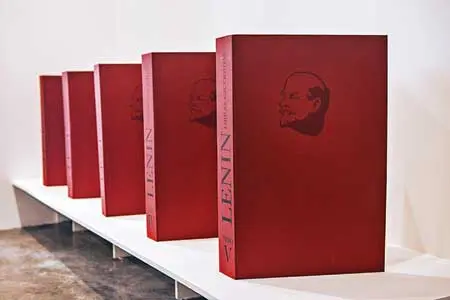
Three large transversally placed tables served as support for the display of the disorganized and sinuous volumes in Desaceleración Fantasmática de la Escritura (Phantasmic Deceleration of Writing): identical uniform books whose fabric covers reveal the iconic profile of Lenin and whose screen-printed spines have the title: "Lenin. Selected Works." written on them. Inside the volumes, an endless amount of electroencephalograms that represent schizophrenic episodes replace the thoughts of the Russian thinker.
This piece combines two visual elements that serve as leitmotivs for other works included in the exhibition. On one hand, there are the red covers of the fake volumes of the selected works by Lenin that—resized to a larger scale and aligned next to each other—conform Espectros (Ghosts), five empty skeletons that look like abandoned buildings and that, just as in Desaceleración, are all exterior, the mere shell of a vanished discourse.
The motif that continually reappears in the show—and one that was already present in the artist’s first personal exhibition titled Translations—is the EEG, graphic organizations of electro encephalic pulses taken from individuals with brain damage. Arroyo uses them as a musical structure of continuums and interruptions that registers the sonorities of the individual as if it were sheet music.
This translation from one language to another, in which the vibrations and the highs and lows describe the lines that in turn create encoded and hermetic images, cannot be interpreted or associated with any other exterior visual referent. It is silent sound; a narrative of alternating variations that can be extrapolated toward readings from other disciplines.
These same electroencephalograms also serve as the data that substitutes the symbols of the flags in the piece Sofía Eólica (Aeolian Sofía)—installed on the gardens of the Hacienda—and in the newspaper images and book pages—and several other models of objects—in the work Psicoquinesias: a group of papers organized in Cartesian grids and placed on the walls, where forms were emptied from their content, cut from their whole and replaced by those graph papers created with electrical impulses—that internal pulse—that replaced matter. They stand as the representation of that which cannot be and can only be guessed— faces perhaps, or maybe landscapes, or even objects.
As if looking through the pages of an art book, the large format pieces Polillas-Obliteraciones (Moths-Obliterations), describe the outlines of imprecise forms—paper cutouts—to which we attribute an image suggested to us by the formulation of the work: the bust of a young Roman, the effigy of Emperor August, or—touching in the dark—a dance, perhaps, of a portrait.
Rather than turning into dark forms as a result of the effect caused by backlighting, these silhouettes are hollow areas surrounded by shadows that used to be—before being affected by the suggested action of moths—darkness that was part of a whole. Thus, the gestation of the image occurs backward, not as the result of addition, but of subtraction. Nonetheless, without boundaries to differentiate the space from its content, any possibility of attributing a forum convened in the external world is nullified and, therefore, the germ of the images is, paradoxically, emptiness. This hollow substitute represents the destroyed memory of something that no longer exists; the pages from a book are internally consumed in a silent and invisible manner.
Lastly, the series Exhumed Books consists of extremely white book copies in which the black letters printed on the jackets reproduce the typography used in texts by Walter Benjamin, Joseph Beuys, and Claudio Perna, but replaces their ideas with imagined content that suggests the implausible revision of their theories or the production of ideas conceived postmortem.
In Walter Benjamin. Restauración del Aura. 1941 (Walter Benjamin. Restoration of the Aura. 1941), only after the German cultural critic’s death in 1940, the lost aura of the work of art—lost during the mechanical reproduction of the work, according to Benjamin’s essay The Work of Art in the Age of Mechanical Reproduction—is restored. On the other hand, the work is titled Joseph Beuys, Claudio Perna. Correspondencia. 1986-1997, (Joseph Beuys, Claudio Perna. Correspondence. 1986-1997) presents a hypothetical dialogue between the two artists that begins the year of Beuys’s death and ends the year that Perna died.
The impenetrability of the suggested scenarios that, as viewers, we are unable to access, the memories of fake notebooks with absent stories and the construction of images that contradict the image itself, are formulations that confront us with art’s persistent inability to name something that cannot be named despite its persistent attempts to achieve it.
COSTANZA DE ROGATIS