
On exhibit at Buenos Aires Museo de Arte Contemporáneo is an excellent show, curated by Ayelén Vázquez, about one of the most distinguished names in Constructive Art in Argentina: Manuel Espinosa (1912-2006).
The exhibition is titled Geometría en movimiento and introduces us to Espinosa’s work from the 1960s, his relationship with kinetic art, and the three-dimensional objects he created: acrylic boxes and one object, El juego de la Matusa, with which he participated already in 1984 in a group exhibition titled El juguete, which brought together important artists from the local scene.
Manuel Espinosa began to act decisively in the local scene with Asociación Arte Concreto Invención (AACI), alongside Maldonado, Lidy Prati, Hlito, Iomni, Molenberg, Souza, Lozza, in creations that scandalized the audience with their use of the trimmed frame and the belligerence of their ideas.
Afterward, and after his visits to Europe with Max Bill, Vantongerloo, Vordemberge-Gildewart, and other constructive artists, Espinosa began to explore unlimited space with free constellations.
The show we are reviewing now illustrates with great accuracy the moment when Espinosa abandons unlimited spaces and opt definitively for two-dimensional space, on the basis of which he would embark on new, unexplored paths.
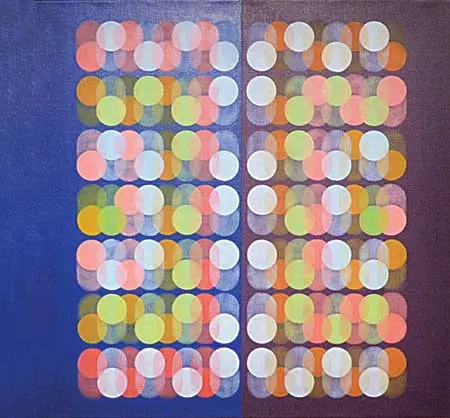
There is a vast display of Espinosa’s production from the 1960s and the variations he did around the theme of the circle. This basic module is reiterated against monochrome backgrounds, always with the same dimensions, that act as elements in a group. A group that, on the other hand, always works according to a rhythm.
In Espinosa, horizontality has enormous strength, and the displacements of the circles take place along rigorous horizontal lines that, in turn, make it possible to organize other visual figures through color, their differentiation, and the degree of luminosity.
The superpositions are organized with strict symmetry. A complex symmetry that can correspond axially to its horizontal or vertical axis, or can be doubly inverted.
The exhibition includes oils on canvas and on cardboard from the circles series. It was only during the following decade that the artist moved from the use of oil to acrylic. A good number of works that exemplify the many possibilities engaged by the artist are on display.
There even are some works that were included in the exhibition 18 variaciones sobre un tema and were installed in 1968 in a way that was absolutely new.
A different group of works, very directly connected to optical kinetic art, is comprised of inks on paper, Basie, a large, tremendously forceful oil on canvas, and one acrylic on canvas that—as attested by its unusual title—belongs to the era when Espinosa was profoundly interested in James Joyce’s Ulysses.
Espinosa’s acrylic boxes from the 1960s, only one of which is dated, are interesting for the visual adventures they provide for viewers through their reflecting stainless-steel surfaces and their potential for many iterations and transformations.
The boxes are well arranged to form a boundary line at one of the space’s ends and lead into El juego de la Matusa, mentioned above. In a small adjacent area, viewers have an opportunity to create their own Matusa using loose colored acrylic pieces that are placed on a large table.
The exhibition also has a significant catalog with a text by the curator, Ayelén Vázquez, a biography, a listing of exhibitions and awards, a general and special bibliography, and the English-language version of the texts. The catalog features photographs not only of all the works in the exhibition but interesting documents referred to the artist.
Doctor Elena Oliveras wrote the introductory prologue.
NELLY PERAZZO