
Anthological Exhibition 1972-2013, a Margarita Checa retrospective covering the Peruvian sculptor’s work since her student years to the present, is open to the public. The exhibition was curated by art historian, independent curator, and critic Luis Eduardo Wuffarden. Margarita Checa is a sculptor who works primarily with wood and bronze; this retrospective features 55 items in total, including two prints, four drawings, 27 small- and medium-format bronze sculptures, 21 wood sculptures, and one sculpture in Huamanga stone. Checa is among the small number of sculptures that work wood in what is known as the “subtraction” method, carving it until the desired shape is achieved. She begins by cutting off the thickest sections with a motorized saw and then carves the material using a pneumatic hammer and a chisel to work out the details.
In her works, Checa uses human figures, often nude, to represent ideas and metaphors for life. For example, she explains her Logos (also known as Fortaleza cargando su debilidad) as “an understanding of totality, because there is no strength without weakness.” 1 This work is larger than actual size (2.04 meters) and depicts a nude female figure carrying in her arms another nude woman; the latter figure’s head rests on the shoulder of the former, her falling arm resembling the Christ figure in Michelangelo’s Pietà. The same posture of the arm is found in Jacques Louis David’s The Death of Marat, but in Checa’s work the woman is not dead, as in these precedents, but in a moment of weakness. The arms were made independently and later attached to the sculpture. The arms were first made in clay, later in plaster, and only when the artist had found the shape she was after were they carved in wood and added to the work. The figures represent two states of the soul of a single individual: anxiety and weakness. Thus, the two figures are made in distinct species of wood: one in traditional, light-hued olivewood, the other in the darker Yacushapana wood, a variant found in Peru. Two states of the soul, two ages, represented both through the size of the figures and through the attitudes they assume. “Rigorously distilling materials taken from the realm of magic, myth, and dreams, her works propose unsettling metaphors of existence and the human condition.” 2
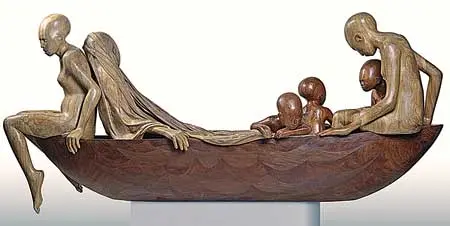
Río infinito is a boat, 2.10 meters long, with two women, one man, and three children on board. One of the women sits at the front of the boat, with the man sitting with his back to her. The other woman and the three children sit towards the stern. The man, covered by a shawl, is asleep. Checa says, “the man is in a state of abandon, trusting the journey itself; the key to his life is to trust, to let himself go with the flow.” 3 All the characters are nude because “nudity is for me something entirely natural, we arrive naked into the world and naked we leave, carrying only our energy.” 4 Being nude, the figures appear more natural, more innocent, devoid of malice in their lives. Their skulls are all elongated, representing the earliest stages of civilization, our origins. Checa uses this as a metaphor for life. She says, “for me, it is the course of life, the path that each of us takes will define its trajectory; we are basically water, we come from water, we are born in water, and we end in water as well.” 5 There are no oars in this boat. The boat is carried by the current but we create our own course.
NOTES
1. Interview with the artist, October 2013.
2. From the exhibition catalog.
3, 4, 5 Interview with the artist, October 2013.
AUGUSTO CHIMPEN