
Marianna Dellekamp’s exhibition at the Museo de Arte Moderno is a well-articulated tour of the photographic arts and its connections with other modes of expression. Proceso Abierto (Open Process) is a fitting title to encompass the various aspects the artist has been developing, and to alert the audience, from the start, not to expect something complete or strict photography, but an elaborate spectrum of processes in which the author posits her ideas investigates uses of photography reflects on that investigation and its applications and builds and uses non-traditional supports. The precedent in Mexican photography can be found in the second half of the 1980s, expressed in an important initial expansion and a slight but noticeable rise of the documentary, social, and local notes. This was seen in several solo and group exhibitions, such as Primera Retrospectiva de Gerardo Suter at Centro Cultural General San Martín and Fotografía Mexicana Generación Ochenta, which displayed original neo-conceptual essences that differed from those seen at the time in Europe and the United States. This situation was confirmed and expanded in the 1990s, with an even more emphatic move away from the topical through the lens and towards installations, objects, and uses of the image in order to present the artist not placed inside an isolated sphere but inserted in and exploring the everyday world.
Dellekamp was born in Mexico City in 1968 and has established her residence there. From the standpoint of a critic, Marianna Dellekamp is undoubtedly deserving of attention as an artist, and curator Graciela Kasep has indeed been following her work. With the broad and solid visual steps taken over the last two decades, it is certainly time for a retrospective of her work. Let’s reflect on the pros and cons of this kind of exhibition. They enrich the historical record of the author’s photography, as well as of her multimedia creations, even if works that have participated in other shows are on display again in the same space. On the other hand, these art exhibitions teach us to preserve documents that not everyone knows to safeguard. Going back to Dellekamp’s work, we notice that she enriches her investigation with works that are devoid of anecdote and of any reductive figuration. Her work is always impeccably finished and focuses on bringing the process to light or suggesting part of the process followed by the artist.
As we travel through the exhibition, we encounter three basic nuclei that coincide with branches of conceptual art. To wit: body, text, and installations. There are works that weave text and body, as in Antropología. Certainly, Marianna Dellekamp is not an orthodox conceptual artist, nor does she belong to the original movement. In terms of her multimedia supports and processes, she uses everything from video to installation, from photography to artist’s books. The processes used by the artist as her signifier and signified are accumulation, reiteration, interpretation, and, to a lesser degree, fragmentation. Cuerpo mediatizado is a work of decomposition and recomposition, a mobile photographic, semi-organic installation in circles of synthetic material that encloses photographs. In it, deconstruction is present in the obliteration of any fixed reading of the image. In the same way, Marianna Dellekamp interacts with the referential modes in which she uses images and supports. Based on all this, we must understand her work as trans-conceptual, which is to say, the raw original impulse taken to a contemporary aesthetic language. She is among those artists who assume in a natural way the processes that integrate new materials and design, extending the symbolic elements to illuminate the sharp governing thoughts in each one of her works.
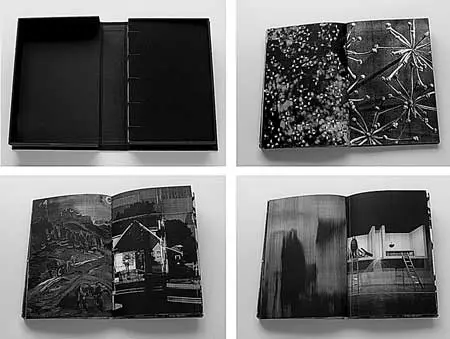
Among Marianna Dellekamp’s best known and most celebrated creations we find several series that include artist’s books or involve the concept of the book. In the latter case, with the use of social media as a co-authoring participatory component, especially in La Biblioteca de la tierra, a sampling of soils from different places around the globe that are each kept in book-format acrylic boxes with the complete origin information for the sample inscribed on the spine. Other series explore the mass-media operations on the female body, certain museums’ isolating and useless cataloging, the marketing actions that change certain urban and social realities. Marianna Dellekamp shifts the traditional rails of documentary photography towards new modes of recording. And the distinctive power of Mexico’s new photography proposals is thus confirmed.
GRACIELA KARTOFEL