
In English, the word “drawing” has many more meanings than its Spanish equivalent dibujo. But the meaning that the title of Mariano Dal Verme’s exhibit at Sicardi Gallery contradicts is the one most commonly used: “a picture or diagram made with a pencil, pen, or crayon rather than paint.” Like its Spanish equivalent, that meaning of “drawing” is familiar to us since childhood, and it is very precise. That is why we are surprised when Dal Verme introduces his tri-dimensional works as drawings. In Spanish, we traced the origin of the word dibujo to a 12th-century adoption of the French word déboissier. At that time the French term was more encompassing than its Spanish or English equivalents for it included “polishing,” “sketching,” “to sculpting,” and other artistic activities. It is this broader and more archaic meaning that validates the claim of Dal Verme’s works to be drawings.
Dal Verme is one of those artists whose works need not be large. His works are about the size of an oversize art book. The meticulous fastidiousness of his works recalls those of Gabriel de la Mora or Marco Maggi and they aim for the exquisiteness of a small format piece. Dal Verme’s materials are just two: paper and graphite in the form of leads for mechanical pencils. It is with leads that Dal Verme meticulously builds the frameworks that often evoke the geodesic constructions of Buckminster Fuller. In spite of these resemblances, Dal Verme has shown no apparent inclination to get rid of paper (board) in his works or to increase their size.
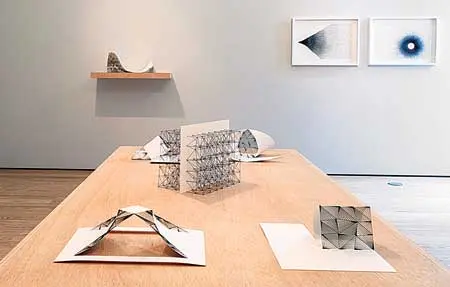
In a few works paper takes on the triangular shape drawn by the lead rods, and is framed by them. In these works, paper plays a different role than mere support for the lead rods. Lead rods and paper are thus indispensable materials in this project of Dal Verme, whose works often resemble architectural scale models. Whether in fact, they will one day become the prototypes of larger works is something that cannot be predicted. By the way, since all of Dal Verme’s works are “untitled,” a reference to specific works is extremely difficult.
It is a remarkable fact that Dal Verme uses pencil leads as construction material rather than as a tool for representation. Its normal use—making marks— is congruent with the purpose for which they were produced, but not the use Dal Verme makes of them. Even when Dal Verme appears to be using the leads to represent a radiant sun (with dark rays), they are not making marks in the traditional sense, but being themselves a representation of rays. More than represent, they substitute for marks that represent.
There are a couple of precedents for the idea that drawings can leave a flat surface and enter into tri-dimensionality. The Paperless drawings that Gego made in the mid-eighties are one. In said drawings, the “marks” are wire, steel rods, plastic tubes, etc. Another precedent is the light drawings Picasso made in 1949 with photographer Gjon Mili at the suggestion of the latter. However, in these drawings, the final work is flat and photographic, even though the drawing that produced them existed ephemerally in three-dimensional space. Inasmuch Dal Verme’s works do not represent but construct, though, his closest antecedent is Gego’s Paperless drawings—with the important difference that Dal Verme’s do include paper, albeit not as the receptacle of marks.
In sum, in spite of their scale model appearance, Dal Verme’s works are not a prototype for anything larger, nor is the paper in them a receptacle for anything drawn on it, nor do the graphite leads make any mark. It is not a Constructivist project in the sense that the works could be used for something. Not doing what is expected may sometimes be a virtue in art. His works invite us to notice what he is not doing, but the raison d’être of his works is to just be objects of aesthetic contemplation.
FERNANDO CASTRO R.