
Mateo Manaure (Uracoa, Venezuela, 1926) is one of the Venezuelan artists from the earlier generations that established the basis for the abstract current that has characterized the visual arts in Venezuela. Manaure’s expansive artistic trajectory includes several periods in which his work experimented with a number of styles, including the well-known academic-formative one. Nonetheless, he is better known for his abstract works, as abstraction has been the main style with which he has approached his artistic projects.
Manaure’s inquiries are not reduced to the formal ones that are intrinsic to the medium, as he has also sought answers to his expressive needs beyond the purely technical. This attitude led him, along with other expatriated artists, to enter the famous Parisian group The Dissidents in 1949. The members of this group shared an interest in abstract art. Manaure’s stay in Paris during such an early stage of his artistic development allowed him to enter into direct contact with the latest artistic tendencies of the time. It is precisely during this period when he was influenced by Neo-plasticism and Kandinsky’s theories—influences that would be decisive for his artistic career.
This is an artist not solely content with developing his own work, but also interested in exploring the world of the galleries. In 1952 he opened with artist Carlos González-Bogen the gallery Cuatro Muros. The importance of this gallery transcended the local art world, as it became the first one to present in Venezuela an exhibition of international abstract art that attracted the interest and attention of artists and collectors from across the country.
Although most of the works by Manaure are within the realm of abstraction, they have also been influenced by several variants of the style. It is possible to observe several periods in which the artist experimented with numerous tendencies that ranged from pure Constructivism to a more lyrical and gestural approach to abstraction. He also created optical and geometrical works that made him stand out particularly during the later periods of his career when it became possible to appreciate a more consolidated and personal style. This exhibition in question focuses on an important part of his later work from the series entitled Polychrome Columns, which he began to work on during the 1970s but continued to develop several decades later. The pieces from this exhibition were created between 2000 and 2002 and can be divided into two groups: the first consists of two-dimensional works and a second group that centers on three-dimensional pieces.
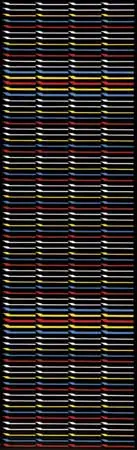
The first group consists of sixteen vertical and rectangular works from 2000 that are in the shape of altarpieces. The use of wood as support reinforces this idea. Manaure applied generous amounts of color on them; lines of contrasting colors are brought together to create optical effects and to give the sensation of a depth of field that does not actually exist. Even in seemingly monochrome works like Columna policromada 9 (Polychrome Column 9), Manaure is able to infuse a sense of movement into the painting and, through the application of several shades of white, to create a characteristic optical effect that convinces viewers of movement that does not actually exist. Other pieces, like Columna Policromada 8 (Polychrome Column 8) successfully display Manaure’s mastery of color and, based on the contrasts between warm and cold colors, he completely convinces us of the existence of volume—however illusory—in that which is actually a two-dimensional painting. These works reveal this artist’s desire to experiment through the use of color.
The second group of works presented in this exhibition consists of five sculptures from 2002. They are totemic forms—literally columns—that reproduce a play on volumes. Like it occurred with the two-dimensional group, this one stands out for the use of contrasting colors like reds and oranges, which are set in contrast against neutral tones like the color black, in order to define the planes. With these sculptural columns the artist proposes to viewers an almost architectural approach that reveals a process that is inverse to the one applied in the other group of works: instead of creating volume with paint, it uses paint to reinforce the volume of the column as it creates several planes.
It is not surprising that Manaure became interested in these types of works, given that the artist has collaborated in urbanization projects like the Ciudad Universitaria de Caracas. His multifaceted interests have led him to create not solely monumental works like his murals, displayed throughout the city, but also more intimate works like his stained glass windows. Manaure also delved into illustration and graphic work, as he collaborated in book design and illustration projects.
This exhibition includes an important part of Manaure’s work, particularly those from his last periods. They reveal Manaure’s masterful use of color and his interest in experimentation.
IRINA LEYVA