
The works by Cuban artists Meira Marrero and José Ángel Toirac (M&T) do not exclusively center on Cuba. They also approach neuralgic themes that pertain to the human condition and, thus, are not exclusive to one territory. Such is the case of Vanitas, a complex and very elaborated proposal by the artistic duo that synthesizes twenty years of collaboration, where even the smallest detail becomes relevant and meaningful. Thus, this is an exhibition to be observed, listened to, and discussed.
Vanitas, a Latin term that means vanity in English, is the concept under which the exhibition is organized. It is not the vanity used in fashion and gossip magazines in connection to glamour, exclusive trips, beauty, or wealth… as the primordial objective of our lives. M&T reclaims the original concept developed in the Book of Ecclesiastes where anything ephemeral is severely punished with the exception of the inexorably passing of time and the arrival of death. Here vanitas is that which it always was, the quality of the useless or vain that turns people into presumptuous and arrogant beings.
The exhibition is a provocative curatorship exercise. Although the theme could have easily lent itself to a flamboyant and macabre spectacle, the result is actually sober and elegant. In the artists’ own words, the works “are allegories for life itself, fame, beauty, friendship, politics, and art, among other things.” They stand for an entire list of vanities as if the exhibition were a ‘symbolic still life’ charged with explicit moralizing meaning about the ephemeral condition of material existence and the indisputable event that death represents.”
Accordingly, the exhibition is inherently ritualistic, a sort of “dance of death” in which we are all reminded of the insignificance of social and economic status and of the fleeting nature of life, as the exhibition itself turns into our own personal “memento mori.” And incidentally, the exhibition begins with a sound installation titled Memento Mori (2013). There, with the use of headphones, we can listen to the phrase “remember that you will die” in thirty-three languages. There are other works that appropriate the traditional, pictorial, forms of the “vanitas” genre. These, according to the artists, replace “the habitual role played by the human skull in the middle of a still-life, since it is likely that the women portrayed are already all dead.” And such is the case of the series that gives the exhibition its title, Vanitas (2006-2013), an unapologetic historiographical and chronographic sequence that shows oil painting portraits of the first twenty-three First Ladies of Cuba, from the time that this position was instituted in 1902 until its disappearance in 1976.
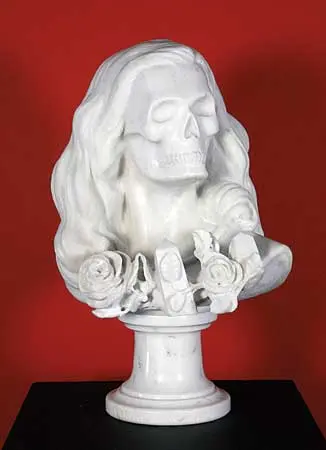
There is also an attractive oil representation with pleasant warm grays from a supposed multicolored allegory of the Republic of Cuba that, represented by a woman, is reproduced on the cover of Vanidades magazine (Havana, 1952). According to the artists, by first rendering the piece monochromatically and then adding color to it, “we succeed in distancing ourselves and reenergizing the meaning of its title, Vanity, amid a context that is more reflective than mundane.” Within this same interpretative line, the work entitled Vanitas Vanitatum (2013) consists of a finely carved white Carrera marble sculpture that reproduces the aforementioned magazine cover image. In this instance, however, the beautiful and idealized face of the young woman has been replaced by a skull. It is the classic theme of beauty and youth as banal and fleeting.
In the same manner, M&T has approached the passing of time and the arrival of death through themes connected to the history of Cuba. Such are the avatars of the remnants of the USS Maine and of the Cuba/US relations in the pieces Salve et Coagula (Dissolve and Coagulate, 2012-1013) and Remember the Maine (2012-2013), the assassinations by both sides before and after the revolutionary process in Cara y Cruz (Heads and Tails, 1996), and the disappearance of the once-celebrated indestructible friendship and political alliance between the Cuban and Soviet peoples in Amistad (Friendship, 1996-2013), among others.
Altogether, the architecture of the exhibition is designed as a large spider web formed by 12 well interconnected artistic units. As the artists themselves point out, “all of our exhibitions are curatorial projects in which the individual works are pieces of a puzzle that help us build a larger picture. Thus, the ‘work’ is the sum of all parts, the exhibition in its entirety. This approach that, for lack of a better term, on other occasions, we have referred to as ‘artistic curatorship,’ allows us to manipulate and recontextualize old works, historic records, pieces by other artists, etc.”
JOSÉ RAMÓN ALONSO