
The Tikuna people of Brazil have a myth, passed down orally for generations, of the great Ceiba, also known as Wone–a colossal tree that lived amongst them in the Brazilian rain forest near the borders of Peru and Colombia. Because the great tree blocked out the sun and overtook the space, all the animals of the region united to overthrow it. The imprint of the fallen tree sculpted the Amazon River, its branches formed the river’s tributaries, its twigs created creeks and streams, and its leaves produced lakes and ponds. Miler Lagos, who lives and works in Bogotá, Colombia, explores this story and its implications in his recent exhibition at Magnan Metz titled The Great Tree of Water, an ambitious group of works that can each stand autonomously on its own or which all cohere into a greater installation.
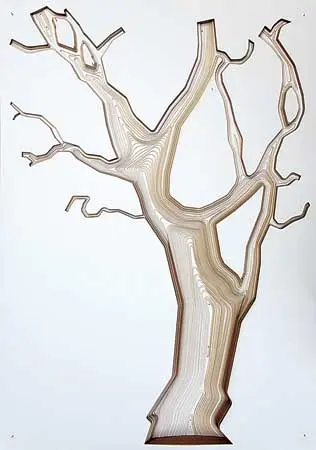
There are four main sections in this show. Along the walls are rich graphite works on paper depicting various rivers such as the Selenga and the Lena. By rendering them graphically, removing their context, and displaying them vertically on the wall these bodies of water do affect the appearance of great tress, including branch and root systems. In an inversion of these drawings, Miller executes a series of deep paper-cut reliefs that are mounted on tabletops, presenting a topographical view of “valleys” or “river beds” created by the negative spaces of the missing trees.
Perhaps most visually arresting are two sculpted-paper projects. One involves reliefs of folded paper shaped into circular forms mounted on the walls; these shaped paper constructions are comprised of various newspapers such as the Wall Street Journal, whose uniformity of layout allows for a series of seemingly abstract concentric patterns to emerge which give the circles the appearance of tree rings. And on the floor is a grouping of sculpted forms that take on the contours densities and appearance of aged tree trunks. Upon closer inspection, one realizes that these trunks are actually stacks of paper with graphic renderings on their surface that have been carved by Lagos to mimic the shape of certain lakes and take on the form of cut trees.
This is a rich collection of artworks done in disparate styles and techniques, anyone set of which would have made for an intriguing exhibition. They are of course threaded together by the related themes of the tree/river analogy, which expands into the relatedness of all life and organisms on this planet. When one looks at the tree/river renderings one realizes that they are also analogous to the body’s circulatory system and that rivers like the Amazon are in fact the lifeblood of the planet. Of course, the choice to employ paper in each project hardly seems accidental or arbitrary, given that paper is an evolution of a tree’s existence. It is also noteworthy that the two projects that make the most use of paper, the tree rings and the sculpted trunks, use paper to present trees that have been cut down—an unfortunate necessity for paper production and also a matter of great concern regarding sites such as the Amazon Rain Forest today.
With his second solo New York exhibition, Lagos ties together mythology, spirituality, and ecological concerns in artworks that are intellectually layered and masterfully crafted. He is proving to be an artist whose talents match his ambitions.
JOHN ANGELINE