
Here is once again one of Puerto Rico’s most important young artists: Omar Velázquez (Isabela, 1984; lives and works in San Juan), who, indeed using multiple and mixed media, is able to communicate forceful messages of social, political, economic, ecological, and existential order so as to helps us see the state of urban abandonment and decay in which we dwell. For almost a decade now, his provocative art has been seen in important biennials, triennials, fairs, and exhibitions both in his native island and in Japan, Spain, Macedonia, Argentina, Mexico, and the United States (Miami, New York, Boston), thus demonstrating that this is a common ailment in all societies.
I know Omar Velázquez since his time as a fine arts student at Universidad de Puerto Rico – Río Piedras (where I teach since 1988). His concentration was in the graphic arts, specifically printmaking. Velázquez readily stood out for the quality and topics of his work, and for bringing printmaking into a well-conceived three-dimensionality.
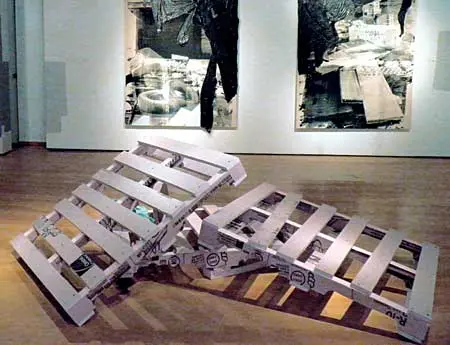
His topics were the social, political, and economic problems of urban areas in a state of complete blight, which destroyed the moral fiber of a good portion of Puerto Rican society.
Here we encountered large-format prints that presented us with sections of a deteriorated Puerto Rican reality, caused by rampant political corruption, brutal social injustice, and drugs. Also, benches where beggars/homeless/street people laid down to sleep, large-format sculptures in paper and wood, covered with Velázquez’s impressive prints.
Omar Velázquez is a multifaceted artist who creates and experiments tirelessly. Inside his studio are a series of projects running in parallel, such as Al Borde, exhibited in 2011 at the Museo de Arte Contemporáneo de Puerto Rico, and Trash, presented that same year in the very popular alternative space Recinto Cerra, in Santurce (San Juan). This year, with La Spera de Beroszi y Pariah, he received the Lexus Fellowship, a highly valued (albeit financially limited, at $9,000) opportunity for emerging artists, who with it are able to work on their projects and then exhibit them in one of Puerto Rico’s well-established museums.
Velázquez is also presenting his work in two important exhibitions: Undo, in the Universidad del Sagrado Corazón Art Gallery, and Solista… pero no solo, with Bobby Cruz, at Espacio 304 gallery. This review focuses on Undo, which has been met with an excellent reception despite being a realistic portrayal of negative aspects of Puerto Rican reality, and as such rather painful and arduous to contemplate.
Undo is the command we give our computers to erase something we have done. It would be very good indeed to be able to undo what we have made of our community, urban centers, cities, societies, nature. But this is almost impossible now. What Omar Velázquez wants is to bring it to our attention, to critique it, and to convince us that there is still time to do something about it or at least stop in our tracks.
To complete he more than a dozen items on exhibit here—graphic on paper (xylography, silkscreens), works on canvas, mixed media, installations, constructions, found and intervened objects—the artist brought his metaphors of street aesthetics to the extreme point, rendering them into controversial but effective works of art that are veritable radiographic plates of our society.
In his essay for the Undo catalog, artist Abdiel Segarra notes that “With his work, Omar Velázquez makes the audience aware of the “inside” and the “outside” of what is understood as art.” He recreates spaces of decay, the refuse/junk (the latter a very fashionable term in Puerto Rican reality since 2000) held within structures, a sense of fatigue, of defeat, of “we can’t.”
The word that best defined Undo (sever of the works share that title), and also the connecting thread coursing through his entire recent oeuvre (all from 2013) is discarded. The way in which we use the thing and then discard them in public or neglected spaces, thus creating a reality that erodes and destroys us, made with refuse, detritus, garbage everywhere.
Although all the works on exhibit are substantial, I was particularly struck by Patches, four wood panels of the kind used to close condemned buildings or to build hurricane shelters, inked over and intervened. The other standout is Ouroboros, postmo-pop in spirit (made with an air conduit and foam in variable dimensions) where the artist creates something that can be seen as a floatation device, a pink raft, or a giant doughnut á la Claes Oldemburg. But Ouroboros is Velázquez’s metaphor for the ancient image of the serpent eating its own tail.
Above all, Undo is an exhibition that confronts us with our surrounding reality even if it is contained in enclosed structures; an exhibition that reveals our detritus, our lack of initiative, our “it is not my responsibility” attitude. But especially, Undo is a space where ideas and possible solutions are born and grow. It is a way for an artist to tell us that it is possible to make our nation better.
MANUEL ÁLVAREZ LEZAMA