
The historical context created by the gathering of eighteen Latin American artists for an exhibition of recent works, conceived by Chilean critic Ernesto Muñoz as a representation established from a variety of identities, synthesized the profile and the concept of the show País Sonhado – Arte Contemporânea de Chile, which presented the last five years in the country’s production.
São Paulo’s Memorial da América Latina hosted a selection of photographs, collages, objects, textiles, installations, embroideries, and sculptures, bringing to Marta Traba Gallery’s exhibition space a number of situations of a strong commitment to different realities of life in the country, especially in the last few decades.
Indeed, the last five decades have seen the power of the projects of artists who struggled for the consolidation of critical practices and sought a long-reaching reaction to the dictatorship, creating alternative narratives about a traumatized country in the process of restructuration.
In a Latin American country with a sustained socio-economic level of development, with its sights on the construction of democracy with future-oriented public policies—as the media has it—Chile’s recent social unrest has brought to light degrees of political and social tension that are a necessary presence for a true social pact.
Through mass media’s records and testimonies, we follow images of multitudes rallying in the streets of the country’s capital, asking for changes to the public education system, a struggle directly organized as a massive youth protest by the student movement.
A significant symptom of decades of democratization, these protest movements reinforced the set of concerns that also drove the projects of Chilean artists in the present context.
In this node of artists participating in a common project, heavily influenced by a critical reflection on the circumstances of contemporary life, we recognize forces associated with the debate about the limitations and the trajectories of several generations present in the country.
Fernando Balmaceda, Denise Blanchard, Rodrigo Bruna, Carlos Edwards, Amelia Errázuriz, Hernán Gana, Maite Izquierdo, Cecilia Juillerat, Paula de Solminihac, Catalina Mena, María José Mir, Lorenzo Moya, Carolina Oltra, Catalina Prado, Francisco Ríos, Pedro Tyler, Cristián Velasco, and Ángela Wilson investigated the events of this Dreamed Country (País Sonhado, in Portuguese).
The group exhibition, organized and sponsored by the Memorial da América Latina with the support of the Embassy of Chile in Brazil and the Chilean consulates in São Paulo and Campinas, featured projects marked by dissonant realities, distant from following a single path.
The image created by the curator for this País Sonhado referred to the context of a mosaic of lived experiences, multiplied by the nature of many transformative circumstances in coexistence with the tensions between the global and the local, so characteristic of the present era.
The gallery’s exhibition space, recreated to hold this dreamed territory in accordance with the same image projected to compose a panoramic of Chile’s current artistic production, drove the visitor’s attention towards a highly diverse range of poetics of investigation.
Walking around the gallery’s 1,000-square meter complex, created by architect Oscar Niemeyer next to the Memorial da America Latina, the Brazilian audience encountered the various profiles of its Latin American neighbor.
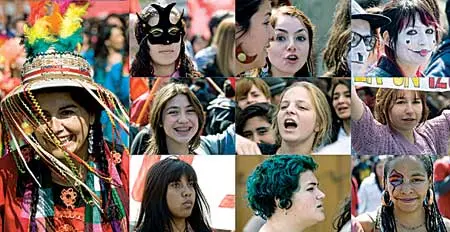
Fernando Balmaceda’s work was born from the street protests and rallies demanding social reform, with the series Marchas Estudiantiles, 2011-2013 as a testimony in 30 color photographs shot over a two-year period. Traveling along with this photographic record gave viewers a detail of recent events in Chilean history, and made it possible for them to recognize among those thousands of youngsters taking to the streets in the capital the conviction born from a critical look at the world.
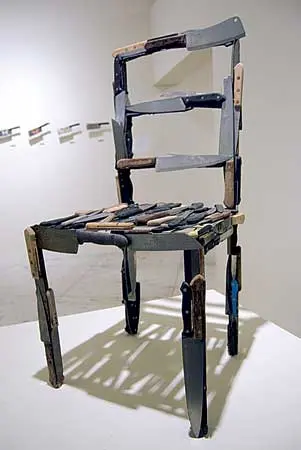
In the work of Catalina Mena, visitors to the gallery found another unsettling perspective on the contemporary Chilean scene, where the artist reinvents strategies for critical reading of her peers’ everyday life. Frequent in her work are uncomfortable signs of gender violence, domestic dramas, anguish, fear, and recursive suffering. The sharp-edged character of Mena’s work was in evidence in Silla, which can be interpreted as the cause of a cutting, challenging impression.
Without warning, a chair made of dozens of thin-edged kitchen knives, table knives, serrated knives, and also broad-bladed machetes, some in laminated steel, some polished, some rusty, imposed the presence of a disorder of the everyday. Among knives and machetes, the chair was created by the juncture of the steel and iron points and dozens of wood and plastic pegs and reminded viewers that this object, subtracted from its habitual uses, could find a different narrative use, anything but utilitarian yet easily recognized as domestic.
Along the same dense line, and as part of another investigation of the same general tenor, exhibited as an installation in Léxico Doméstico, a show at Isabel Aninat Gallery in Santiago, Mena presented, in critical dialog, a set of machetes in line against a wall. The thirteen machetes, perforated with precision and displaying a uniform shape and size, with shining prints, held motifs of different kinds of butterflies. Each print worked as support, as canvas or frame, was embroidered with a colorful motif.
Indeed, Catalina Mena’s visual poetics stands out in the Chilean context for its caustic understanding of the pitfalls of private life, expressed through the blunt, forceful display of divergent propositions present in established models, revised by the poetics of this young artist.
The next section featured the work of Pedro Tyler, a young Uruguayan artist living in Chile, who presented as well his sharp confrontation of the viewer with everyday objects, reconfigured as elements in an ambiguous, contradictory-seeming discourse. His recent Caja de Pandora continues on a path that the artist has explored in detail: the material resources of measurement systems, be it metric tapes or metal rulers, recur in his creations, always recomposed as narratives set on spatial arrangements. Comprised of nine knives attached to the wall and arranged in the shape of a box, its particular geometry displayed a series of prints created on the basis of metal rulers. Oscura Luz was also made using metal rulers and it presented a silhouette attached to the wall, a star composed by an arrangement of ten pointed metallic knives with measuring rulers transformed into sharp, stabbing objects. As part of this tense confrontation, Tyler also presented his 2009 video Vigilia, which featured metallic sounds and prints thrown by a knife-thrower.
As viewers returned towards the entrance to the large Gallery, they encounter María José Mir’s set of three works using seams on black, graphite, and gray fabric, with delicately composed points that formed a well-ordered patchwork. Pelos mecánicos 4.1 combined the memory of the practice of sewing and the context of an elaborate reflection on expanded pictorial fields, integrated into a textile matrix.
Exploring the large room revealed for viewers the scope of another project, this time thanks to the expression of Carolina Oltra’s work in the realm of photographic investigations. In her Bordes series, Oltra composes a vivid field of observation, transformed by backlight photography and placed in rustic wooden drawers mounted on wheels. In these six mobile wooden drawers arranged on the floor and lighted by LED lamps, the idea of a reinvented landscape was composed of images in stretched barbed wire, records of the twisted threads, and metallic mesh placed on various rocks. In this encounter with the landscape of Chile, with her exploration and recognition of the changes imposed by human activity on the natural environment—when the act of enclosing a space with barbed wire limits our access, when the metallic mesh that covers the rocks in the desert alters nature to fit the project of highway construction—Oltra moves around the territory as a traveler and an ethnographer/artist.
Desvelo, an installation by Angela Wilson, confronts viewers with nine interlining panels with digital prints and paint intervention, in mixed technique, including watercolor, China ink, and watered synthetic varnish, suspended from the gallery’s ceiling. Among the images printed and splotched on the panels, we recognized records of the past, historic photographic registers of Santiago de Chile, superimposed to create a transparency effect that traversed the city’s layers of memory.
Catalina Prado participated in the show with Mi patria, a recent mixed-technique work intended to embody an elaborate fiction of Chile. As a strategy, her painting created a historical detour on a physical map of the country. The support and the structure of the work were given by the cartographic scope of an old document, a map, marked by the artist with a new element: a painted self-portrait. On a large-format panel, three vertical bands displayed rock formations, peaks, plateaus, and plains from the landscape of Chile, and, to the left of the panel, the artist herself as the founder of the capital, painted next to Santiago’s colonial nucleus.
Denise Blanchard’s work, Paño de té, was comprised of an arrangement of dozens of used and discarded teabags, grouped to form a mosaic of wan colors created by the support’s exposure and drying times.
In their projects, Carlos Edwards and Rodrigo Bruna presented cuts, gashes, and fissures on a variety of materials, intended to incorporate renewed sensorial fields and experimentations that prodded the full activation of other modes of capturing the context of their works. In Flotante, from 2013, Edwards experimented with the physical alteration of hollowed-out granite blocks, submerged in water-filled acrylic boxes that favored flotation. For Rodrigo Bruna, the concept of Crack gave new scope to the record of a seismic movement, a recurrent topic in the Chilean imagination, on a trimmed plane arranged as a mural installation.
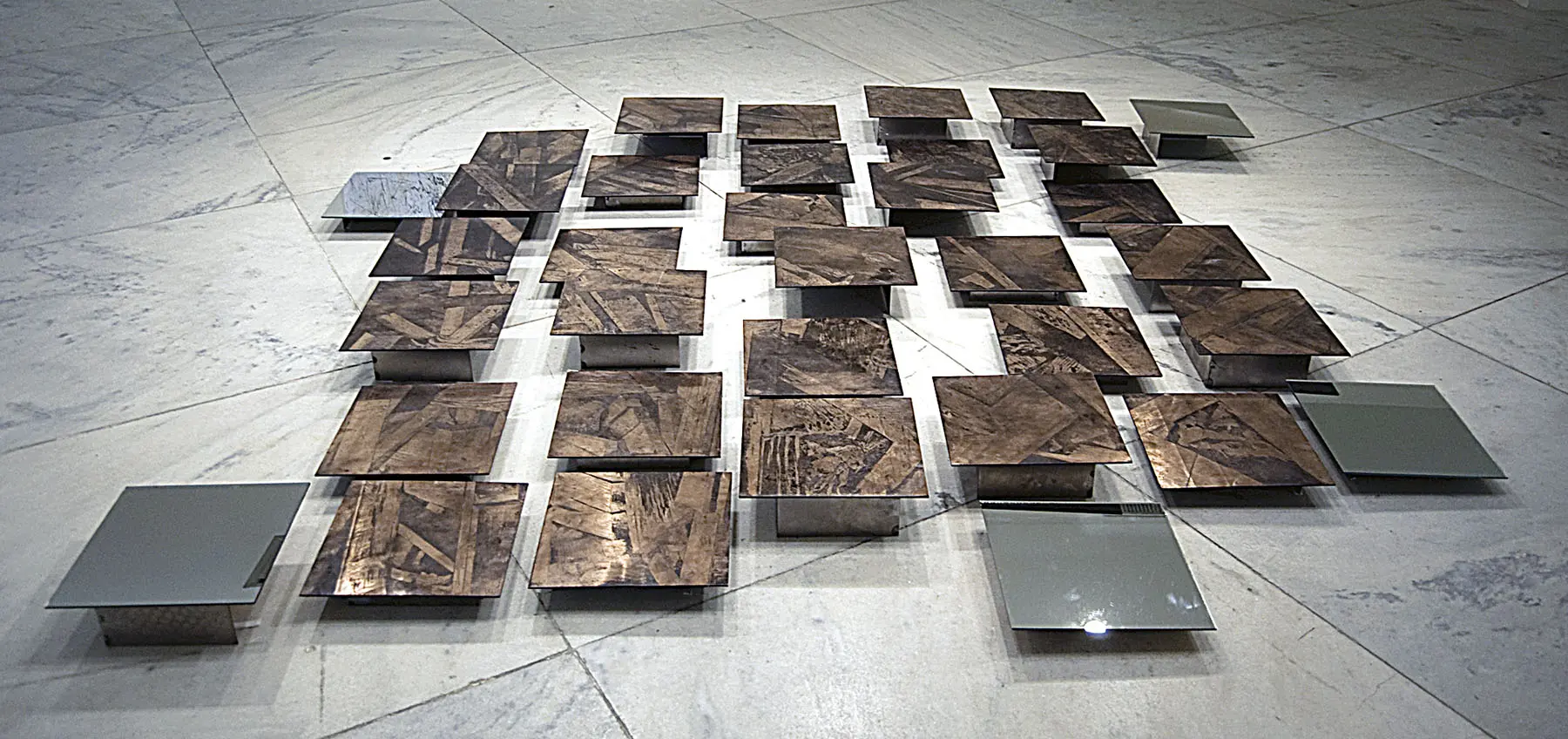
In separate spaces, Amelia Errázuriz and Cecilia Juillerat attempted to elaborate micro-narratives and shared a concern for the dynamics of an almost playful environment and the stories of a universe of children’s tales. In Geografías, Errázuriz proposed an arrangement of engraved bronze plaques, organized on the gallery floor as a reconceived game of memory. Juillerat presented painted and sewn narratives in a series of five paintings on interlining fabric.
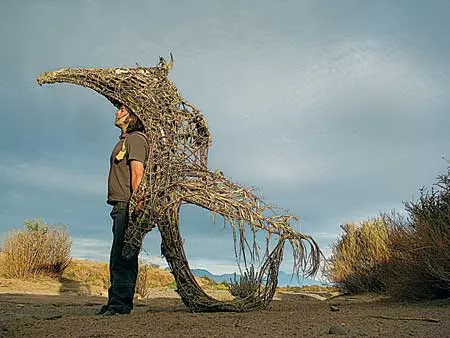
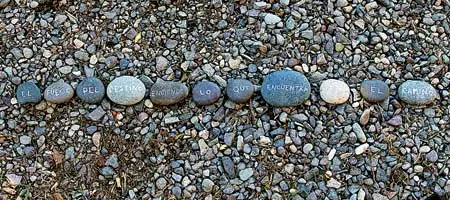
Lorenzo Moya and Francisco Ríos established lines of investigation founded on contact with the natural world and the shifts operated on our thinking about the landscape on the basis of its reinvention. For his Las piedras del camino, Moya uses landscape painting as a means to capture the gaze situated between two horizons, in the direction of photographic register, with an inscription painted on rocks: el fuego del destino enciende lo que encuentra en el camino (“the fire of destiny lights up what it finds in its path”). For Francisco Ríos, a collision with nature generates a trajectory through the different pre-Columbian cultures that inhabited the territory of Latin America. In Camahueto at the San Pedro Valley in Atacama, Ríos is photographed in the midst of an action, embodying an entity sculpted in plant fiber and connecting the earthly and the spiritual domains, according to the mythology of the Chilota indigenous group.

The line of investigation followed by Patricia Solminihac’s works included in this group show cohered with her recent approach. Interested in exploratory composition Solminihac seeks to question viewers with the full fragility of impossible plots. In her In Absentia, the photographic register of the artist’s everyday chores is printed in layers, and, as we move back through them, becomes permeable to the discovery of other possible meanings.
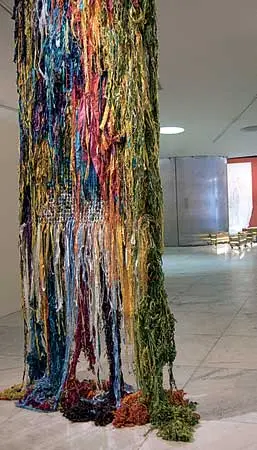
The context of Maite Izquierdo’s work proposed a new approach, with a textile environment presented as a single artwork in the exhibition space. A recent creation by the artist, Retazos gathers thin strips of woven material into residual layers—resulting from industrial-production waste—with colorful knots arranged on different levels.
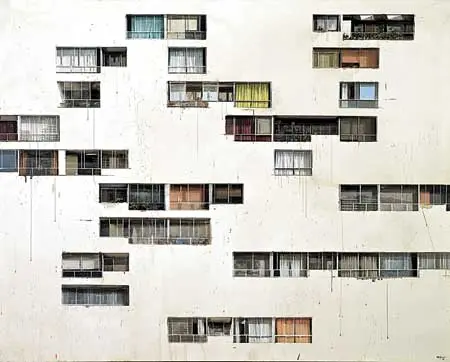
With his project Sociedad Anónima, Hernán Gana established a register that confounds the viewer’s perception. Using oil and acrylic on canvas, Gana paints more than 100 curtainless windows, exposed as in a photograph. The ruse and the viewer’s self-deception—provoked by the illusion of an image recreated in painting with the language of photography—were transformed into contingent elements of a kind of understanding of our environment that is connected to the artist’s study of contemporary life.
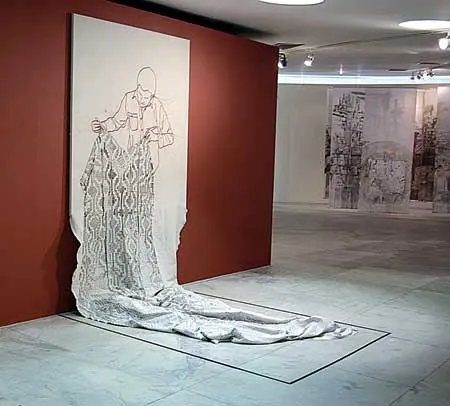
The space dedicated to Cristián Velasco’s project, in the main room, promoted an inscription of his work, driven by the symbolic dimensions of community-based social practices, as a significant presence in the working-class space, something frequent in the Latin American context, with a work reenergized by the experience of a sociocultural dialog with the past and with tradition.
With Revision de un proceso desvanecido, on display in the gallery’s central space, Velasco proposed a formal arrangement that unfolded into a detailed study combining embroidery and sewing into an artisanal synthesis. Revisión presented a male silhouette embroidered in red on cotton fabric, attached to the wall. The edges of the cotton fabric dislodged from the structure, and the silhouette of a blanket, embroidered in black thread, invaded the floor with its Mapuche motifs, commonly found in manufactured Chilean textiles. Velasco’s work, as in other occasions, investigates the traces of human action and their capacity for transformation, using elements of textile production as a recourse for revealing the conditions of a consistent Latin American cultural narrative.
Resulting from a series of experiences elaborated by the artists, the exhibition País Sonhado shed light on an emerging debate around matters present in the Chilean art scene: the revision of the past the recognition of issues that were determinant to the country’s artistic practice and continue to resonate.
Indeed, the Memorial da América Latina, considered as an architectural statement by Oscar Niemeyer’s political conscience, possesses unique conditions for a group exhibition of contemporary Chilean art, recovering the weight of a Latin American project of multiple forms of conscience and broad-based coexistence in a regional space.
CLAUDIA FAZZOLARI