
Wonderland is the title of the most recent series of works by Miami-based Cuban artist Rafael López-Ramos. The series, whose premiere took place last year at 17 Frost Art Space in Brooklyn, carries forth the line of investigation that has characterized the artist from the start of his career.
Interested in the deconstruction of the ideological fallacy that underpins contemporary Western society, Wonderland takes as its starting point various iconographies taken from the rarefied world of advertising, which, confronted in controversial fables, interrogate our aspirations, social goals, and personal fulfillment. Behind these intricate collages lies a sharp critique: the trivialization of our existence through the seductive and misleading universe of advertising, a ceaseless bombardment that predetermines our social role and our most intimate strivings.
The playful compositions in Wonderland imply an associative flirtation in the mind of the observer, who, based on the fragments that comprise the work, must reconstruct the intricate thread of the artist’s discourse. In a pastiche where sensuality approaches bawdiness—not because of the recurrence of genitalia, but because of its reduction to mere merchandise—López-Ramos creates sensations of simultaneous pleasure and repulsion, forcing us at the same time to reflect on the seductive world of advertising and its correspondence to our consumer needs and to veiled ideological messages.
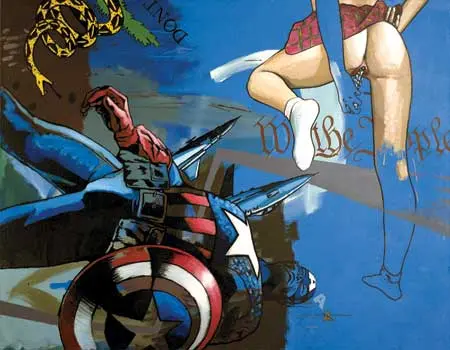
Starting with advertising to reflect on social and economic issues, Wonderland represents a moment of synthesis and revision of the artist’s career. The inclusion of objects, trademark logos, labels, and magazine images, among other elements, creates a palimpsest with multiple semantic layers, enticing like a threatening spider web.
Three main bodies of work appear in the series: Wonderland, Wonder Banners, and POLYsexyGONS. Wonder Banners uses for its support strips of decorative vinyl wallpaper. López-Ramos’ intervention on the support is directly connected to the boom period in an industry that soon becomes an echo of an achieved American dream.1 But these complacent, overly prim decorations—symbols of a promise of comfort and prosperity—are soon subjected to a critique for their metamorphosis of an ideology of control over women, reduced by the gender-assigned role to the domestic realm.2
Given this, Wonder Banner, which speaks of critical topics such as the economy or foreign policy, establishes an interesting conceptual bridge with POLYsexyGONS, focused on the recurrence of the female figure as a mere sexual object.
The recourse to the female figure is the leitmotif giving coherence to the series. López-Ramos leans on a long tradition—latent both in the fine arts and in the entertainment industry—where women are reduced to simple objects of desire. These misleading Madonnas—most in the midst of ecstasy that would rival that of Bernini’s Saint Theresa—appear suspended against backgrounds in an abstract-expressionist lineage and coexist with whimsical objects that generate a tensional counterpoint.
López-Ramos’ polygons intertwine with the tradition of trash art or junk art. His proposal implies a subversive appropriation of the residue of consumption that becomes an anti-establishment proclamation.
In Wonderland there are no hierarchies. The most innocuous objects—icons of our everyday life—coexist with heroes, politicians, and legendary dragons, among other characters, all of them amalgamated into an exuberant pastiche that embodies our contemporary society. This idea is reinforced by the use of collage and the incorporation of found objects that act as a playful detonator.
Irony and kitsch are the two main resources threading through the discourse of the series. López-Ramos’ mordant approach is deeply rooted in an extended feeling of disappointment and decay experienced daily by common people in our globalized world, where trust and a sense of the future become merely a mirage, achievable only through the fallacy of the mass media.
Rafael López-Ramos’ Wonderland unveils for us the subterfuge that underlies the seemingly harmless seductions of advertising. The complex apparatus of subjugation and ideological manipulation embodied in the media thus revealed, Wonderland, with obvious contact points with the work of Lewis Carroll, emerges as an unsettling parable of power and its control mechanisms, where a longed-for imaginary world of marvels and miracles becomes its precise opposite.
NOTES
1. The decorative-paper industry has its initial boom in the United States in the 1930s, and it saw a revival with the appearance of vinyl products in 1947 and pre-glued papers in the 1950s.
2. In that connection it is necessary to mention Charlotte Perkins Gilman's novel The Yellow Wallpaper.
JANET BATET