
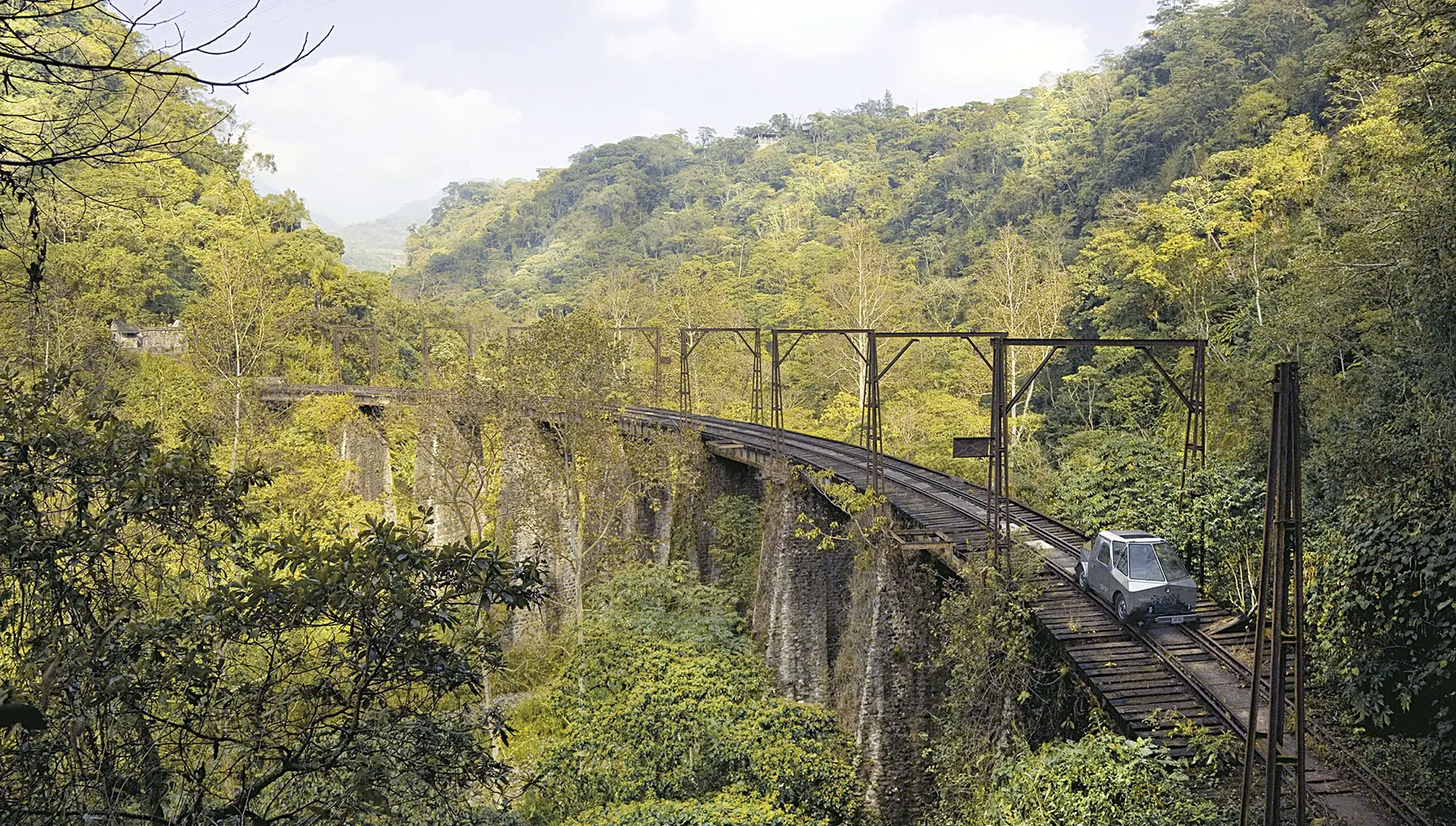
One hundred years ago, the landscape of the railroad system in Europe was very different than today. The network was growing and featured, as part of its grid, important examples of world-class engineering. The railroad was a symbol of progress; a forward march that seemed to be conquered, by means of rails and cross ties, the entire country. Proof of this is an 1881 painting by José María Velasco which featured a train, pulled by a steam locomotive, traversing the Metlac Bridge (the structure that gives the painting its title) with a wilderness landscape in the background. Around 1910, the railroad acquired a new significance thanks to the crucial role it played in the Revolution. The post-revolutionary state created a myth around these machines, connecting them to social change. This perception of the railroad was disseminated through art as well as through literature and movies. The myth has survived until our own era, as demonstrated by the commemorative banknote emitted by Banco de México in 2012, featuring a heroic image of a locomotive. That same year, as the Bicentennial of Mexico’s independence and the Centennial of the Revolution was being celebrated, Iván Puig and Andrés Padilla began the earliest explorations for their SEFT-11 project, evaluating, through several study trips to the ruins of what had been that wondrous railroad network, the course followed by the ideas of progress and revolutionary change that are contained in the figure of the train at a distance of at least a century. Against the ideals formulated initially, the contrast between these two eras does not reveal as can be seen in the final results of the project as a whole a continuity in development and “progress,” but a process of impoverishment and increasing marginalization.
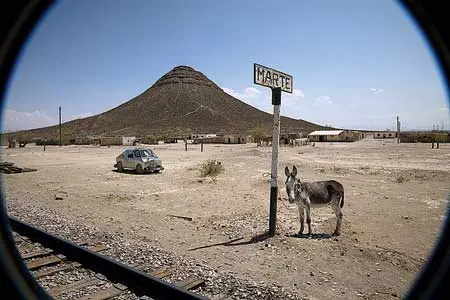
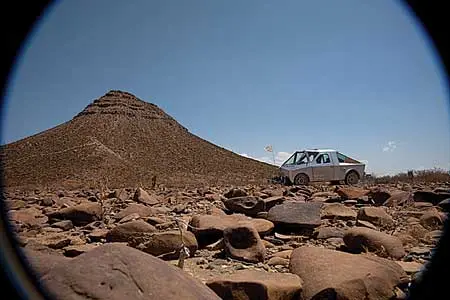
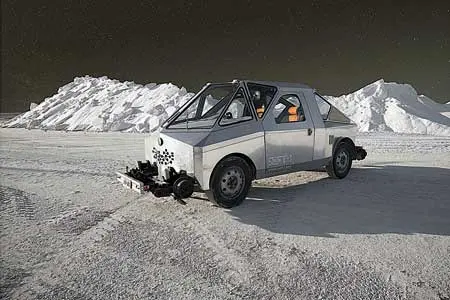
The SEFT-1 (Manned Railroad Exploratory Probe, in its Spanish acronym) is a vehicle designed by Puig and Padilla, capable of moving both on expressways and on rails. Its appearance, both inside and outside, refers to a Sci-Fi aesthetic, mainly to vehicles used for traveling on the surface of satellites and other planets. Like scientists investigating never-before-seen terrains, Puig and Padilla kept logs and records (using photography and video) of their explorations on the various railroad lines that criss-cross the country, and they collected and organized objects and materials found throughout the route. These documents were open for consultation for the public almost immediately after they were found or recorded by the authors, via the project’s web page. This strategy can be understood as an updating, using contemporary communications technology, of the activities of traveling artists who worked through the Nineteenth Century, who combined scientific investigation and visual arts.
The result of several months traveling through the remains of Mexico’s railroad system can be seen, in large measure, as possessing a documentary character. The artists interviewed numerous people who explained how life was in their communities before the 1990s, the decade when the network was entirely privatized and large-scale passenger trips came to an end. Remote villages not accessible by highway, previously connected via the railroad, were suddenly left isolated. A network that at some point had represented progress, change, and material abundance began to undergo along its entire length a process of impoverishment, decay, and disintegration; precisely the opposite of the promises and ideals contained in the image of the train. Puig and Padilla deploy multiple solutions beyond the documentary record in order to emphasize the contrast; in this way, they formulate a critique of the current state of affairs. An example of these strategies is their quote, using photography of Velasco’s painting El Puente de Metlac. The artists positioned the SEFT-1 at the same angle Velasco had placed the steam locomotive in his composition. The final image produced a feeling of estrangement, as we discover the futuristic-looking machine in the midst of the tropical landscape. Above all, the photograph spotlights the current state of the structure, victim of disuse and decay, and contrasts it with the practically brand-new version depicted in Velasco’s 1881 painting.
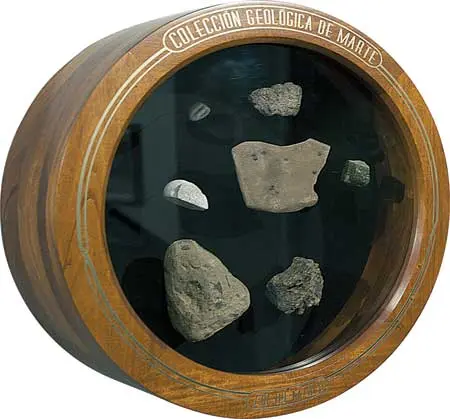
Since the first exhibition of the results of the project at the Museo Nacional de Arte in 2011, the artists have developed an installation featuring some of the photographs and videos of their explorations, computers with access to the web page, graphic interventions on the walls, as well as an arrangement of the material samples collected along the way. With these, they create an information-loaded space that, among other things, presents a panoramic vista of the current situation of the country through the ruins of a railroad system that covers it from north to south and from coast to coast. In this way, the project puts on display everything from the convulsive geography of the county’s northern region, marked by conflicts between organized-crime groups, to the spectacular and manic architecture erected in the central area of the nation’s territory in celebration of the Bicentennial and the Centennial. Similarly, the project’s installations reveal with greater clarity the connection that the artists seek to establish with a science-fiction narrative. The artists present their findings like explorers after an expedition to a remote, unknown place: objects that are subjected to a classificatory system of the artists’ own invention, and put on display in the manner of old cabinets. The objects lend themselves to an interplay of free associations on the part of viewers, although they mostly coincide with representations of ruins, waste, detritus, obsolescence, and death. The objects—technologies in disuse, merchandise rendered useless by the effects of weather, animal bones—reinforce the intention of signaling the way in which, over the course of the last 100 years, the idea of progress has not brought along any advance, welfare, or development. This reflection is also engaged through humor, as can be seen, for instance, in a photograph of a sign indicating the name of a village, “Marte,” used to tie down a donkey.
The SEFT-1 vehicle has also operated in Ecuador’s railroad system, where the artists explored three networks in 2012. Although caused by particular and specific circumstances, the current state of the Ecuadorian railroad system is similar to that of Mexico. This can be seen in the documentation and record of the routs, which can be perused via the SEFT-1 web page. Since the beginning of his career, Iván Puig has created a series known as Historias de América Latina, where he revisits historical experiences that are shared by countries in the region, as in Parallantos, which can apply both to Mexico and Colombia (where it was first exhibited in 2009) with its focus on an analysis of the violence suffered in both countries as the State and organized crime clash. Through its explorations in Ecuador, SEFT-1 connects with this line in Puig’s work. Were this project to travel to other Latin American countries, the results are very likely to be similar. Besides contemplating local histories, the SEFT-1 project highlights the region’s shared historical processes, in this case binging to the fore the privileging of highway development to least since the post-war period, as well as the decay of public infrastructure as a consequence of neoliberal policies implemented on a regional scale since the 1980s.
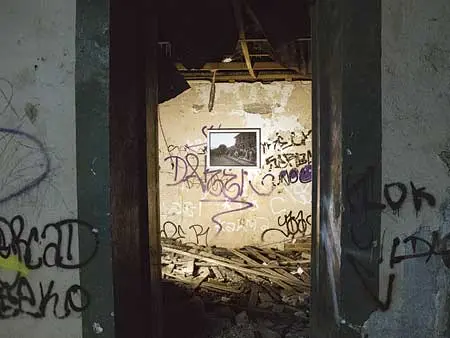
Puig and Padilla recently presented the SEFT-1 project in the city of Cuernavaca, in the Mexican state of Morelos. For the first time on this occasion, they set aside the installation strategy commonly used to display the results of their investigation. Exhibiting in an abandoned railroad station, the artists opted for a solution that included intervening in the site. The Cuernavaca station, abandoned for over a decade, was left in a total state of blight after a fire couple of years ago. After years of inactivity, the artists restored the building’s electrical connection, lighting, and showcased its now-ruined architecture like never before. They also intervened in the building’s original, early twentieth-century architectural plan, so that the image bears witness to its current deterioration. To underscore the temporal contrast that permeates their proposal, the artists placed inside one of the building’s most damaged rooms an image of the station from its boom times; they also created an audio work featuring a description by one of the station’s former workers of the space’s original characteristics, its furniture, and its operation. Puig and Padilla also printed a poster, displayed it in a movie-theater marquee, with the slogan: “The ruins of the future are built today”. This assertion prefigures the activity of others who, like Puig and Padilla, may be emboldened to investigate and consider the course of our ideas of progress in the future.
NOTE
1. SEFT -1 has been developed from 2010 to 2013.
* All images illustrating the text are courtesy of the artists and Arróniz Arte Contemporáneo, Mexico.
DANIEL GARZA USABIAGA
Doctor in History and Art Theory. Visual Arts Coordinator of the Museo Universitario del Chopo, D.F.