
a) I must display some drawings in a gallery. Before mounting them on the wall, they are on the floor. The empty sensation of it being absurd.
b) I walk toward the gallery. The discomfort of certain expressions like “my work” or “the piece,” implies a desire to make certain actions productive.
c) I arrive at the gallery and a spell is broken. Papers lie on the floor about to become nothing.
This is an excerpt from the number 17 text that was part of one of the pieces in the exhibition titled Essay by Bernardo Ortiz. There were a total of 19 texts that appeared in the lower part over yellow painting; “footnotes” that not solely acquired the appearance of pages but also of drawings in which the artist offered reflections, anecdotes, or invented quotations about actions and themes that converged with his artistic practice. Honoré de Balzac, Ludwig Wittgenstein, Haruki Murakami, and Giorgio Agamben, among others, were enunciated as references that stimulated the works and, most importantly, the visual display that Ortiz installed in the gallery.
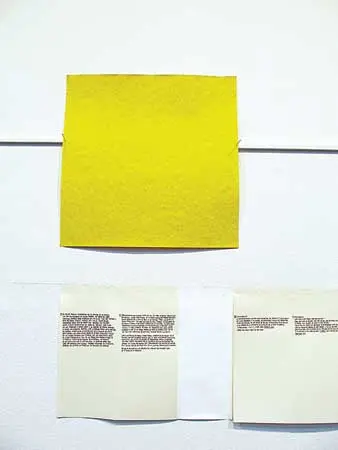
Viewers encountered formalist creations that were barely attached to the wall by pins or by balsa wood sticks and that were easily affected by the lightest of breezes. These moving papers could even be described as alive. Their color and transparency were exposed, and so were their lines, points, and stains. Ortiz’s interventions on the surfaces warned us of something. They were his thought routines on display. The placement of the works was suggestive to visitors who time and time again—as if in a dance—had to get close or move far away in order to see the works, in something that could be considered an extension of the very act of “perceiving.” Ortiz arranged the works in such a manner that a “sort of dance” was possible as part of a strategy without warranties.
Another brief text, displayed on one of those yellowish pages that Ortiz often uses, commented on the expression “that painting does not tell me anything,” a statement or even an incisive complaint often pronounced by viewers that, on this occasion, was answered with the offhand remark: “As if a painting had to speak, respond or mean anything.”
To quote this part of the writing is a way of being reminded of the dramatic statement contained in the pieces that Bernardo Ortiz displayed in the space: namely that his devices seduce and inquire but do not explain. These fragments either say something or nothing at all and at some point make those who read them feel lost. The occurrence experienced is reminiscent of Alice’s bewilderment as a result of the riddles posed to her at every turn by the fiction she found herself immersed in.
In Drawings, an exhibition presented in 2011 at the same gallery, Ortiz’s proposal was in some ways even more cryptic. As the artist himself has said, although in that exhibition his preoccupations were the same as those latent in Essays, he acknowledged that in the most recent exhibition, there was the explicit intention of revealing more of his creative processes, to the extent of even including the personal and mundane anecdotes that unavoidably permeate his work. This intention led him to include documents as an archive of relational—and chaotic—schemes, along with texts that became the leitmotiv with which he pieced together the concept and form of the exhibition project. It is important to point out that these types of strategies are coherent with Ortiz’s interest in building proposals in which openness as an active element remains relevant and is able to breathe.
In another exhibition room, a table with two chairs and a watch await the action scheduled to be performed by Ortiz and Erick Beltrán—a guest Mexican artist—three weeks after the opening of the show. Game Piece turned out to be the match that lit the fuse of ideas proposed by the other works. The action planned by the two artists consisted of a conversation that simulated the method of the exquisite corpse game. Each speaker would project an image and begin to say things about the image. In turn, the members of the public would become the “confused” witnesses that attempted to follow the game, in the middle of a back and forth of stories that would oscillate between fiction and reality. It was a performance based on the language games proposed by Ludwig Wittgenstein in his book Philosophical Investigations (1953). Before that action took place, the artists hung on the wall evocative images whose dialogue in crescendo was about to elicit.
When one evaluates the exhibition in its entirety, then the drawings, paintings, texts, printed archives, and even the presence of the exhibition room where Game Piece took place, can be compared to visiting a toy store or a store of objects designed to stimulate in young children an appreciation for mathematics, perception, and abstraction. And although such comparison could to a certain extent be construed as daring, it does allow us to put on the table the elements that Ortiz favors, in order to strengthen the act of looking, the quiet contemplation of forms created by the folding of a piece of paper, or to find out how is it that a surface unfolds, the effect of color or of the stains that are presented as such. What are we looking at in Essay? And, most importantly, what do these papers contain? Perhaps, as Bernardo Ortiz surely would say without hesitation: “everything and nothing at once.”
ERIKA MARTÍNEZ CUERVO