
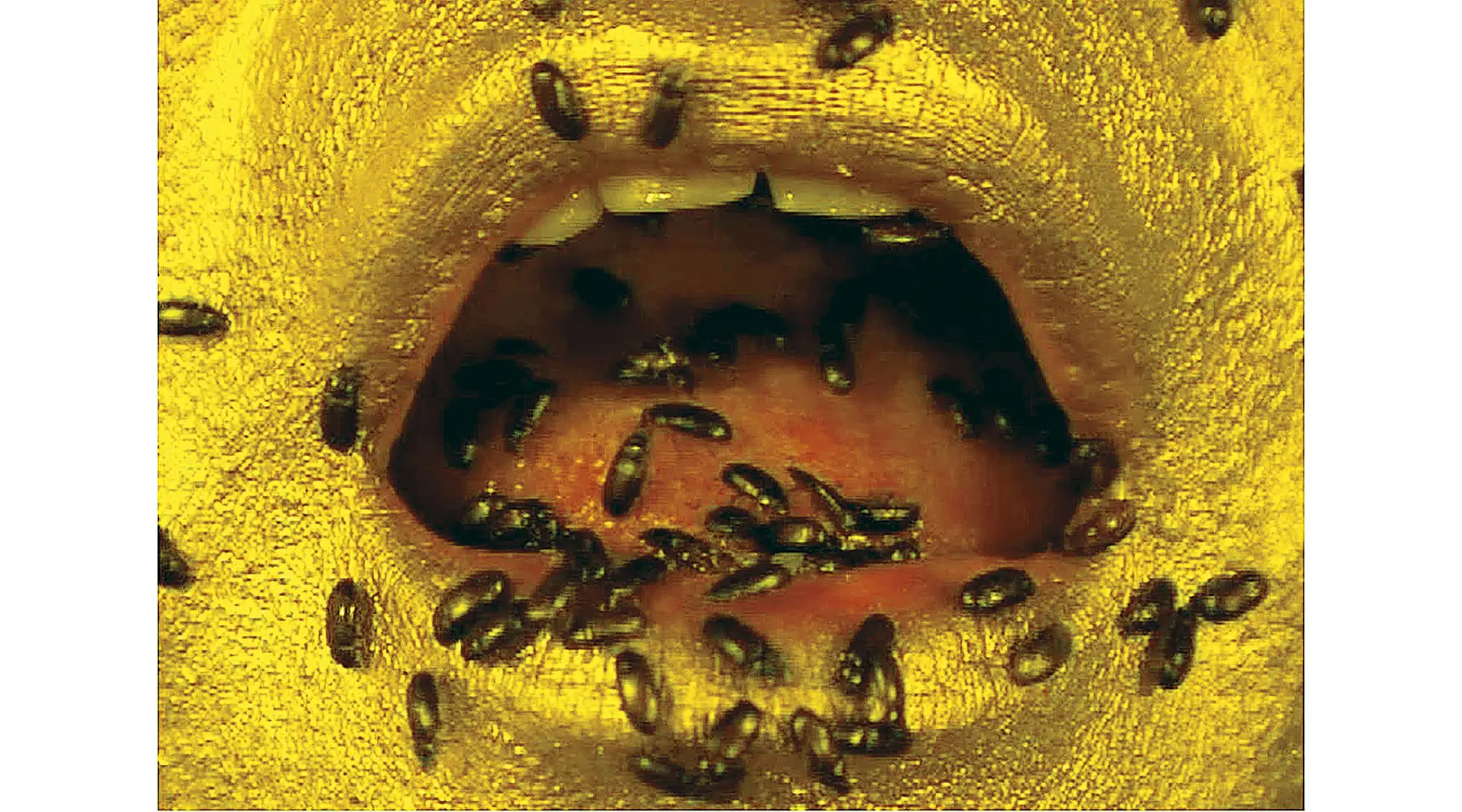
Writing about the experience of visiting a Biennial means already presenting readers with a partisan argument. Any critical piece of writing is, first and foremost, permeated by the cultural baggage and the acquired knowledge of the person analyzing the curatorship, the spaces, and the artists on the exhibit. To my mind, it is also important to note as part of the data for the writer his or her course through gallery after gallery filled with poetics that in general point in disparate directions, not to mention the necessary travel between the various institutions hosting the event, which add to the cultural estrangement of any foreign visitor to the city.
Having said this, let’s confront the challenge of commenting on the Curitiba Biennial. The 2013 edition marks the event’s 20th-anniversary celebration, bringing to its visitors the memory of a trajectory that began in 1993 as the VientoSur Visual Arts Show. In subsequent editions, the curators strove to bring together artists of what is known as the Southern Cone (Argentina, Chile, and Uruguay), added to representatives of Brazil and Paraguay. Starting in 2009, the event was rechristened “biennial,” and in 2011 it officially became the International Curitiba Biennial. With this, Latin America ceased to be the explicit focus and the event reached a level of international participation similar to that of the Mercosur Biennial held in the nearby city of Porto Alegre during more or less the same period.
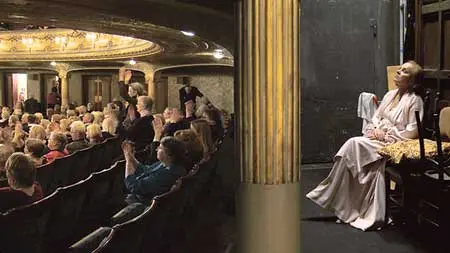
We must not leave unmentioned the city itself, Curitiba, where the event takes place. The capital of the southern state of Paraná, Curitiba possesses a diverse ethnic composition thanks to several ways of immigration in the Nineteenth and Twentieth Centuries. German, Polish, Ukrainian, Italian, and Japanese populations arrived in Paraná, worked in agriculture, established small towns marked with the seal of their respective home cultures, and became integrated into Brazilian society, which, as is known, holds miscigenação, the mixing of blood, as one of its cardinal rules.
In that sense—and speaking from the point of view of a person born in Rio de Janeiro, which for better or worse became Brazil’s postcard to the world since the time it was the nation’s capital to the present—Curitiba does not fit into the expected exoticism of a tropical paradise. Arriving at the airport, one hears locals conversing in German; walking around the urban grid, one perceives a particular sense of spatial organization and the cleanliness of the streets that makes its inhabitants so proud. Where is the cultural landscape of chaos, informality, and confusion framed by the ocean and the Atlantic forest? For sure, that brasiliana iconography, established in the Nineteenth Century by artists-explorers and promptly exported to Europe, does not fit into the sometimes aseptic presentation of the city of Curitiba. One must conclude that, felicitously, many Brazils coexist in this nation; in other words, that terra brasilensis is not confined to São Paulo and Rio de Janeiro.

After these considerations about Curitiba, to which I would like to return later in this article, the question remains: having set aside the “Latin American” focus of the exhibition and having established itself as an international biennial, what are the curator’s responses to the challenge of putting forth a large-scale event in a city that defies the Brazilian stereotype? Teixeira Coelho and Ticio Escobar opted for conceiving the exhibition on the basis of the absence of a proper name. The first text in the catalog, authored by Teixeira Coelho, is titled “Biennial, Words, and Art.” After an interesting archeological exploration of the idea of the art exhibit in Western culture, from the cabinets of curiosities to contemporary art fairs, Teixeira Coelho comments on his curatorial proposal:”…a Biennial is justified as a totality, rather than through each of the individual works it contains, in the hope or the belief that a universal justification will justify the particular as well. The justification of the biennial as a totality comes from the adoption of what became a cultural habit: a title and a theme, even a working hypothesis.”
In other words, the text critiques the establishment of exclusionary themes and asserts that nothing of the sort takes place in this biennial; or, as some readers may deduce, that the absence of a theme is the theme here. Coelho hastens to add that “…in the past, the biennial became a matter of words. The word comes first, then the art, an option perhaps derived from a misinterpretation of sacred texts that tell us that “in the beginning was the Word”: Word there means action. And action is art. Art, then, comes first.” It suffices to contrast this edition of the Curitiba Biennial with its immediate predecessor, curated by Ticio Escobar and Alfons Hug and titled Beyond the Crisis, to realize that, yes, the seeming absence of a proper name is a welcome relief from the diffuse curatorial framework previously proposed.

However, what was interesting to personally confirm in this biennial was the way in which that discourse is clearly articulated in the event’s main exhibition. A kind of “central pavilion” (thinking of a model such as the Venice Biennale) located in the Oscar Niemeyer Museum, while other spaces lacked a unitary connection with the whole. As Teixeira Coelho puts it at the end of his text: “This doesn’t mean that there is no proposal here, as can easily be seen. But the proposal is not speculative, nor does it launch a thesis; if such a thing were possible, it is empirical in nature.”
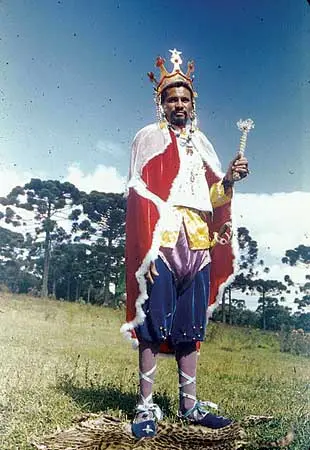
This drive is clearly on display, for example, in the video exhibit presented in the space mentioned, which featured a variety of aesthetic proposals in different projection rooms. Whatever connections the viewer was able to make between, for example, Abismo, by João Castillo, which “interrogated” negritude on the basis of a relationship to the landscape, and Belo Monte, a contemplative video work by Caio Reisewitz, those bridges were never a single, one-way path. There was room there, as Marcel Duchamp advocated, for an exercise in artistic coefficients on the part of the observer; this is to say, it was necessary for us to connect the dots of the curatorial narrative too, according to our own experience along with the show, make the lines born from such encounters fully believable.
This topic reappears in the text about the Biennial’s largest series of galleries we encountered at the Oscar Niemeyer Museum. Authored by Ticio Escobar and Adriana Almada, adjunct general curator, and titled After the Title, it rejects a certain formalist tendency in contemporary art as well as its content potential. In the author’s terms, space is sought between “lite aestheticism” and “the protracted dictatorship of meaning.” According to them, the event needed to privilege a trans-disciplinary character that put in play the open work of art as posited by Umberto Eco in his 1972 book of that title. Interestingly, however, there is a small contradiction in this proposal: the authors end up asserting that “the exhibition works through certain matters in contemporary art that, according to the general curatorial concept, are not presented in a thematic sequence, but, for editorial purposes only, are grouped under headings that help our reading.”
It is precisely those headings that run counter to the organization of the works in the show. As we first entered, we were welcomed by an interesting gallery (perhaps due more to the relevance of the topic than the power of the images) with works by indigenous artists who participated in the 1st Contemporary Indigenous Art Biennial held in Mexico in 2012. How necessary was it to open a separate space to house these works, and to label it Other Gazes, placing them in such proximity to one another as to constitute almost a small stand-alone group exhibit within the general, collective nature of the biennial? Even if we can understand the pedagogical intent and the need to bring this art closer to the general public (a desire made explicit by the curators, and indeed laudable), was it necessary to make the spatiality so obvious? Wasn’t it possible to maintain the environment as a constellation (another term used by the curators, which also brings to mind the most recent São Paulo Biennial) with clear gulfs and trajectories, as seen in a much more efficient way in the video exhibit?
And many more subdivisions are found throughout the museum: Behind the Scene; Image, Memory, and Trauma; Circular River. And graver that this case seems to me the other museums in Curitiba with exhibitions signed by Tereza de Arruda. Two exhibitions inscribed in a series titled Disparities on View exist in a large disconnect from the basic initial proposal. As I explored these two exhibitions, Personification of Identities (Casa Andrada Muricy) and Constructions of Illusion (SESC Paço da Liberdade), I was left wondering, again, how necessary is it to create subdivisions for the audience? Was there perhaps a fear of thinking the event in a more organic way, as a whole, perplexing the public? Why announcing so incisively in the curatorial discourse the peculiar strength of each work, there not being subject to a different discourse (which can be illustrative) and, moreover, to the taste and subjectivity of the curator? More than once in these museums, I found interesting images that nevertheless, as Teixeira Coelho posits in his text, could not be contained in the labels referred to the field of theorizing human experiences in the contemporary era.
On the other hand, the general curator’s decision to work with a team of young curators who, according to Stephanie Dahn Batista, went through Curitiba’s public collections in search of works able to establish a dialog with Brazilian and foreign artists, struck me as productive. The nonlinearity of the exhibitions conceived for five of the city’s remaining museums, especially at the Museum of Photography and the Print Museum, agreed with the curatorial intent as I was able to understand it, and clashed with topics present, for instance, at the Oscar Niemeyer Museum. All of this without recourse to conceptual shields of any kind, but instead connecting images that because of their power appealed to the viewer’s reasoning, always by means of spatiality that prompts and motivates, like that of film editing.
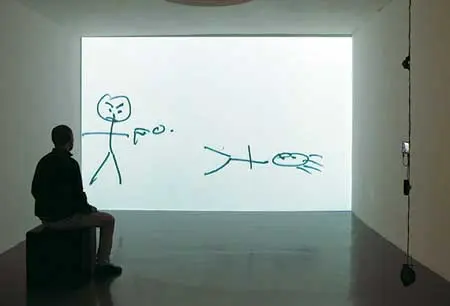
What are then some of the themes fluctuating in the Curitiba Biennial’s exhibitions? Going back to the issue of contemporary indigenous art, mentioned above, I believe that the borders between problematic categories such as “popular art” and “erudite art” touch some of the artists selected, be it those receiving awards in Mexico or even at the Oscar Niemeyer Museum. I must note the acuity of a local figure previously unknown to me, Efigênia Rolim, who presented objects and an interview and reprocessed one material culture into another (not that of ceramics and traditions that are often interpreted in a primitivist key, but of that which is excess in industrial culture). In the same sense, it was possible to connect her work with a name of growing importance in the international reception of “Brazilian art,” Adriano Costa, who also groups and reconfigures precarious objects in search of reasserting the flatness of the ground and inviting viewers to enjoy them through relationships of color and geometry.
As Stephanie Dahn Batista comments in her text for the catalog—and I fully agree— the decision to display images by ethnographer, photographer, and draftsman Vladimir Kozak, who lived in Curitiba between 1938 and 1979, was significant. Besides stretching the boundaries of the visual arts and helping us reflect on images that are perhaps closer to the concept of visual culture for the era, it curated the gaze of a contemporary artist who appropriated a culture of images, and in that way contributed to making the general public more familiar with a little-known, little-studied figure in the history of the image in Brazil. Similarly, the exhibition of part of the collection of Potty Lazzarotto, another Curitiba-based artist who collected ceramic artifacts from various indigenous cultures, also facilitated formal and semantic connections beyond the boundaries of the conceptual character of contemporary art; in those moments we are reminded that any production of images requires concepts in order to exist.
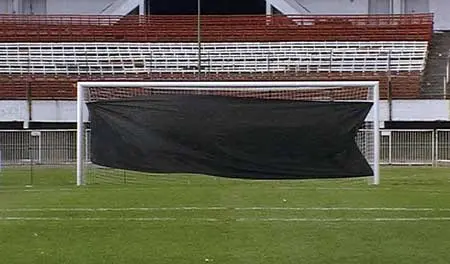
Something else that grabbed my attention was the significant presence of Latin American artists, especially from Spanish-speaking countries. If on the one hand, they match a certain international expectation in terms of shows of Latin American art, with many of the works selected dealing with violence and representations of matter of local identity, on the other hand, some of them put forth interesting proposals interrogating the role of the political in contemporary art. I am referring here to a video by Carlos Trilnic, 1978-2003, where the violence of the Argentine dictatorship as the World Cup was taking place is remembered by means of the simple, yet painful, act of hanging a black cloth from a soccer-field goal. The wind makes the mourning cloth sway as the bodies of soccer fans characteristically do in the bleachers. With Desapariciones, Colombia’s Edwin Sánchez combines declarations by witnesses of drug-trafficking activities in Bogotá with drawings that transform the text into explicit cruelties. Between cartoons, caricatures, and the weight of history, these anonymous voices never cease speaking.
Finally, and to return to the issue of the central role played by the city of Curitiba itself in this event, I will again quote the words of Teixeira Coelho: “Not only can the same title or theme be found in two biennials held in different cities and different years, but the same selection of works can accommodate different titles and themes.” Although the initial intention of the curators deserves attention for their supposed rejection of any specific themes, it is impossible not to notice that, as the curator says about other exhibitions, it could be accused of making a number of choices that could also be on exhibit anywhere in the world, and more than once at that. In that sense, given Curitiba’s cultural wealth and the elusive character of a stereotypical image of Brazil, I think that something to be explored in the future is the pertinence of the exhibition to local culture and the dialog between the two.
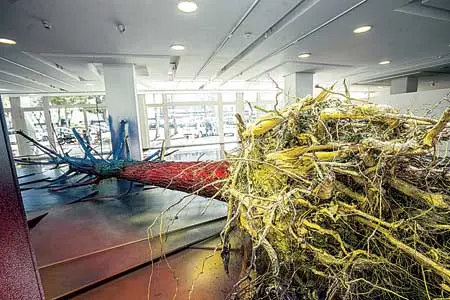
As an anecdote, I remember a work by Katharina Grosse on exhibit at the FIEP Cultural Center. It is an araucaria tree, a symbol of Paraná’s cultural identity and the origin of Curitiba’s name. Overturned, it presented the public with a view of its roots. As it is to be expected from her artistic investigation, Grosse created, according to the catalog text,¿“a new work of art, investigating the vitality of her expansive line, color, and form in unique combinations, inserted in materials from the local context, thus shaping a dialog between her artistic practice and ‘brazilianness’ as she sees it.”
Not knowing what species of tree I was looking at, I asked the guide present at the site if it was an araucaria. To my surprise, the young man was uncertain and seemed to have never even wondered about it. To use this as a metaphor, I believe that the Curitiba Biennial will have much to gain from not being like that araucaria tree forgotten on the ground.
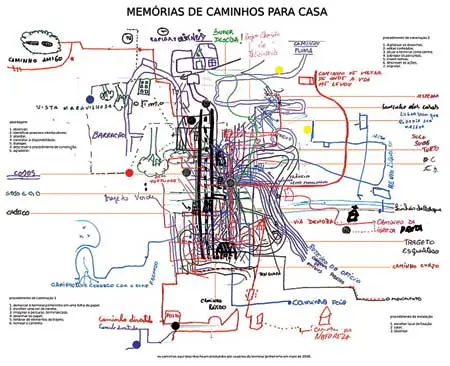
The issue is not to select works of art that illustrate the city of Curitiba, but to map, like the E/OU collective proposes in its artistic experiences, the many public, private, and imaginary histories that a city with so many strata has to offer. On that basis, we shall perhaps think of Curitiba, and of the arts, beyond the idea of location, in dialog with a certain global contemporary art scene, and always, it is my hope, in search of the existential matters that come through in the images.
RAPHAEL FONSECA
Critic, curator, and art historian. Professor do Colégio Pedro II. Gathers his written production in the blog http://gabinetedejeronimo.blogspot.com