
To reflect on the work by Gilda Mantilla (Los Angeles, 1967) is to enter into one of the most mesmerizing artistic trajectories in the local art scene of Peru. Since the late 1980s, Mantilla has used painting and drawing as seismographs for contemporary life. Her first works attempted horizontal dialogues with the popular aesthetics and visual resources found on the streets, as she explored the ways in which these changeable visual manifestations shaped subjectivity and desire day-to-day. It was unavoidable to perceive in her painting certain autobiographical elements that always pointed to deep-rooted social issues: religious tradition in the national culture, the commercialization of beauty, popular advertisement, and street painting, among others. Mantilla’s paintings made no concessions when it came to introducing compelling and sharp commentary on everyday effective negotiations between female-marked bodies and the public sphere.
Eventually, Mantilla began to use drawing as a tool for analysis and research, sometimes in collaboration with artist Raimond Chaves (Bogotá, 1963). Together, they have completed visual expeditions through several Latin American cities, edited street periodicals, created sculptures and installations that explore the weather and its effect on local populations, among other projects. Following this last long working period of collaboration with Chaves, Mantilla has resumed her personal production through two solo exhibitions that should be approached as part of the same research: It is Necessary to Confront Vague Ideas with Clear Images (2010), and the ongoing exhibition A Thing like You or Me, both at Galería Revólver.
Mantilla’s resumption of her personal work is truly promising. Her most recent proposals pick up the elegant simplicity that questions and explores the expressive possibilities of the apparently banal and insignificant, in this instance, she chose glass as the central element of her new project. It serves as an excuse to ponder about the limitations of representation and the possibilities of communication in an environment oversaturated with messages and content. The subtlety and intelligence of her new works surprise and challenge any expectations of literality and speed imposed by the market on contemporary art productions. In A Thing like You or Me, the simple glass appears in several drawings and sculptures that serve as questions about stability, observation, doubt, pain, urgency, impossibility, and desire.
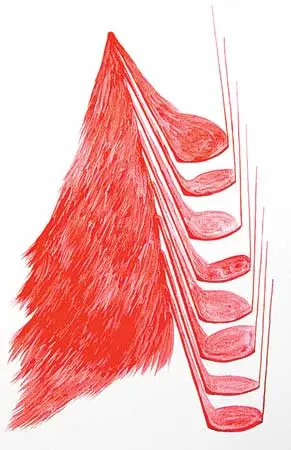
One drawing describes the glass silhouette repeatedly and in ascending order. The reiteration of the intense red color suggests a precarious column that at its top appears to turn into the top and hillside of a mountain. This glass landscape suggests flow, contention, nature, and, on the other hand, disaster, agitation, and tragedy. Conversely, other glasses are depicted upside down, piled one on top of the others. These have stopped serving as mere liquid containers and appear to be imagining other lives and functionalities, with their external surfaces serving as new support. Other works are allegories for movement and the eventual migration. Like those in which a black liquid subtly advances through the thin borders of two glasses placed next to each other; or in a sculpture where a dark stain drips from one glass into another, without exactly revealing which direction the liquid is moving toward.
In other works yet, the glass is transformed, it has turned into Siamese twins united at the base or mouth, or it has become a rough or a pointed surface with erotic evocations. In the same manner, other forms also emerge, like a glass plant, a glass stain, a glass-shadow, a glass-no-glass, a glass-cape, a glass moon, or a glass leg. The question about the apparent utility of the element never stops being present. In no instance is the glass described as fulfilling its conventional purpose of containing liquid, nor does its content stay quiet before the object that tries to contain it. The exhibition emphasizes the tension between that which resists being surrounded, restrained, and contained and, on the other hand, a receptacle avid to contain but simply unable to do so. Furthermore, notwithstanding the aforementioned, one could affirm that the glasses depicted in the exhibition are not actually, and never have been, glasses.
Mantilla approaches the object and its image for what it truly is: namely, more than a representation subjected to a pre-established social contract or any preconceived notion of the relationship between image and meaning. This is to say: That which is, is the enigma of that which we do not know what it is or the purpose that it serves; A Thing like You or Me.
MIGUEL A. LÓPEZ