
Héctor Zamora: Panglossian Paradigm is one of the first projects curated by Ruth Estévez in her new post as Gallery Director and Curator of REDCAT, Los Angeles, since November 2012. The sculptural installation consists of a hollow construction stud frame that was built up from a wooden frame interlocked inside shopping carts. Héctor Zamora (Mexico, b. 1974, lives in Brazil) has been interested in transforming spaces for more than a decade, using materials that are culturally charged and pertinent to the community or place where his projects are presented, in the form of social critique but also challenging utopian ideas of stability and progress. His iconic piece Paracaidista, from 2004, on the façade of Museo Carrillo Gil in Mexico City, entailed the physical invasion of a public institution with a parasitic architectural structure that was built with the aid and supervision of architects and construction workers. Paracaidismo in Mexico is the term used for the illegal practice of occupying the abandoned property, but in the case of this work, the “parasite” to the museum was a structure that functioned fully as a home to Zamora in the duration of the exhibition. Its temporality and precariousness were part of his institutional critique, which questioned several sociopolitical levels; the role of the museum, the role of the artist, the blur between legality and illegality, and also the fine line between architecture and artistic practice. Due to his training as a graphic designer, Zamora possesses an aesthetic formalism that is translated into interventions where space is invaded by the piece, or the piece is invaded by space (sometimes in a metaphoric way, with materials or objects). Panglossian Paradigm is, in a way, a parasite that invades the space of the gallery but simultaneously allows itself to be invaded through the emptiness of its grid.
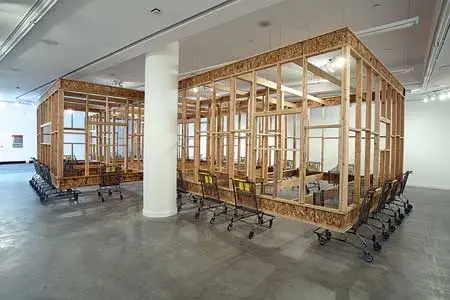
The term “Panglossian Paradigm” refers to the baseless optimism of Pangloss, a character in Voltaire’s novel Candide, also used by evolutionary biologists Stephen J. Gould and Richard Lewontin to coin the term Panglossian Paradigm, reversing the idea of invention and adaptation and suggesting the existence of “accidents” in the form of new objects or “sub-products.” Interestingly, Zamora’s Panglossian Paradigm embodies the creature born from the combination of a timber stud frame with twenty-nine shopping carts and represents—literally and philosophically—a baseless (the base of the frame seats inside the carts, “floating” 2 feet from the floor) optimism of a possible better future after the recent economic crisis in the United States (which has also resulted in thousands of people losing their mortgages to banks) using the construction frame and the shopping cart as cultural signifiers. These two objects exemplify systems of mass production by being containers—the frame is a potential container of a home, furniture, house appliances, people; and the cart is a temporary container of potential purchased goods—but is also symbolic of the economic crisis. To give a specific example, shopping carts are part of the Los Angeles urban landscape, either by abandonment, as containers of waste, or as containers of temporary housing goods and recycling materials to obtain income by the homeless, going back to the opposing economic connotations of wealth and dispossession in this work. Both objects are symbols of mass production: while the shopping carts in the sculptural installation were used objects, the stud frame was newly built specifically for the project. Thus, the structure of the house is not a ruin of the past but something newly constructed, interwoven with/from used carts which are the foundation that, poetically, keeps the structure apparently stable but it is half-finished. Could it be a representation of the abandonment of utopia or, on the contrary, a sign of hope for a new beginning?
Evidently, the open wooden structure also makes reference to the Domino House (1914–1915) prototype by Le Corbusier. The idea behind Le Corbusier’s design was to be manufactured in series, becoming a universal construction system with minor alterations throughout time. American suburb construction standards use the inexpensive and quick-to-build timber stud frame as its basis, and like the Domino House, Zamora's Panglossian Paradigm house frame represents the dream of a universal constructive system and an origin myth of decay. In the context of its immediate surroundings, Zamora’s installation works as a sort of response to three architecture-related events in the area: the first being the current edition of Pacific Standard Time: Modern Architecture in L.A., an initiative of the Getty in which about ten institutions, including the Getty itself, participated with exhibitions and programs about the history of Los Angeles architecture. The second and third, the construction projects neighboring REDCAT: The Broad, a new museum designed by architects Diller Scofidio + Renfro which will house and exhibit the art collections of Eli and Edythe Broad; and the Grand Avenue Project, a $120 million, 19-story apartment building by the estate firm Related California, adjacent to The Broad, both anticipated to open in 2014 in a greater-than life “integrated” cultural project which mirrors the construction of apartment complexes adjacent to shopping malls and other attractions. The design of The Broad is called “the veil and the vault;” the vault due to its obvious function as the keeper of the collection, and the veil since its surface will be covered by an exoskeleton structure reminiscent of mesh netting. Zamora does not only echo this grid-like design with Panglossian Paradigm, but is also similar to his earlier project, Muégano, 2010-12, in the Christchurch Botanic Gardens in New Zealand, which consisted of a grid of hollow metal cubes stuck to each other and was also made as a comment on traditional suburb housing structures in Western culture and the pre-made greenhouse frames sold at hardware stores. The cultural connotations and social critique in his work are present in the way he transforms space but also in the way he allows space and materials to occupy and invade his own.
In the same way, he utilizes negative space with structures such as Muégano or Panglossian Paradigm, he also uses positive space using materials that overflow from a specific place. For example, in Delirio Atopico (Atopic Delirium), 2009, thousands of symbolically-charged bananas emanated from a building in Bogotá, Colombia; and in Reductio Ad Absurdum, 2012, at Scottsdale Museum of Art in Arizona, orange sand spilled out from a trailer house in an installation that responded to the natural environment of the Arizona desert and the social context of the local architecture. Panglossian Paradigm is thus a response to the immediate urban landscape and a commentary on the general social connotations of architecture in the context of the United States and particularly the city of Los Angeles. Since Panglossian Paradigm is an archetype of precariousness—a half-finished ruin—Zamora invites the viewer to question their own political spaces within the contrasting concepts of consumption and accumulation, in the present economic crisis, and how both can coexist, comfortably, in first-world cultures such as the American.
SELENE PRECIADO