
Perhaps a good way to begin this article is by focusing on the work by Marcos Chaves, one of the artists invited to participate in Journeys, an exhibition that opened from April 13 to June 23 of this year at the Bela Maré Galpão—located in the Maré Complex—in Rio de Janeiro. Chaves intervened in the footbridge located on Avenida Brasil, one of the most agitated and congested avenues in the city and one of the arteries that connect the downtown area with the suburbs. There, Chaves hung two large canvases, each facing a different direction with phrases that read "Amarécomplexo," and on the other, "Amarésimples."
These plays on words reached the internet, appearing in social networks and instigating unsuspecting passersby not used to the traffic created by the public that works for or attends contemporary art exhibitions. Thus the word amar (to love) could be configured as something simple or complex; in other words, visitors were invited to enjoy the possibility of conceiving love as a double-edged sword, as an act that is intrinsically simple and complex. Nearby the footbridge, there is a neighborhood known by some as "Favela de la Marea," and by others as "Complejo de la Marea," and by others yet as "Marea." This section of Rio de Janeiro is populated by 30,000 inhabitants. Notwithstanding the different names given to the neighborhood, the formulation put forward by Chaves is undeniable: Marea is simple and Marea is complex.
Located on the north side of Rio de Janeiro, it is a region geographically placed opposite from where the postcard photos of Rio de Janeiro are taken and removed from anything "Brazilian," the southern area and its littorals. Like any other neighborhood that is outside of the historic downtown area or the sandy beaches of the city, most of the area is neglected and excluded from the touristic images of Rio de Janeiro and the stereotyped notions of its culture. To make things worse, the area is invaded by drug trafficking, precarious housing, and irregular urban planning. Nonetheless, and as Marcos Chaves demonstrates with his phrase, there is an element that transcends socioeconomic categories, touches on the human element, and stimulates the encounter with art: love, or thinking more broadly, the desire for life and the angst of going to cultural events that, unfortunately, most times are exclusive to the inhabitants of the other side of town.
Thus to contemplate a contemporary art exhibition in this neighborhood becomes a challenge, one that is both simple and complex. How to construct a curatorial narrative that interacts with this space without appropriating it in a superficially ethnographic and relational manner? How to guarantee that the inhabitants of Marea visit the exhibition so it does not just become a mere exotic parenthesis in the routines of those members from the artistic circuit of the southern area of Rio de Janeiro?
The introductory text of the accompanying catalog, written by curators Felipe Scovino and Raul Mourão, states the following: "The questions waving in the air are: how to live in a world governed by differences, and what is the role of artists in this rapidly changing town?" And at the end of the text, the curators conclude: "Journeys 2: Contemporary Art in La Marea, is an exhibition that creates in this manner a correspondence with new notions that flow across the city: reinvention, recovery, and transformation." After reading the entire curatorial text, one is left with the impression that the exhibition was conceived to address, as one of its central themes, contemporary perceptions about the city, the changes it undergoes, and, thus, the manner in which an inhabitant from La Marea perceives himself/herself and others. Nonetheless, was this actually part of the narrative that transpired in the group of works that were part of the show?
Some of the statements formulated in a series of interviews—all of which are available online—with the curators, producers and some of the participating artists are noteworthy. Raul Mourão, for instance, affirms that "it is an exhibition that was not entirely conceptualized; we are relying on the names." Other interviewees comment on the "fast communication" of the works and emphasize the prominence of the participating artists and their well-established international careers.
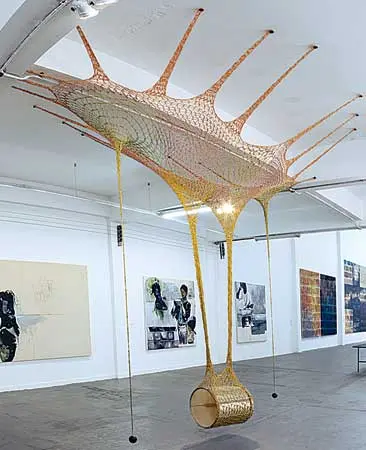
Upon reading the ten names of the artists that participated in the exhibition at the main space—without forgetting, of course, the three other artists credited as special participants that presented their works nearby the space—one cannot avoid considering the weight of their names, known even to those vaguely familiar with Brazil’s participation in the international contemporary art scene. For many international curators, Ernesto Neto and Vik Muniz are standard-bearers of the notion of Brazilian art.
Daniel Senise, Marcelo Silveira, along with younger artists Cadu and Luiza Baldan, is also well-known as a result of their frequent participation in group exhibitions at Brazil’s most prominent museums. Notwithstanding the element of name recognition that weighs heavily on the exhibition, and beyond any curriculums or graduate degrees linked to names I already knew, I am compelled to wonder: How do these works establish a dialogue with La Marea? How can these works be approached and, at the same time, compel the inhabitants of the area to interact with them, considering the curatorial willingness to question the processes of renovation of any city?
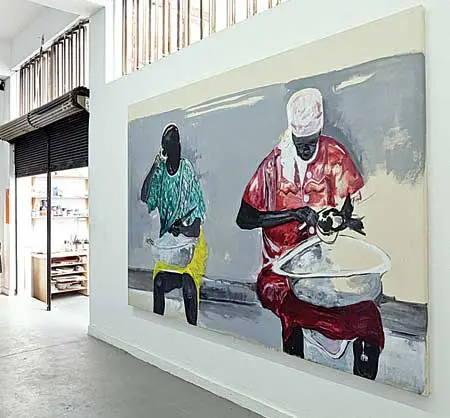
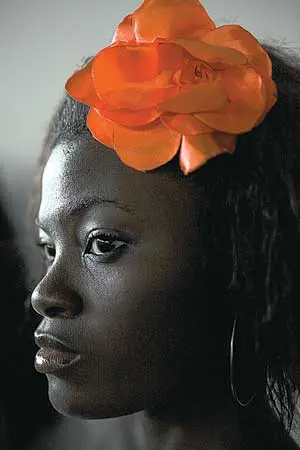
Large-scale paintings by Carlos Vergara were displayed in the middle of one of the walls of the Bela Maré Galpão space. With an artistic trajectory that includes his participation in several important exhibitions in Brazil since the 1960s, it is difficult to narrow down Vergara’s artistic production to a specific language. His most recent creations rely on several ways of constructing images two-dimensionally. His group of images at the Bela Maré Galpão space represented an interesting counterpoint to the large library of wooden shelves on the opposite side of the wall. There were also images of dreamy landscapes by Arjan Martins displayed next to Vergaras’s work. With quick strokes that revealed the thickness of the pigment, Martins depicts human figures performing mundane acts, like peeling or cutting food. The form is far from banal: the space between the figures is occupied by an emptiness that makes his images breathe and achieve a spatiality that dialogs with the tradition of photography. These canvases appear to be barely finished. It is important that the environment that surrounds his narratives is not saturated with visual information, so viewers can concentrate on what is occurring within the frame. Negritude is present and perhaps the stereotype of an image of the favela is recodified.
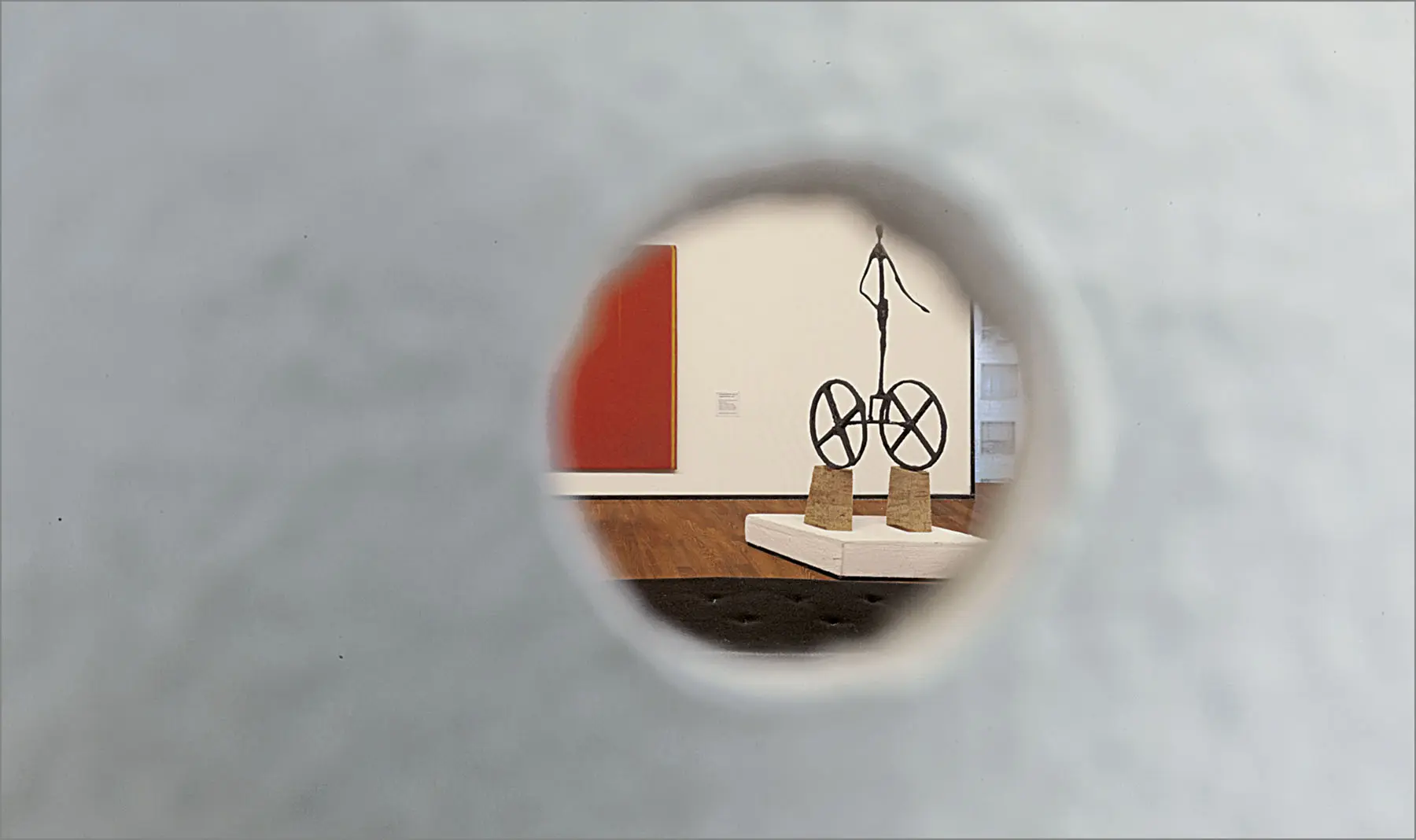
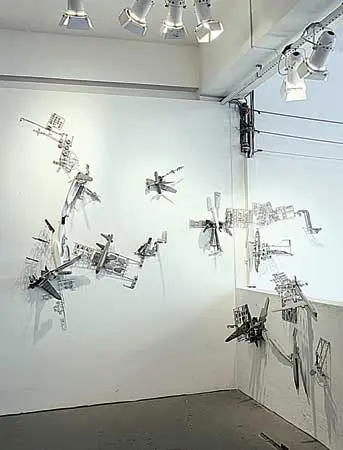
Daniel Senise, another artist generally remembered for his trajectory as a painter, presented a work that also broadened the expectations of the gaze. An installation based on magical eyes invited viewers to observe something that appeared to be hidden behind one of the walls of the exhibition. The hidden surprises were visions of several museums, one of which was the image of the Diego Velázquez exhibition area at El Museo del Prado—set against the real vision of the Bela Maré Galpão. Thus, tradition and contemporaneity stood side by side and the Bela Maré Galpão was able to dialogue with Madrid, as Ajan Martins established a dialogue with Velázquez. Daniel Senise painted without painting through a reference that placed the local context in dialogue with a broad conception of art and museum. On the other hand, Cadu offered an installation—fashioned with aeromodelling pieces glued to the wall—that established a relationship between drawing, engineering, and machines. The disassembled scale model created a network of forms in the space as it built a sort of literal aerial map that also reminded us—given the recent events in the history of Rio de Janeiro—of the occupation of favelas by the military police and the radical government surveillance of those who dare to protest on the streets.
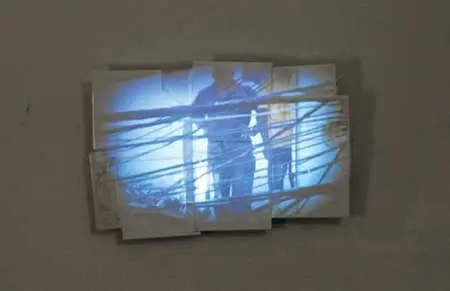
Lucas Bambozzi showed a video installation directly connected to the cultural weight of the image and the term favelado that has been pejoratively used for a long time to refer to the resident of a shantytown, A group of La Marea residents gather in a sort of line that faces the public in a projection screen in a large and dark exhibition room. Whether we are a traditional family from Ipanema or residents of La Marea, we are invited to establish visual contact that is nonetheless through the audiovisual record. This moving portrait makes us wonder about our place in a city so full of social contrasts and the importance of eye contact in our routine.
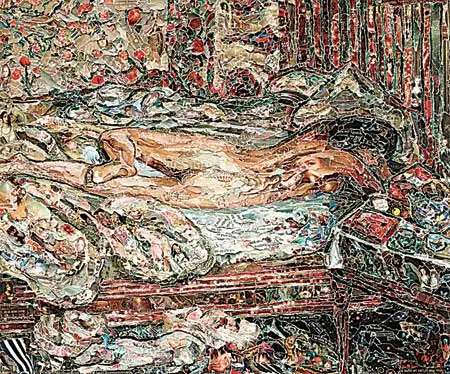
To counterpoint the works that I just briefly commented on and that, in my opinion, raise questions that appear to match the curatorial intentions, there is the already institutionalized production by Vik Muniz. An artist that got recognition for his documentary Basura Extraordinaria (Extraordinary Garbage, 2010) and by designing the opening of a famous Brazilian soap opera, Muniz showed a group of images from his series Pictures of Magazine (2010). How do these images dialog with the other works in the exhibition? Could it be that we must appeal to an interpretation of the "precarious" in connection with those magazine cutouts that reference works from the so-called "Western painting tradition"? Can this supposedly precarious nature of the image dialog with the entropy of the favela? Is it possible to discern that in high-resolution images that free our gaze from any suspicion of dirt? Like a contemporary Arcimboldo, Vik Muniz—to my surprise included by the curatorship in this exhibition—reminds me that Brazil is implanted in the category of "Latin American Art" by many of the institutionalized perspectives that exist in the Western world. In other words: To what extent can a reinterpretation of Pierre Bonnard—made by himself—be digested at the Bela Maré Galpão, once its initial potency as an image has faded? What problems do they contribute to the city and to the existence, beyond being a mannerist formula of art within the contemporary? Less international projection, a lesser-known name, and a more complicated work could have been a better alternative for the curators.
In the words of a person interviewed in one of the videos about the exhibition: this project "is not a favor." It is not a gesture to culturally assist the favela, but a space to promote contemporary art that, very much like the Museo de Arte de Rio—the new darling of the artistic class in Rio de Janeiro—should be alive for prolonged periods and open permanently. This being the second edition of the event, and has presented to the public some works that proposed problems about the relationship between the city and humanity that were not so obvious, one hopes that more editions are organized to continue a dialog between the local and the global and that other names, like that of Ratão Diniz—a photographer born in a favela who offers a provocative gaze of his surrounding—are included to establish a better interaction and to avoid turning it into a platform to enjoy, or to appropriate, in an exotic manner a historically constructed otherness that pertains to Rio de Janeiro.
Further from being the "other," a "periphery" or something "marginal," La Marea is a mirror of Rio de Janeiro. Like Marcos Chaves affirmed, it is a space that has been many times interpreted as a simplistic complex point of view that asks for other opportunities to evaluate its image and self-image.
RAPHAEL FONSECA